 Rated 5 star on

MVPs for Funded Startups: What Investors Check
Quick answer
Investors check that your company owns its code and accounts, with written assignments from every founder and contractor. They look for basic security, like no keys in code, and an architecture that can grow. They expect real metrics and a known technical debt list with a plan. Prepare these documents early.
When a startup raises money, investors look past the demo. They want to know the company owns its code, the product is reasonably secure, the numbers are real and the technology won't collapse when growth arrives. Founders who prepare raise with fewer delays; those who don't can see deals slow or terms change.
Key Takeaways
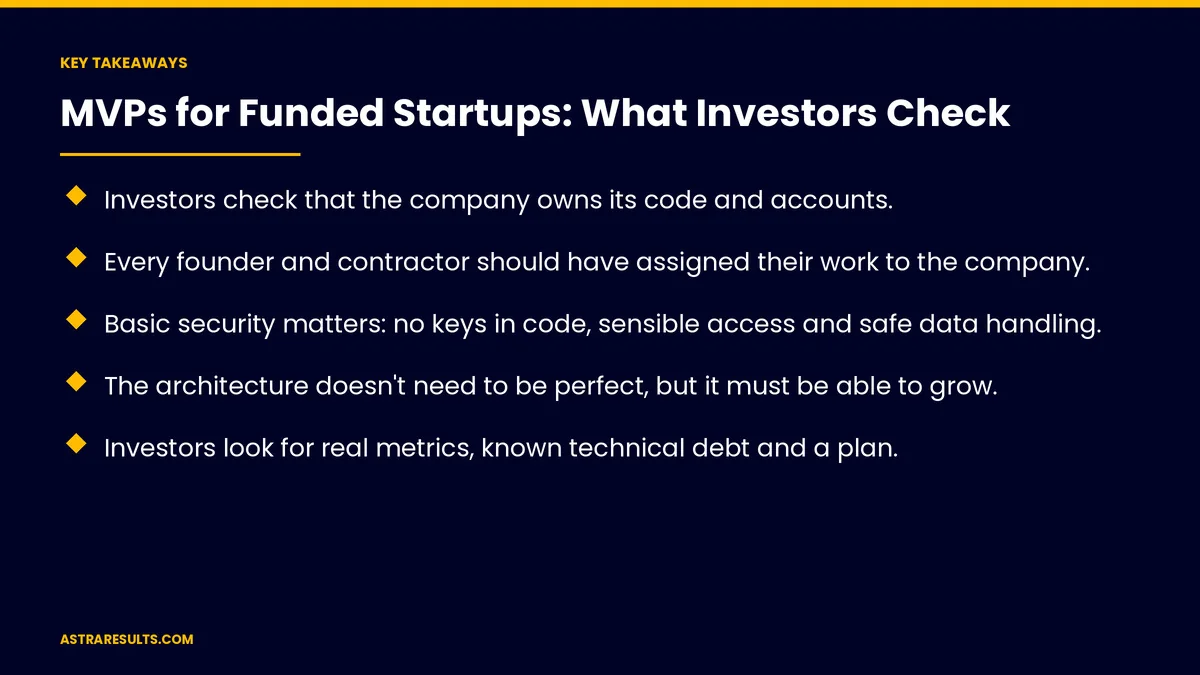
- Investors check that the company owns its code and accounts.
- Every founder and contractor should have assigned their work to the company.
- Basic security matters: no keys in code, sensible access and safe data handling.
- The architecture doesn't need to be perfect, but it must be able to grow.
- Investors look for real metrics, known technical debt and a plan.
- Prepare a document checklist before the first investor call.
Published: October 22, 2026 | Reading Time: ~9 minutes | Category: MVP Development
This guide covers what investors check in an MVP: ownership, open-source licenses, accounts, security basics, privacy, architecture, tests and releases, key-person risk, technical debt, metrics, costs, a document checklist and red flags. Put plainly: own your code, secure the basics, measure accurately and write down what's next.
This is general information. Have counsel review ownership and investment documents.
In This Playbook
- Who should own a startup's MVP code?
- Open-source licenses
- Accounts
- Security basics
- Privacy
- How scalable must an MVP's architecture be?
- Tests and releases
- Key-person risk
- How much technical debt do investors accept?
- Metrics
- Costs
- A document checklist
- Red flags
- What to measure
- The first three months before raising
Who should own a startup's MVP code?
Code owned by the company. Not by founders personally or contractors.
Written assignments. Every founder, employee and contractor assigns their work, as covered in owning your code.
Agency components. Licensed clearly if an agency built part of it.
Open-source licenses
A list of libraries. With their licenses.
No surprises. Some licenses require sharing changes.
Kept current. As libraries change, as covered in dependency updates.
Accounts
In the company's name. Code repository, cloud, domains and app stores.
Admin access controlled. Not on a departed contractor's email.
Security basics
No keys in code. Stored safely, as covered in API security.
Access checks. Users see only their own data.
Two-step sign-in. For admin accounts.
Known issues fixed. Or listed with a plan.
Privacy
A privacy policy that matches reality. What's collected and why.
Consent where needed. For emails, texts and tracking.
Sensitive data handled carefully. Health, financial or children's data brings extra rules.
How scalable must an MVP's architecture be?
Able to grow. Not perfect, just not a dead end.
Clear plan for the next stage. As weighed in from MVP to product.
No one-off hacks at the core. Or a plan to replace them.
Tests and releases
Some automated tests. On the most important flows.
A repeatable release process. Not one person's laptop.
Backups. That restore.
Key-person risk
More than one person knows the system. Or documentation fills the gap.
Documented setup. A new developer can build and run it.
How much technical debt do investors accept?
Known shortcuts listed. Investors expect some.
A plan and a cost. For fixing the important ones.
Openness helps. Hidden problems found later hurt trust.
Metrics
Real numbers. Activation, retention and revenue, as covered in MVP metrics.
Consistent definitions. The same numbers in every deck.
Demand evidence. As in validating demand.
Costs
Cloud and vendor bills. And how they grow with users.
Build costs to date. And what's next, as covered in MVP timelines and budgets.
A document checklist
Ownership assignments. Founders, employees and contractors.
Open-source list. With licenses.
Architecture overview. One or two pages.
Security summary. What's in place and what's planned.
Metrics dashboard. With definitions.
Technical debt list. With a plan.
Red flags
Code owned by a contractor. With no assignment.
Keys in the code. Or shared passwords.
One person holds everything. No documentation.
Metrics that don't match. Between documents.
What to measure
Checklist completeness. Before raising.
Open security issues. By severity.
Documentation coverage. Setup and key systems.
Metric consistency. Across documents.
Time to answer investor questions. Faster with preparation.
The first three months before raising
Days 1–30: ownership and accounts
Collect assignments from everyone who built the product, move accounts into the company's name and list open-source licenses.
Days 31–60: security and documentation
Remove keys from code, check access, document setup and write an architecture overview and security summary.
Days 61–90: metrics and debt
Align metric definitions, build the dashboard, list technical debt with a plan and assemble the document checklist.
How Astra prepares MVPs for investors
Astra Results Marketing builds and prepares MVPs for funded startups. We keep code and accounts in the company's name, secure the basics, document the system, align metrics and list technical debt with a plan, so investor checks go smoothly.
Engagements begin with an MVP readiness review through our MVP development team.
Related reading
Frequently asked questions
What do investors check in an MVP?
Ownership of code and accounts, open-source licenses, security basics, privacy, architecture, tests, key-person risk, technical debt, metrics and costs.
Why does code ownership matter to investors?
If a founder or contractor owns the code personally, the company may not own its main asset. Written assignments fix that.
Does the architecture need to be perfect?
No. It needs to be able to grow, with a clear plan for the next stage.
Should we hide technical debt?
No. Investors expect some. A list with a plan builds trust; hidden problems found later damage it.
What documents should we prepare?
Ownership assignments, an open-source list, an architecture overview, a security summary, a metrics dashboard and a technical debt list.
What are common red flags?
Contractor-owned code, keys in the code, one person holding everything and metrics that don't match between documents.
Ready for investors to look under the hood? Astra Results Marketing prepares MVPs for investor checks with clean ownership, secured basics, clear documentation, aligned metrics and a clear plan for what's next. ▸ CALL (786) 321-2866 · ▸ REQUEST YOUR CONSULTATION





