 Rated 5 star on

Validating Demand Before You Build Anything
Quick answer
Validate demand by testing real commitment, not compliments or survey interest. Interview people about the problem before pitching any solution. Use landing pages, waitlists and pre-orders to see who acts. Manual service can prove demand before you automate. Set success thresholds before testing, and follow the FTC's shipping and refund rules for pre-orders.
The most expensive way to learn nobody wants a product is to build it first. Friends say it's great, a survey shows interest and the launch is quiet. People are kind in conversation but careful with money. Validating demand means testing what people do, such as signing up, paying or committing, before writing much code.
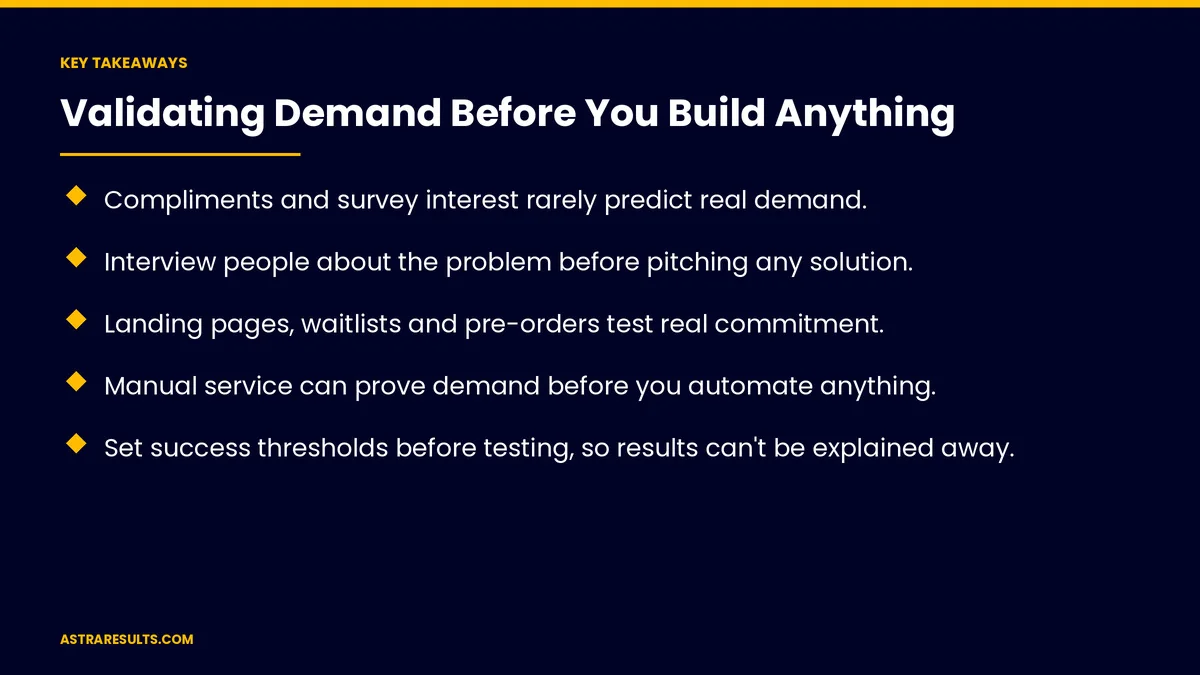
Key Takeaways
- Compliments and survey interest rarely predict real demand.
- Interview people about the problem before pitching any solution.
- Landing pages, waitlists and pre-orders test real commitment.
- Manual service can prove demand before you automate anything.
- Set success thresholds before testing, so results can't be explained away.
- If you take pre-order payments, follow the FTC's shipping and refund rules.
Published: October 31, 2026 | Reading Time: ~9 minutes | Category: MVP Development
This guide covers ways to validate demand: problem interviews, search research, landing page tests, waitlists and pre-orders, ad tests, manual service, business commitments, price tests, success thresholds and pre-order rules. Put plainly: test what people do, not what they say, and decide your pass mark before you start.
In This Playbook
- Why opinions mislead
- Interviews about the problem
- How does search data show demand for a product?
- Landing page tests
- Waitlists and pre-orders
- Small ad tests
- Manual service before automation
- Commitments from business buyers
- Price tests
- Set success thresholds first
- What should a demand validation test measure?
- The first three months
Why opinions mislead
People are polite. "I'd use that" costs nothing to say.
Surveys overstate interest. Saying yes is easy; paying is not.
Founders hear what they hope. Without clear tests, weak signals feel strong.
Look for actions. Sign-ups, deposits, time spent and referrals.
Interviews about the problem
Ask about the past, not the future. "Tell me about the last time this happened" beats "Would you buy this?"
Avoid pitching. Learn how people handle the problem today.
Listen for spending. Money or time already spent on workarounds shows real pain.
Talk to enough people. Patterns appear after a series of conversations, not one or two.
How does search data show demand for a product?
Check what people search. Search volume for the problem and existing solutions shows interest.
Read the results. Competitors and forums reveal what people want and what's missing.
Problem-first searches. The searches buyers make before they know a product exists, as covered in SaaS SEO.
Landing page tests
One page, one offer. Describe the product and ask for one action, as covered in one page, one offer, one action.
Be clear it's coming. Say the product isn't available yet.
Short forms. Ask only for what you need, as covered in form length.
Quick to build. Simple tools work well, as weighed in no-code, low-code or custom.
Waitlists and pre-orders
Waitlists. A first signal, stronger if people share or answer follow-up questions.
Deposits and pre-orders. Much stronger signals, because money is involved.
Follow the rules. If you take payment, the FTC's mail and internet order rule requires shipping within the time you state, or within 30 days if you don't state one, unless buyers agree to a delay or get a refund.
Make refunds easy. If plans change, refund promptly.
Small ad tests
Test messages. Different headlines and offers to see what attracts interest.
Small budgets. Enough to see patterns, not to scale.
Measure actions. Sign-ups and deposits, not just clicks.
Manual service before automation
Do it by hand first. Deliver the result manually to early customers.
Learn what matters. See which parts customers value before building software.
Charge for it. Payment proves value better than free trials.
Commitments from business buyers
Letters of intent. Written interest from companies, with expected terms.
Paid pilots. A small paid trial shows serious intent.
Ask who approves budgets. Interest from someone without budget authority is weaker.
Price tests
Show a real price. Interest at "free" says little about willingness to pay. For app products, store payment rules affect pricing, as covered in in-app payments.
Compare options. Different price points or packages on test pages.
Watch what people choose. Actions reveal value better than questions.
Set success thresholds first
Decide the pass mark. Such as a target share of visitors joining a waitlist or a number of paid pilots.
Write it down. Before starting the test.
Act on results. Proceed, change direction or stop.
Then build small. Move into a focused first version, as covered in scoping an MVP.
What should a demand validation test measure?
Interview patterns. How many people describe the same problem.
Landing page conversion. Visitors who join or pre-order.
Paid commitments. Deposits, pre-orders or paid pilots.
Cost per sign-up. From small ad tests.
Follow-up engagement. People who reply, share or ask when it's ready.
The first three months
Days 1–30: learn the problem
Interview potential customers about the problem and how they handle it today. Research search demand and competitors, and write down success thresholds for the next tests.
Days 31–60: test commitment
Launch a landing page with a waitlist or pre-order, run small ad tests and try a manual version of the service with early customers.
Days 61–90: decide
Compare results with your thresholds. Proceed to a focused first version, change direction or stop, and refund any pre-orders you can't fulfill on time.
How Astra helps validate demand
Astra Results Marketing helps founders and businesses test demand before building. We plan interviews, research search demand, build landing pages and waitlists, run small ad tests and set success thresholds in advance.
When the results justify it, we build the smallest useful product. Engagements begin with a demand validation plan through our MVP development team.
Related reading
Frequently asked questions
Why aren't surveys enough to validate demand?
People are polite and saying yes costs nothing. Actions such as signing up, paying a deposit or committing to a pilot are much stronger signals.
What should we ask in customer interviews?
Ask about the problem and past experiences, such as the last time it happened and what they did, rather than whether they'd buy your idea.
Is it okay to test with a landing page before the product exists?
Yes, if you're clear the product isn't available yet. Waitlists and pre-orders show real interest.
What rules apply to pre-orders?
The FTC's mail and internet order rule requires shipping within the time you state, or within 30 days if none is stated, unless buyers agree to a delay or get a refund.
How do we know if a test passed?
Set a success threshold before you start, such as a sign-up rate or number of paid pilots, write it down and compare the results against it.
What comes after validation?
A focused first version that solves the core problem, built with the smallest useful scope.
Ready to know people want it before you build it? Astra Results Marketing plans interviews, landing page tests, waitlists and pre-orders with clear success thresholds, then builds the smallest useful product when demand is proven. ▸ CALL (786) 321-2866 · ▸ REQUEST YOUR CONSULTATION





