 Rated 5 star on

Nonprofit Online Stores That Fund Programs
Quick answer
A nonprofit online store funds programs when products carry the mission and inventory risk stays low. Use print-on-demand or small batches. Say clearly how much of each sale funds programs. A purchase isn't a full donation, so confirm tax rules with an advisor. Offer an optional donation at checkout and report impact.
An online store can do more for a nonprofit than sell T-shirts. Done well, it raises unrestricted money, spreads the mission every time someone wears or uses a product and brings in supporters who might never have donated. Done poorly, it ties up cash in inventory and confuses buyers about what counts as a donation.
Key Takeaways
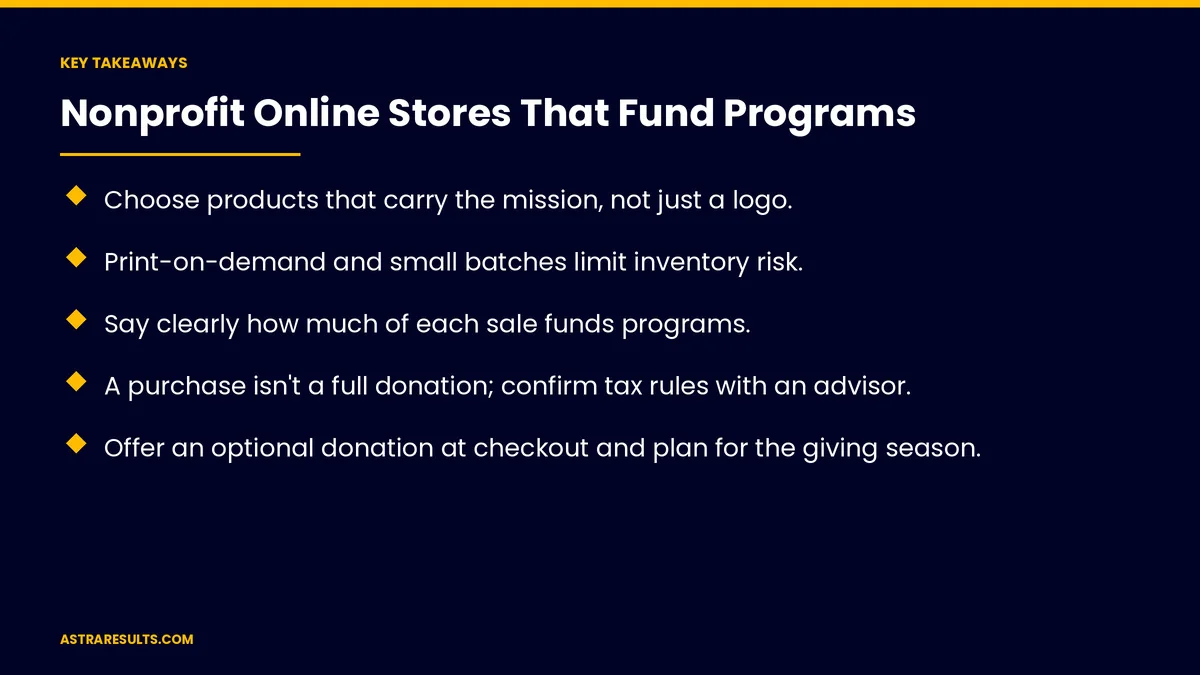
- Choose products that carry the mission, not just a logo.
- Print-on-demand and small batches limit inventory risk.
- Say clearly how much of each sale funds programs.
- A purchase isn't a full donation; confirm tax rules with an advisor.
- Offer an optional donation at checkout and plan for the giving season.
- Keep buyers and donors in one record and report impact to both.
Published: October 17, 2026 | Reading Time: ~8 minutes | Category: E-Commerce Marketing
This guide covers nonprofit stores: mission products, inventory risk, clear funding claims, tax points, checkout donations, the giving season, one record for buyers and donors, and impact. Put plainly: sell products that carry the mission, say exactly where the money goes and treat every buyer as a future donor.
This is general information, not tax or legal advice. Confirm tax and fundraising rules with a qualified advisor.
In This Playbook
- Choose mission products
- Avoid inventory risk
- Clear claims about where money goes
- Tax points to confirm
- How can a nonprofit store add donations at checkout?
- The giving season
- One record for buyers and donors
- Report impact
- What to measure
- The first three months
Choose mission products
Products that tell the story. Items tied to programs, places or the people you serve.
Made by the people you serve. Where it fits your mission and is done fairly.
Quality matters. A product people keep spreads the message for years.
Show it well. Clear photos and descriptions, as covered in product pages that convert.
Avoid inventory risk
Print-on-demand. Items made only after an order.
Small batches. For special items, with preorders where possible.
Know the full cost. Products, shipping, fees and staff time, as covered in what an online store costs.
Keep the store lean. Only tools that earn their place, as covered in Shopify apps.
Clear claims about where money goes
Be specific. "Profits fund our after-school program" or "$10 from each sale funds one meal."
Make it true. Check the numbers before publishing them.
Keep wording consistent. On product pages, ads and social posts, as covered in creative compliance.
Partners selling for you. Businesses that promise a share of sales to your cause may face state rules; check with counsel.
Tax points to confirm
A purchase isn't a full donation. Only the amount paid above the item's fair value may be deductible.
Written disclosures. The IRS requires a written statement for payments over $75 that are partly a donation and partly a purchase.
Sales tax. May apply to store sales depending on the state.
Business income tax. Income from sales unrelated to the mission can be taxable.
How can a nonprofit store add donations at checkout?
An optional donation. Add a round-up or fixed amount at checkout.
Separate it clearly. The donation and the purchase shown as different lines.
Receipts. Donation receipts for the donated amount.
The giving season
Giving Tuesday and year-end. Plan products and messages early.
Gift bundles. Products paired with a donation.
Matching gifts. Highlight matches from sponsors when available.
Email. Store updates and impact stories to supporters, as covered in the e-commerce stack.
One record for buyers and donors
Buyers are supporters. Many will donate later if invited.
One record per person. Purchases and donations together, as covered in one donor record across systems.
Thoughtful follow-up. A thank-you and an impact story, then an invitation, as in donor conversations at scale.
Report impact
Show what sales funded. Meals served, students supported or trees planted.
Share regularly. On the store, in emails and on social.
Thank buyers. They helped, even if they didn't donate.
What to measure
Net proceeds. Sales minus all costs.
Buyers who later donate. The long-term value of the store.
Checkout donations. Share of orders with a donation.
Repeat buyers. People coming back.
Giving-season results. Compared with last year.
The first three months
Days 1–30: plan and confirm
Choose a few mission products, pick print-on-demand or small batches and confirm tax and fundraising rules with an advisor. Write clear funding claims.
Days 31–60: launch
Open the store with strong product pages, an optional checkout donation and buyer records connected to your donor system.
Days 61–90: grow and report
Plan giving-season bundles, send impact updates to buyers and track net proceeds and buyers who later donate.
How Astra builds nonprofit stores
Astra Results Marketing helps nonprofits build online stores that fund programs. We choose mission products, limit inventory risk, write clear funding claims, add checkout donations and connect buyers to your donor records.
We plan giving-season campaigns and report impact. Engagements begin with a store plan through our e-commerce marketing team.
Related reading
Frequently asked questions
Can an online store really fund programs?
Yes, when products carry the mission, costs stay low and buyers are invited to become donors. Measure net proceeds, not just sales.
Is buying from a nonprofit store a tax-deductible donation?
Usually not in full. Only the amount paid above the item's fair value may be deductible. Confirm with a tax advisor.
Do nonprofit store sales owe sales tax?
It depends on the state. Some states tax nonprofit sales and others exempt some of them. Check your state's rules.
How do we avoid inventory problems?
Use print-on-demand, small batches and preorders, and know the full cost of each product before launching it.
Should we add donations at checkout?
Yes, as an optional round-up or fixed amount, shown separately from the purchase, with a receipt for the donated amount.
How do we turn buyers into donors?
Keep buyers and donors in one record, thank buyers with impact stories and invite them to give.
Ready for an online store that funds your programs? Astra Results Marketing builds nonprofit stores with mission products, clear funding claims, checkout donations and buyer records that turn customers into donors. ▸ CALL (786) 321-2866 · ▸ REQUEST YOUR CONSULTATION





