Rated 5 star on

Nonprofit Engagement: Donor Conversations at Scale
Quick answer
A nonprofit keeps donor conversations personal at scale by automating stewardship, not solicitation. Every gift gets a personal thank-you within 48 hours. Donor, volunteer and attendee questions are answered quickly, even on giving days. Asks and major-gift conversations stay with people. Success is measured by second-gift rate and staff hours returned.
A development director with one coordinator is responsible for four thousand donors. She knows the top forty by name and calls them. The rest receive an automated receipt, a year-end appeal and silence. Most gave once. Most will not give again, and the reason is not the cause. It is that nobody spoke to them.
Key Takeaways
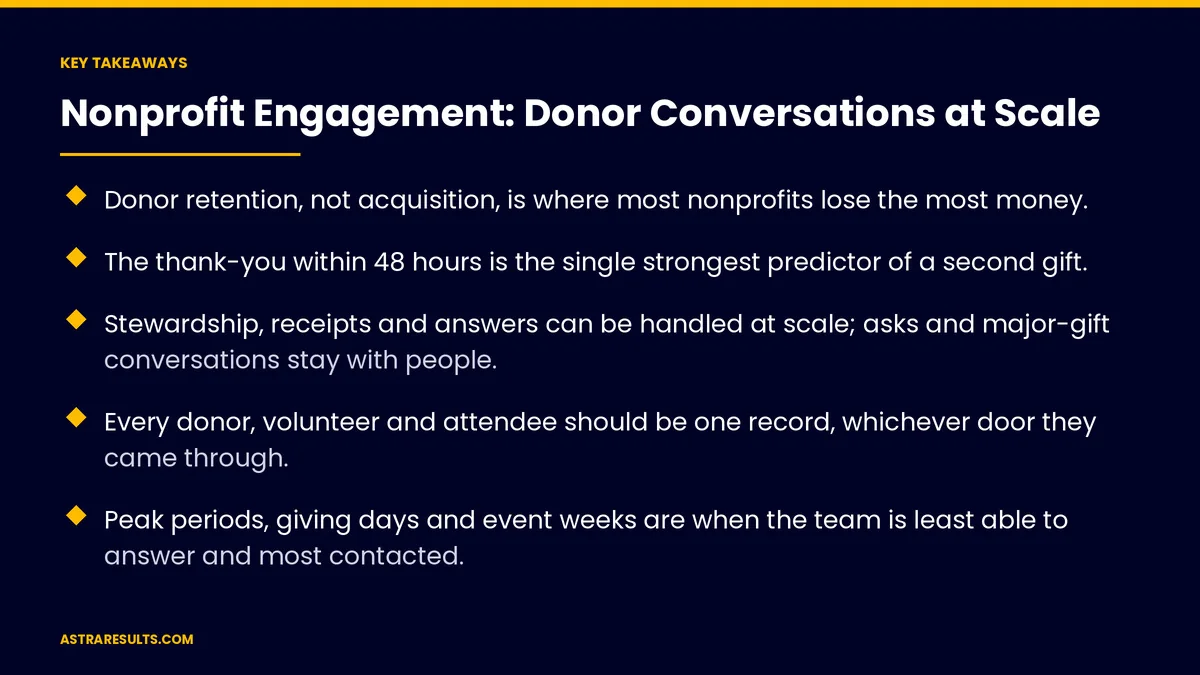
- Donor retention, not acquisition, is where most nonprofits lose the most money.
- The thank-you within 48 hours is the single strongest predictor of a second gift.
- Stewardship, receipts and answers can be handled at scale; asks and major-gift conversations stay with people.
- Every donor, volunteer and attendee should be one record, whichever door they came through.
- Peak periods, giving days and event weeks are when the team is least able to answer and most contacted.
- Measure by second-gift rate, response time and staff hours returned to major-gift work.
Published: October 21, 2026 | Reading Time: ~12 minutes | Category: Customer Engagement
Nonprofits have the engagement problem in its purest form. The relationship is the revenue, the team is tiny. A giving day brings more contacts than the team can answer. This piece covers how a small team keeps conversations personal at scale, and where system-handled stewardship ends and the human ask begins.
Put plainly: thank every gift as if it were the only one, and keep human time for the conversations that need it.
Guidance for executive directors, development staff and board members. Nothing here is legal advice. Receipt requirements, donor data privacy, text consent and state charitable solicitation registration all apply and should be confirmed with counsel and the organization's auditor.
In This Playbook
- The retention problem, stated plainly
- The 48-hour thank-you
- What is the difference between donor stewardship and solicitation?
- Questions donors and volunteers ask
- Peak periods: the gala, the giving day, year end
- One record: donors, volunteers, clients, attendees
- Spanish and the communities served
- What it returns
- The first three months
- Astra's part in it
The retention problem, stated plainly
The number most boards never see. The share of first-time donors who give a second time. Across the sector it is low, and most organizations do not track it because acquisition is what the campaign reports.
Why donors lapse. Surveys of lapsed donors have long pointed to the same reasons. They were not thanked properly, they were not told what their gift did. They were asked again before either happened. None of these is about the mission.
The economics. A retained donor costs a fraction of a newly acquired one and gives more over time. A small improvement in second-gift rate is worth more than most acquisition campaigns. It is the work the team has the least time for.
Where this piece sits. The engagement layers are the same seven described in the engagement stack explained, applied to an organization whose customers are donors, volunteers and the people it serves.
The 48-hour thank-you
What it is. A personal thank-you, distinct from the tax receipt, within two days of the gift. Naming the donor, the amount if appropriate, and what it makes possible in one concrete sentence. Signed by a person.
Why it matters. It is the most consistently reported driver of second gifts, and the most consistently missed, because it arrives in the week the team is busiest.
What the system does. Drafts the thank-you in the organization's voice from the gift record, chooses the concrete impact sentence from a maintained set the program staff wrote, and queues it for a person to approve and send. For gifts below a threshold the organization sets, it sends automatically. Above it, a person signs and often calls.
The channel. Matches the donor: email for most, a text for those who opted in, a handwritten card triggered for the top tier. Drafting in the organization's voice is the generative work described in generative AI at work, with a person as the author of record.
What is the difference between donor stewardship and solicitation?
The distinction that governs the design. Stewardship tells a donor what happened because of their gift. Solicitation asks for the next one. Systems can carry stewardship at scale with dignity. Asks should come from people, or at least be written and timed by them.
What the system may carry. Thank-yous, receipts, impact updates matched to what the donor supported, event confirmations, volunteer scheduling, answers to questions about programs, giving options and logistics.
What stays with people. Major-gift conversations, planned-giving discussions, board and foundation relationships, any donor who is upset, and the ask itself for anyone above the threshold the organization sets.
The handoff. A donor who replies to an impact update with "I would like to do more" is a conversation, not a workflow. The system flags it the same day and hands it to a named person with the donor's full history.
Questions donors and volunteers ask
Donors. Where is my receipt. Is my gift tax-deductible. Can I give in someone's memory. How do I set up a monthly gift. Can I give stock or from a donor-advised fund. What percentage goes to programs. Can I restrict my gift.
Volunteers. When is the next shift. What do I bring. Is there parking. Can my teenager come. How do I log my hours. Can our company do a group day.
Event attendees. Where do I park. Is there a dress code. Can I change my meal choice. Where is my table. Can I still buy a ticket.
The pattern. Nearly all of these are answerable from data the organization holds, at any hour, in the language the person asked in. The remainder route to a person with context. The intake discipline for a nonprofit is the same one a business uses, described in every lead answered in seconds, with a gentler tone and a longer memory.
Peak periods: the gala, the giving day, year end
The problem. The three weeks a year when contact volume is ten times normal are the same weeks the team is running the event. Voicemails from donors trying to give go unanswered on the day they most wanted to.
Giving days. Questions about matching, deadlines and how to give arrive in the hundreds over 24 hours. The system answers all of them, confirms every gift within minutes with the running total, and flags any gift above the major threshold to a person immediately, while it is still the donor's most enthusiastic hour.
Event weeks. Registration changes, table assignments, dietary requests, sponsor logistics and day-of directions handled by message, so the coordinator is on the floor rather than on the phone.
Year end. The December surge in receipts, deductibility questions and stock-gift instructions handled at the hour donors ask, including the evening of the 31st.
One record: donors, volunteers, clients, attendees
The reality. The same person is a monthly donor in the giving platform, a volunteer in the scheduling tool, an attendee in the event system and a name on a board member's spreadsheet. Four records, four spellings, four histories.
Why it matters. The volunteer who has given two hundred hours and never been asked for a gift is a relationship the organization does not know it has. The donor who attended three events and lapsed is a relationship it lost without noticing.
The build. Identity resolution across systems into the donor database or CRM, with rules for merging and for consent. This is the data work described in the foundation every AI project needs. For most nonprofits it is the largest single piece of the project.
Consent and dignity. Some people served by the organization are also donors or volunteers. Records of service are held separately and never used for solicitation. The rules are written before the merge, with counsel.
Spanish and the communities served
The base. Many South Florida nonprofits serve, and are supported by, communities that live in Spanish. Thank-yous, impact updates, volunteer logistics and program answers handled natively in Spanish, in the register the person uses, are a base requirement, for the reasons in what changes when Spanish is a channel.
Haitian Creole and Portuguese. Where the community requires it, the same standard applies. What the system cannot handle natively routes to a person who can.
What it returns
Second-gift rate. The share of first-time donors who give again within twelve months. The number the whole program is measured on.
Thank-you time. Median hours from gift to personal thank-you, before and after.
Response time. Median time to a useful answer for donor, volunteer and attendee questions, including peak weeks.
Staff hours returned. Coordinator and director time moved from receipts and logistics to major-gift work, counted against a baseline in the way automation KPIs are counted.
Relationships found. Volunteers and attendees identified as prospects, and lapsed donors reactivated by a stewardship touch rather than an appeal.
Cost to raise a dollar. The board's number, improved from the retention side rather than the acquisition side.
The first three months
Days 1–30: the baseline and the voice
Second-gift rate, thank-you time and response time calculated from the last twelve months. Contacts across giving, volunteer, event and board systems mapped to one record with merge and consent rules written. Program staff write the concrete impact sentences. Thank-you thresholds set: automatic below, signed above, called at the top.
Days 31–60: thank-yous and answers
Personal thank-yous drafted and sent within 48 hours for every gift, in English and Spanish. Donor, volunteer and attendee questions answered on the organization's channels at any hour. Flags to a named person for major-gift signals and upset donors.
Days 61–90: impact, peak readiness, review
Impact updates matched to what each donor supported. Playbooks for the next giving day and event week loaded. Volunteers and attendees surfaced as prospects. Second-gift rate on the first cohort, thank-you time, response time and staff hours compared to the baseline.
Astra's part in it
Astra Results Marketing begins with the second-gift rate, because most development teams have never seen it and it reframes what the program is for. One record is built across every system the organization runs, with consent rules that keep records of service apart from fundraising.
The 48-hour thank-you goes live first, drafted in the organization's voice and signed by a person above the threshold the board sets. Answers for donors, volunteers and attendees follow, in the languages the community uses, with every major-gift signal and every upset donor handed to a named person the same day.
Reporting runs on second-gift rate, thank-you time, response time and staff hours returned to major-gift work. Engagements begin with a twelve-month retention baseline through our AI customer engagement team.
Related reading
Frequently asked questions
Why focus on retention rather than acquisition?
Because a retained donor costs a fraction of a new one and gives more over time, and because the reasons donors lapse, not being thanked, not being told what their gift did, and being asked again too soon, are the ones a small team can fix. The second-gift rate is the number to run on.
What is the 48-hour thank-you?
A personal message, separate from the tax receipt, within two days of the gift, naming the donor and one concrete thing the gift makes possible, signed by a person. The system drafts it from the gift record. A person approves above a threshold the organization sets.
What should never be automated?
The ask, for anyone above the organization's major-gift threshold. Planned-giving and foundation conversations. Any donor who is upset. The system carries stewardship and answers. It hands conversations to people the same day.
How are peak periods handled?
Giving-day questions and gift confirmations are answered in minutes with the running total, event-week logistics are handled by message, and year-end receipt and deductibility questions are answered at the hour donors ask. Gifts above the major threshold are flagged to a person immediately.
Why does one record matter for a nonprofit?
Because the same person is a donor in one system, a volunteer in another and an attendee in a third. The volunteer with two hundred hours who has never been asked, and the lapsed donor who attended three events, are relationships the organization cannot see until the records are one.
How is the return measured?
Second-gift rate for first-time donors, median hours from gift to thank-you, response time including peak weeks, staff hours moved to major-gift work, prospects found among volunteers and attendees, and cost to raise a dollar, each against a twelve-month baseline.
Ready to thank every gift within 48 hours? Astra Results Marketing calculates your second-gift rate, builds one record across every system you run with consent rules that protect the people you serve, and takes thank-yous and answers live in English and Spanish, measured in donors who give again. ▸ CALL (786) 321-2866 · ▸ REQUEST YOUR CONSULTATION