 Rated 5 star on

Nonprofit Data: One Donor Record Across Systems
Quick answer
Nonprofits get one donor record by combining data from donation, event, email, volunteer and accounting systems with clear matching rules. Match on email, then name with address or phone, and have people review uncertain matches. Link family members into households and agree on gift credit rules. Reconcile donation totals with accounting.
A loyal donor gives online in spring, buys gala tickets in fall and volunteers twice. To the nonprofit's systems, she might be four different people. She gets thanked twice for one gift, asked again a week after giving and left off the major donor list. One combined record fixes those mistakes and gives leaders numbers they trust.
Key Takeaways
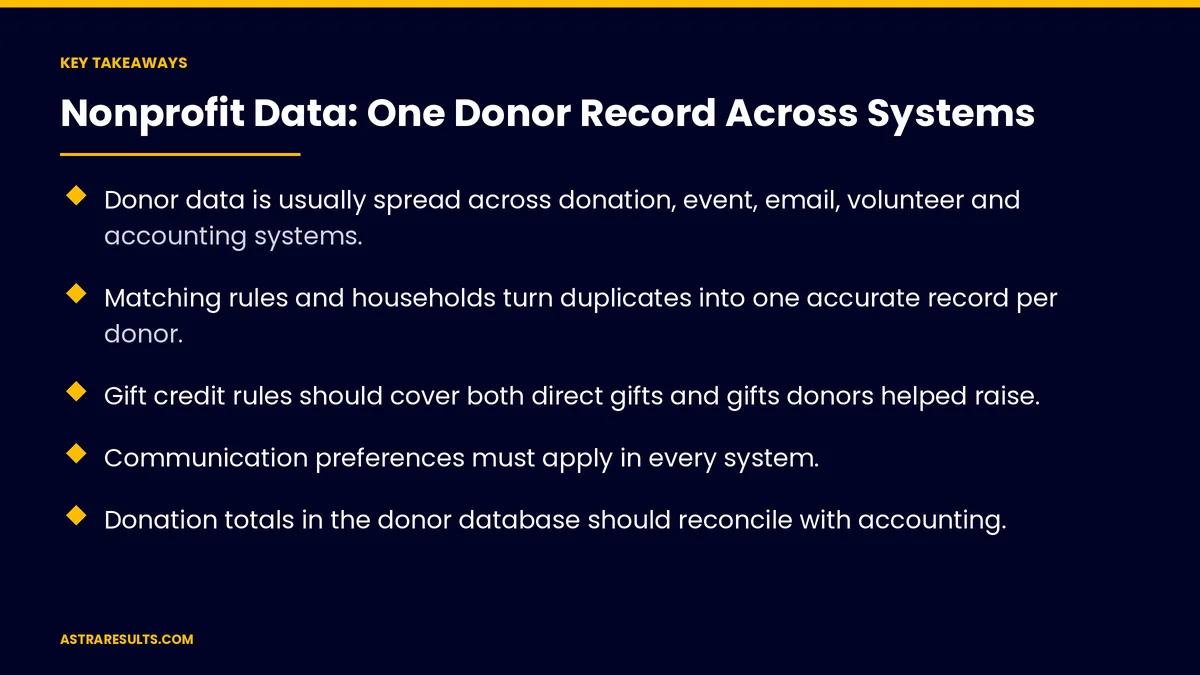
- Donor data is usually spread across donation, event, email, volunteer and accounting systems.
- Matching rules and households turn duplicates into one accurate record per donor.
- Gift credit rules should cover both direct gifts and gifts donors helped raise.
- Communication preferences must apply in every system.
- Donation totals in the donor database should reconcile with accounting.
- Clean, combined data supports better thank-yous, appeals and retention reports.
Published: October 24, 2026 | Reading Time: ~9 minutes | Category: Data Engineering
This guide covers how nonprofits build one donor record across systems: where donor data lives, matching and households, crediting gifts, honoring preferences, acknowledgments, reconciling with accounting, reporting and keeping it clean. Put plainly: one donor, one record, every gift and preference in one place.
This is general information, not tax or legal advice. Check acknowledgment and reporting rules with your accountant.
In This Playbook
- Where donor data lives
- Why separate systems cause problems
- Matching and households
- Crediting gifts correctly
- Preferences and privacy
- Acknowledgments
- Reconciling with accounting
- Reports leaders can trust
- Keeping it clean
- Using clean data
- What should a nonprofit measure in its donor data?
- The first three months
Where donor data lives
Online donation forms. One-time and monthly gifts.
The donor database. The main record, often a CRM built for nonprofits.
Events and ticketing. Galas, runs and auctions.
Email platform. Newsletters, appeals and engagement.
Peer-to-peer fundraising. Supporters raising money from friends.
Volunteer tools. Hours and roles.
Accounting. The official record of what came in.
Why separate systems cause problems
Duplicates. The same person appears several times with different emails or addresses.
Wrong thank-yous. Donors are thanked twice, late or not at all.
Poorly timed appeals. Someone who just gave gets asked again.
Missed major donors. Gifts split across records hide a donor's true total.
Reports that don't match. Fundraising and finance report different numbers.
Matching and households
Matching rules. Combine records using email, then name with address or phone.
Review uncertain matches. People confirm close calls before records merge. Businesses face the same problem matching customer accounts on orders, as in wholesaler purchase order reading.
Households. Link spouses or family members while keeping each person's record.
One record to keep. Decide which details win when records merge, as with avoiding duplicates in connecting your CRM to your booking system.
Crediting gifts correctly
Hard credit. The person or organization whose money it was.
Soft credit. People who helped, such as a peer-to-peer fundraiser or a spouse.
Matching gifts. Employer matches linked to the employee's gift.
Event purchases. Separate the ticket's value from the donation part.
Restricted gifts. Track gifts given for a specific purpose.
Preferences and privacy
One set of preferences. If someone opts out of email or mail, every system respects it.
Anonymous donors. Keep their wishes in every list and report.
Protect payment data. Card details stay with the payment processor, not in spreadsheets or the database.
Limit access. Staff see only what their role needs.
Never share lists without permission. Donor trust depends on it.
Acknowledgments
Timely thank-yous. From one accurate record, sent once.
Written acknowledgments. For a single gift of $250 or more, donors need written acknowledgment to claim a deduction.
Goods or services received. For payments over $75 that include goods or services, such as a gala dinner, the acknowledgment should state the value received.
Check with your accountant. Rules and wording matter.
Reconciling with accounting
Regular reconciliation. Gift totals in the donor database match what accounting recorded.
Clear rules for timing. When a gift is counted, especially pledges and recurring gifts.
Fees and refunds. Processor fees and refunds handled consistently.
One shared calendar. Fundraising and finance close the month together.
Reports leaders can trust
Donor retention. How many donors gave again this year.
Lapsed donors. People who gave last year but not this year.
Average and total giving. By campaign, channel and donor group.
Major donor pipeline. True totals, including household and soft credits.
Combined data, one source. Built on clean pipelines, as covered in data pipelines explained.
Keeping it clean
Shared data entry rules. Names, addresses and gift codes entered the same way.
Monthly duplicate checks. Catch new duplicates early.
Decide which system owns what. Written down, as covered in planning an integration.
Retire side spreadsheets. Move ongoing tracking into the database, as covered in replacing spreadsheets.
Budget sensibly. Most nonprofits need clean daily data, not real-time, as covered in what data infrastructure costs.
Using clean data
Personal outreach. Conversations based on a donor's full history, as covered in donor conversations at scale.
Smarter appeals. Ask at the right time, for the right amount.
Better board reports. Numbers everyone agrees on.
What should a nonprofit measure in its donor data?
Duplicate rate. Share of records that are duplicates.
Acknowledgment speed. Days from gift to thank-you.
Reconciliation gaps. Differences between the donor database and accounting.
Donor retention. Year over year.
Preference errors. Messages sent to people who opted out.
The first three months
Days 1–30: map and measure
List every system that holds donor data and what each contains. Measure duplicates, acknowledgment speed and reconciliation gaps. Agree on matching rules and gift credit rules.
Days 31–60: combine and clean
Merge duplicates with review of uncertain matches, link households and connect donation, event and email data to the donor database. Apply communication preferences everywhere.
Days 61–90: reconcile and report
Reconcile gift totals with accounting, build retention and lapsed-donor reports and set monthly cleaning routines. Compare duplicates, acknowledgment speed and gaps with the baseline.
How does Astra build one donor record for nonprofits?
Astra Results Marketing helps nonprofits build one donor record across systems. We map where donor data lives, set matching and household rules, connect donation, event and email data, and reconcile gift totals with accounting.
Preferences apply everywhere, payment data stays protected and leaders get reports they can trust. Engagements begin with a donor data review through our data engineering team.
Related reading
Frequently asked questions
Why do nonprofits end up with duplicate donor records?
Because donations, events, email, peer-to-peer fundraising and volunteer tools each create their own records, often with different emails or addresses for the same person.
How do we match donor records?
Use rules based on email, then name with address or phone, and have people review uncertain matches before merging. Link family members into households.
What is a soft credit?
Credit given to someone who helped bring in a gift without paying it, such as a peer-to-peer fundraiser or a spouse, so their influence shows in reports.
What acknowledgment rules apply?
Donors need written acknowledgment for a single gift of $250 or more to claim a deduction, and payments over $75 that include goods or services should state the value received. Check details with your accountant.
Why reconcile donor data with accounting?
So fundraising and finance report the same totals, with clear rules for timing, pledges, recurring gifts, fees and refunds.
Where should we start?
Map where donor data lives, measure duplicates and reconciliation gaps, and agree on matching and gift credit rules before connecting systems.
Ready for one donor record you can trust? Astra Results Marketing helps nonprofits combine donation, event, email and accounting data into one donor record, with matching, households, preferences and reconciled reports. ▸ CALL (786) 321-2866 · ▸ REQUEST YOUR CONSULTATION





