 Rated 5 star on

Restaurant Agents: Reorder, Schedule, Respond
Quick answer
Restaurant AI agents draft supplier orders, staff schedules and replies to reviews and inquiries, so managers spend less time on paperwork. Reorder agents compare stock with par levels and upcoming demand. Scheduling agents build drafts from forecast covers and availability. Spend caps and approvals keep managers in control. Measure food cost, waste and labor cost.
A restaurant manager's day is full of work that isn't hospitality. Counting stock and placing supplier orders. Building next week's schedule around who can work when. Replying to reviews and catering inquiries late at night. Each task matters, and each one pulls the manager off the floor. AI agents can do the first draft of all three.
Key Takeaways
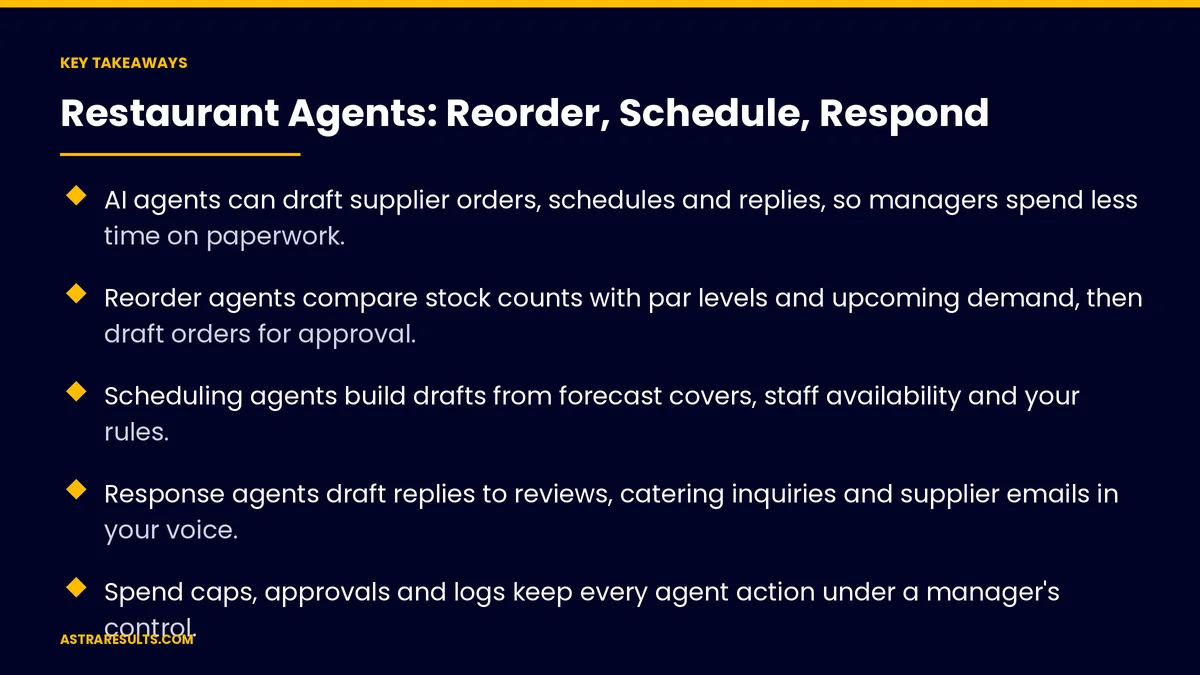
- AI agents can draft supplier orders, schedules and replies, so managers spend less time on paperwork.
- Reorder agents compare stock counts with par levels and upcoming demand, then draft orders for approval.
- Scheduling agents build drafts from forecast covers, staff availability and your rules.
- Response agents draft replies to reviews, catering inquiries and supplier emails in your voice.
- Spend caps, approvals and logs keep every agent action under a manager's control.
- Measure food cost, waste, labor cost and manager hours saved, not just tasks automated.
Published: October 24, 2026 | Reading Time: ~10 minutes | Category: Custom AI Agents
This guide covers how restaurants use AI agents for back-of-house work: reordering supplies, building schedules and responding to reviews and inquiries. It also covers the approvals and limits that keep managers in charge. Put plainly: let agents prepare the orders, schedules and replies, and let managers approve them.
In This Playbook
- What a restaurant agent does
- Reorder: supplies without the guesswork
- Schedule: drafts built from demand
- Respond: reviews, inquiries and suppliers
- Approvals and limits
- Connecting the systems
- Which restaurant agent should we start with?
- Kitchen and office numbers
- The first three months
What a restaurant agent does
It acts, within limits. Unlike a chatbot, an agent can read your systems, prepare an order or a schedule and send it once approved.
It works from your data. Sales, stock counts, recipes, staff availability and past orders.
It drafts; managers decide. Orders, schedules and public replies wait for approval until you're confident enough to let small routine ones through.
It's built for safety. Each agent gets only the access it needs, with limits and logs, following the baseline in agent security. What agents are and why they matter is covered in AI agents.
Reorder: supplies without the guesswork
Start from counts. The agent reads stock counts, or estimates usage from sales and recipes.
Compare with par levels. How much of each item you want on hand for the days until the next delivery.
Look ahead. Adjust for upcoming events, holidays, weather and reservations.
Draft the order. By supplier, with quantities and expected cost.
Check prices. Flag items that cost more than usual or more than another approved supplier.
Wait for approval. The manager reviews and sends, or edits first. Orders above a spending cap always need approval.
Track waste. Items thrown away feed back into par levels, so the next order is smarter.
Schedule: drafts built from demand
Forecast covers. Expected guests by day and shift, from past sales, reservations and events.
Match staff to demand. How many servers, cooks and dishwashers each shift needs.
Respect availability. Who can work when, time-off requests and maximum hours.
Follow your rules. Breaks, overtime limits, minor work rules and any local requirements that apply.
Draft, then approve. The manager adjusts and publishes. The agent never publishes on its own.
Handle swaps. Staff request shift trades; the agent checks coverage and rules and sends them for approval.
Respond: reviews, inquiries and suppliers
Review replies. Drafts that thank guests, address specific complaints and invite them back, in your voice.
Escalate serious ones. Complaints about food safety, allergies or staff behavior go straight to a manager, never to an auto-reply.
Catering and event inquiries. Collect date, headcount, menu needs and budget, then draft a quote for the manager.
Supplier emails. Confirm deliveries, flag shortages and track credits for damaged goods.
Guest messages stay separate. Ordering and reservation conversations with guests are covered in restaurant engagement.
Approvals and limits
Spending caps. Orders above a set amount always need a manager.
Approved suppliers only. The agent can't add new vendors.
No publishing alone. Schedules and public review replies wait for approval.
Daily limits. A maximum number of orders and messages per day.
A stop switch. A manager can pause any agent instantly.
Full logs. Every draft, approval and action recorded.
Connecting the systems
Point-of-sale. Sales by item and time, the basis for usage and forecasts.
Inventory and recipes. Stock counts and what each dish uses.
Supplier portals and email. Where orders are placed and confirmed.
Scheduling tool. Where shifts, availability and swaps live.
Review sites. Where replies are posted after approval.
Clean connections. Each one with limited access, as covered in API integration.
Which restaurant agent should we start with?
One agent first. Reorder is often the easiest place to prove value, because savings show up in food cost.
Shadow mode. The agent drafts while managers keep working their usual way, then compare.
One location first. Prove it, then expand across locations.
Train managers. Show them how to review, edit and approve quickly. The workflow side is covered in AI task management.
Kitchen and office numbers
Food cost percentage. Before and after the reorder agent.
Waste and stockouts. Items thrown away and items that ran out.
Labor cost percentage. Against covers served.
Schedule changes after publishing. Fewer last-minute fixes means better drafts.
Review response time. Hours from review to reply.
Manager hours saved. Time returned to the floor each week.
The first three months
Days 1–30: data and rules
Connect point-of-sale, inventory and scheduling data. Set par levels, supplier lists, spending caps and scheduling rules. Record baseline food cost, waste, labor cost and manager hours.
Days 31–60: reorder in shadow mode
Run the reorder agent alongside your usual ordering. Compare drafts with what managers order. Fix par levels and rules, then switch to agent drafts with manager approval.
Days 61–90: add schedules and responses
Add the scheduling and response agents with approval for every action. Track food cost, waste, labor cost, review response time and manager hours against the baseline.
How Astra builds restaurant agents
Astra Results Marketing builds AI agents for restaurants that take back-of-house work off managers' plates. Our agents draft supplier orders from counts and forecasts, build schedules from expected covers and your rules, and draft replies to reviews and inquiries in your voice.
Every agent works within spending caps, approvals, limits and logs, with a stop switch for managers. We start with one agent at one location and measure food cost, labor cost and hours saved. Engagements begin with an operations review through our custom AI agent development team.
Related reading
Frequently asked questions
What can AI agents do for a restaurant?
Draft supplier orders from stock counts and forecasts, build staff schedules from expected covers and availability, and draft replies to reviews, catering inquiries and supplier emails, all for a manager to approve.
Will an agent place orders without a manager?
Not unless you allow it. Orders above a spending cap always need approval, and agents only order from approved suppliers. Many restaurants let small routine orders through once the agent has proven reliable.
How does a scheduling agent decide staffing?
From forecast covers by shift, staff availability, time-off requests and your rules for breaks, overtime and minor workers. It drafts the schedule; the manager adjusts and publishes it.
Should agents reply to reviews automatically?
Draft, yes; publish, only with approval. Serious complaints about food safety, allergies or staff should always go straight to a manager.
Which systems does a restaurant agent need?
Point-of-sale, inventory and recipe data, supplier portals or email, a scheduling tool and review sites, each connected with limited access.
How do we know the agents are worth it?
Compare food cost, waste, stockouts, labor cost, review response time and manager hours saved against a baseline recorded before launch.
Ready to give managers their time back? Astra Results Marketing builds restaurant agents that draft orders, schedules and replies from your own data, with spending caps, approvals and a stop switch, measured by food cost, labor cost and hours saved. ▸ CALL (786) 321-2866 · ▸ REQUEST YOUR CONSULTATION





