Rated 5 star on

Restaurant Engagement: Orders, Waitlists, Feedback
Quick answer
A restaurant fixes engagement by answering every contact during service, when staff are busiest. Most calls ask about hours, menu, dietary needs or wait times. A system can answer those, take orders and run the waitlist by message. Feedback goes privately to the person who can fix it. Success is measured in covers recovered.
The phone rings at 7:40 on a Friday. The host is seating a party of six, the bar is three deep. The caller wants to know if there is a wait, whether the risotto can be made dairy-free. If they can order two to go. Nobody answers. The caller books elsewhere and the restaurant never knows.
Key Takeaways
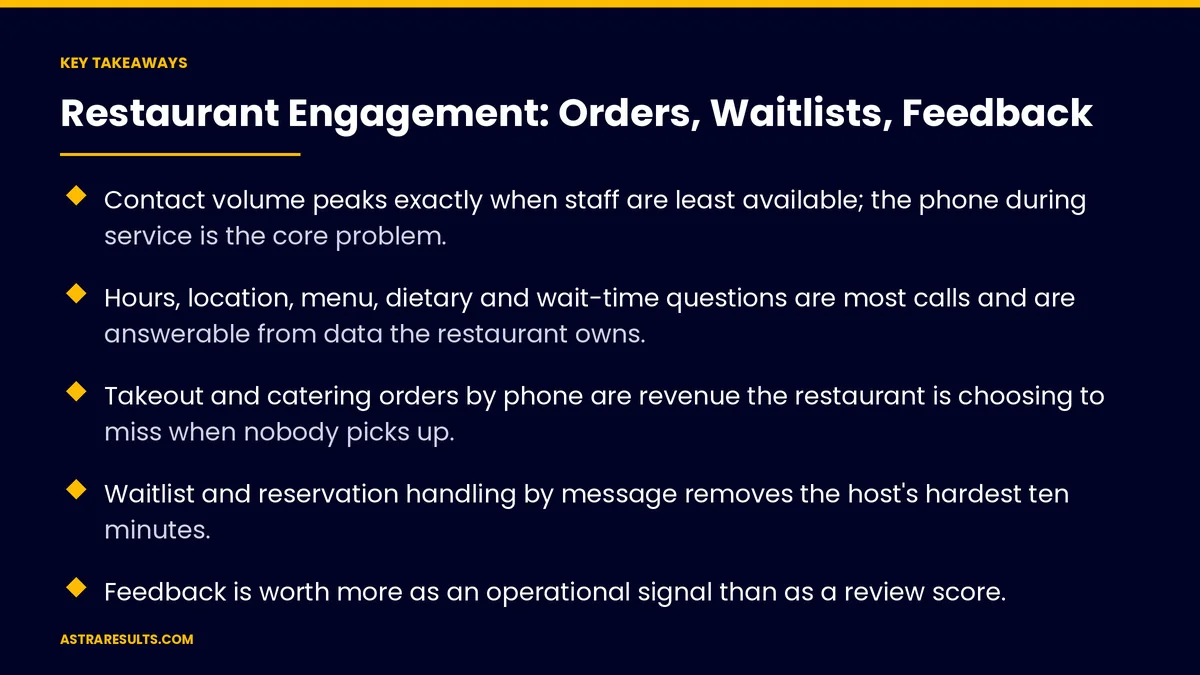
- Contact volume peaks exactly when staff are least available; the phone during service is the core problem.
- Hours, location, menu, dietary and wait-time questions are most calls and are answerable from data the restaurant owns.
- Takeout and catering orders by phone are revenue the restaurant is choosing to miss when nobody picks up.
- Waitlist and reservation handling by message removes the host's hardest ten minutes.
- Feedback is worth more as an operational signal than as a review score.
- Measure by answered contacts during service, orders taken by phone and message, and covers recovered.
Published: October 24, 2026 | Reading Time: ~12 minutes | Category: Customer Engagement
Restaurants have the hardest version of the engagement problem. The highest contact volume arrives exactly when the fewest people are free. Every unanswered contact is a cover or a ticket lost tonight, not a lead lost this quarter.
This piece covers the three jobs a restaurant's phone is asked to do, and how to do them without pulling anyone off the floor. Put plainly: answer every contact during service, and let the people on the floor stay there.
Guidance for owners and operators of restaurants and multi-unit groups. Nothing here is legal advice. Allergen communication, text consent, tipping rules and recorded calls are governed by rules that vary by jurisdiction and must be confirmed with counsel and the operator's insurer.
In This Playbook
- Why restaurants are the hardest case
- The questions that make up most calls
- Orders by phone and message
- Waitlists and reservations
- Feedback: the signal, not the score
- Spanish, and the staff who speak it
- Connecting to what the restaurant already runs
- What it returns
- The first three months
- How this is done at Astra
Why restaurants are the hardest case
Inverse availability. A law firm's calls arrive during office hours when staff are at desks. A restaurant's arrive at 7 pm when every employee has hands full. The engagement layer is not a convenience here. It is the only way the phone gets answered at all.
Tonight, not this quarter. A missed call to a dealership costs a lead that may convert next month. A missed call to a restaurant costs a table tonight. The caller has already eaten elsewhere before anyone listens to the voicemail.
Thin margins. Adding a host or a phone person to cover peak costs more than most independents can carry. The economics push toward software handling the routine contacts, which is the same logic as every lead answered in seconds, compressed into a four-hour window.
High repetition. Hours, address, parking, wait time, whether a dish can be made without something, whether there is a kids' menu. The same thirty questions, hundreds of times a week.
The questions that make up most calls
Hours and location. Including holiday hours, which no website keeps current and which cause a real share of Sunday calls.
Menu and dietary. Is it gluten-free, can it be made without nuts, is there a vegan option, how spicy. Answerable from a maintained menu with allergen and modification data, with a firm rule: where an allergen question carries risk, the system states what the menu says and hands to a person rather than reassuring.
Wait time and availability. Tonight, for four, now. Answerable only if the system can see the floor: the waitlist and reservation system, live.
Parking, dress, large parties, private events. Routine for the first three. The fourth is a lead worth a person's follow-up the next morning, captured with the details.
Lost items, complaints, refunds. Collected with facts and routed to a manager. Never argued with by software.
Orders by phone and message
The revenue being missed. Takeout and catering orders that arrive by phone during service are, at most restaurants, either taken badly by a distracted host or not taken at all. Neither is a technology problem yet. Both become one the moment the phone can be answered every time.
What the system does. Takes the order against the live menu, confirms modifications, quotes a ready time from the kitchen's current load, takes payment or a card hold according to house rules, and sends written confirmation. The order lands in the point of sale like any other.
What it does not do. Promise a dish the kitchen has run out of, quote a time the kitchen cannot hit, or take an order the restaurant would not take from a person in the room. The rules are the operator's. The software enforces them consistently.
Catering and large orders. Captured completely, priced against the catering menu where one exists, and handed to a person for confirmation. These are the highest-value contacts a restaurant phone receives and the least often followed up.
Channels. Phone still dominates for orders. Text and WhatsApp are growing for repeat customers, and are the natural channel for "your order is ready." The channel comparison in voice, chat, SMS and WhatsApp applies, with phone weighted heavier than in most industries.
Waitlists and reservations
The host's hardest ten minutes. Managing a waitlist while seating, answering the phone and greeting the door. Something drops. Usually it is the phone.
Reservations. Booking, changing and canceling against the live system, by phone or message, with confirmations and reminders that reduce no-shows. Deposit and cancellation policies stated plainly and applied consistently.
Remote waitlist. A guest texts "how long for two" and gets a real answer from the live list, joins remotely, and is told when to walk over. The host sees them arrive already on the list.
No-show recovery. A reservation that does not arrive within the grace period triggers a message. The table is released to the waitlist automatically. Each recovered table is a cover the restaurant would have lost.
The large-party lead. Anyone asking about eight or more, or about a private room, is captured with date, size and contact and followed up by a person the next day. These are the reservations that fill a slow Tuesday.
Feedback: the signal, not the score
The review reflex. Most operators think about feedback as star ratings on public platforms. Those matter for discovery, and the discipline of responding to them is part of the social media guide. But the score is the last step of a process that starts much earlier.
Ask at the right moment. A short message an hour after the visit or the pickup: how was it, one to five, and a box. Response rates are far higher than for a public review request, and the comments are more specific.
Route by content. A complaint about a cold dish goes to the kitchen lead. A complaint about a wait goes to the front-of-house manager. A compliment about a server goes to the server. Classification by language model makes this automatic, and the manager sees a daily summary instead of scattered messages.
Recover before it goes public. A guest who reports a bad experience privately and hears back from a manager within the hour rarely posts about it. One who hears nothing usually does.
The operational loop. Feedback aggregated weekly by dish, shift and server tells the operator what to fix. This is worth more than the average rating, and it is the reason to ask.
Spanish, and the staff who speak it
Guests. A large share of South Florida diners call and message in Spanish. The system handles both natively, in the register the guest uses, as covered in what changes when Spanish is a channel.
Staff. Kitchen and floor teams are often bilingual or Spanish-dominant. Order confirmations, feedback routing and manager summaries should reach them in the language they work in, or the loop breaks at the last step.
Connecting to what the restaurant already runs
The record. Point of sale, reservation and waitlist system, online ordering, the menu with allergen data, the loyalty list where one exists. The engagement layer reads all of them and writes orders, reservations and feedback back to them, following the build order in the engagement stack explained.
Live or nothing. Wait times, table availability and sold-out items must be live. A stale answer here is worse than no answer, because the guest arrives and the promise is broken in person.
Multi-unit. Each location has its own hours, menu variations and floor. The system answers for the location the guest asked about, and group management sees all of them in one view.
What it returns
Contacts answered during service. The share of calls and messages between 5 and 10 pm that reached an answer, before and after. At most independents this moves from a minority to nearly all.
Orders taken by phone and message. Counted and valued, by hour. The revenue that was ringing into voicemail.
Covers recovered. No-shows converted to waitlist seats, remote waitlist joins that arrived, large-party leads that booked.
Feedback response rate and recovery rate. How many guests answered, and how many reported problems were resolved before appearing publicly.
Host and manager time. Counted the way automation KPIs are counted: against a baseline, in minutes per shift.
The first three months
Days 1–30: count the ringing phone
Calls and messages logged for thirty days by hour, type and whether answered, including the ones that went to voicemail during service. Menu, allergen and modification data assembled and given an owner. Reservation, waitlist and point-of-sale connections confirmed. Allergen handling rules and order rules written with the operator.
Days 31–60: answer and take orders
Hours, menu, dietary and wait-time answers live on phone and text in English and Spanish, reading the live floor. Takeout orders taken and confirmed into the point of sale. Complaints and large-party requests captured and routed to a person. Post-visit feedback message live.
Days 61–90: waitlist, recovery, review
Remote waitlist and reservation changes live. No-show recovery running. Feedback routed by content with a daily manager summary. Answered-during-service share, phone and message order revenue, covers recovered and host minutes compared to Day 1.
How this is done at Astra
Astra Results Marketing starts by counting the phone during service, because most operators know they miss calls and none know how many, or what they were about. Menu and allergen data is assembled and owned before the system speaks. The rules for what it may promise are the operator's rules, applied every time.
Answers and takeout orders go live first, in both languages, reading the live floor and writing to the point of sale. Waitlist, reservation and no-show recovery follow. Feedback is asked privately, routed by content to the person who can fix it, and summarized weekly by dish and shift.
Reporting runs on contacts answered during service, orders taken, covers recovered and host minutes returned. Engagements begin with a thirty-day service-hours call log through our AI customer engagement team.
Related reading
Frequently asked questions
Why is the restaurant phone a special case?
Because contact volume peaks exactly when staff are least free. A missed call costs a table or an order tonight rather than a lead next month. Answering the phone during service is the whole problem, and adding a person to do it rarely pays.
Can the system take takeout orders?
Yes, against the live menu, with modifications confirmed, a ready time quoted from current kitchen load, payment taken according to house rules and written confirmation sent. It will not promise a sold-out dish or a time the kitchen cannot hit.
How are allergen questions handled?
The system states what the maintained menu says about a dish and, where a question carries risk, hands to a person rather than reassuring. Allergen data needs a named owner and rules agreed with the operator and their insurer before anything goes live.
What does remote waitlist mean?
A guest asks by message how long the wait is, gets an answer from the live list, joins without being present and is told when to walk over. No-shows past the grace period are released to that list automatically.
Why ask for feedback privately first?
Response rates are far higher, comments are more specific. A guest who reports a problem and hears from a manager within the hour rarely posts about it publicly. The feedback is also routed by content to the person who can fix the cause.
How is the return measured?
Contacts answered during service, orders taken by phone and message with their value, covers recovered from no-shows and waitlists, feedback response and recovery rates. Host and manager minutes returned per shift, each against a thirty-day baseline.
Ready to answer the phone at 7:40 on a Friday? Astra Results Marketing counts what you miss during service, assembles and owns your menu and allergen data, and takes answers, orders, waitlist and feedback live in English and Spanish, measured in covers and tickets recovered. ▸ CALL (786) 321-2866 · ▸ REQUEST YOUR CONSULTATION