 Rated 5 star on


Rules vs NLP Classification
Quick answer
Most businesses sort text best with a hybrid of rules and language models. Rules are cheap, predictable and suit a few clear categories or things that must never be missed. Language models handle varied wording, misspellings and many languages at high volume. Confidence thresholds send uncertain messages to a person. Test both on labeled real messages.
Every business sorts text: support emails into queues, leads into hot and cold, reviews into praise and complaints, forms into the right department. The question is how. Simple rules, like "if the message says refund, send it to billing," are cheap and predictable. Language models handle messy, varied wording. Most good systems use both, each where it fits.
Key Takeaways
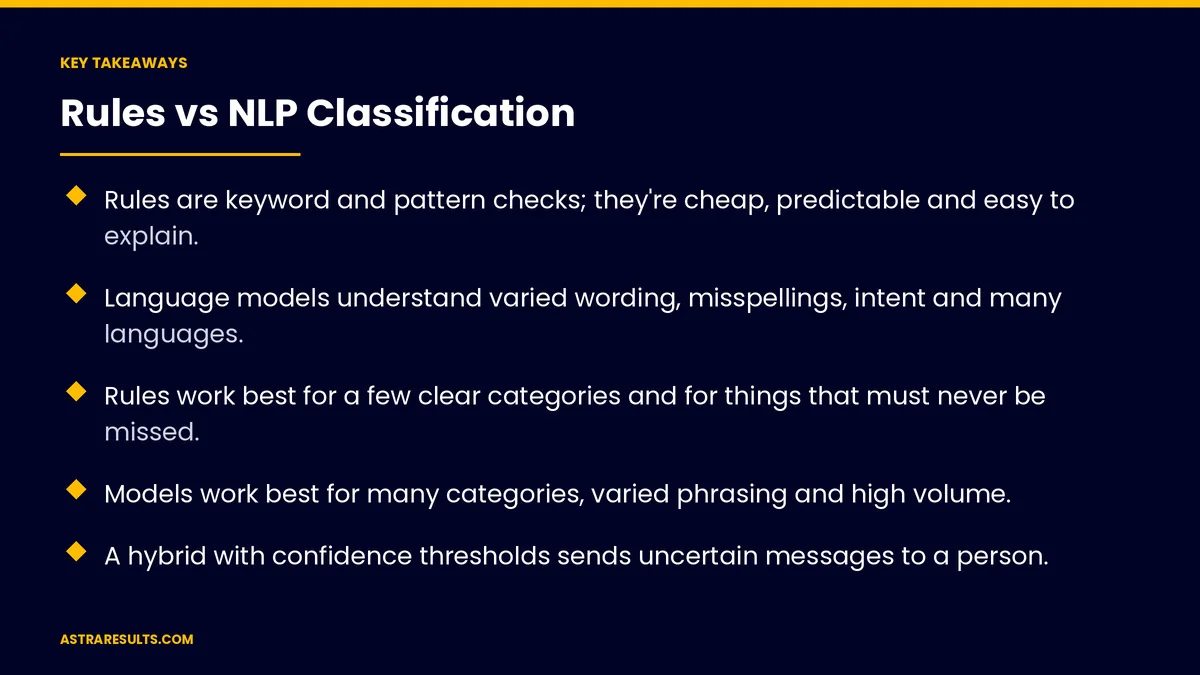
- Rules are keyword and pattern checks; they're cheap, predictable and easy to explain.
- Language models understand varied wording, misspellings, intent and many languages.
- Rules work best for a few clear categories and for things that must never be missed.
- Models work best for many categories, varied phrasing and high volume.
- A hybrid with confidence thresholds sends uncertain messages to a person.
- Test both on a labeled sample of real messages before trusting either.
Published: October 5, 2026 | Reading Time: ~9 minutes | Category: Natural Language Processing
This guide compares rules and NLP for classifying text: where rules work best, where language models win, why a hybrid usually beats either alone, how confidence thresholds send doubtful cases to people, and how to test accuracy. Put plainly: use rules where you need certainty, models where wording varies, and people where the system isn't sure.
In This Playbook
- What each approach is
- Where rules work best
- Where rules break
- Where language models win
- Why a hybrid usually wins
- Testing accuracy
- Common uses
- Cost and upkeep
- Classification numbers to track
- The first three months
What each approach is
Rules. Keyword lists, patterns and if-then logic. "If the subject contains invoice, route to accounting."
Language models. Software trained to understand meaning, so "my charge looks wrong" and "billed twice" land in the same place. The basics are covered in natural language processing for business.
Both sort text into categories. The difference is how they decide.
Where rules work best
A few clear categories. When messages use predictable words.
Things that must never be missed. Opt-out words like STOP, cancellation requests or legal terms that require action, as covered in outbound compliance.
Exact explanations. When you must show precisely why a message was routed.
Low volume. When building and testing a model isn't worth it yet.
Structured inputs. Form fields, drop-downs and codes, where wording doesn't vary.
Where rules break
Varied wording. Customers describe the same problem in dozens of ways.
Misspellings and slang. Rules miss what they weren't written for.
Many languages. Rules must be rewritten for each language and mixed messages.
Rule sprawl. Hundreds of rules that conflict and nobody wants to touch.
Where language models win
Many categories. Dozens of intents or topics.
Messy, real-world text. Emails, chats, reviews and transcripts.
Intent and tone. Telling a complaint from a question, or an urgent request from a casual one.
Multiple languages. Understanding Spanish, English and mixed messages, as covered in multilingual NLP.
High volume. Where small accuracy gains save many hours.
Why a hybrid usually wins
Rules for guarantees. Opt-outs, emergencies and legal triggers caught every time.
Models for everything else. Varied requests sorted by meaning.
Confidence thresholds. When the model isn't sure, send the message to a person instead of guessing.
People improve the system. Their decisions on uncertain messages become examples that make the model better.
Understand, then act. The same pattern behind good AI systems, as covered in GenAI + NLP.
Testing accuracy
Label real examples. A few hundred past messages sorted by people who know the work.
Test both approaches. Run rules and the model on the same labeled sample.
Look at mistakes, not just scores. Which categories get confused, and how costly each mistake is.
Missed versus wrong. Missing an urgent message can cost more than sending a normal one to the wrong queue.
Retest regularly. Language and products change, so accuracy drifts, as covered in the ML stack explained.
Common uses
Support routing. Sending tickets to the right team, with urgent ones flagged, as in intelligent support.
Lead sorting. Separating ready-to-buy inquiries from job seekers, vendors and spam.
Review and feedback tagging. Grouping comments by topic and tone.
Return reasons. Classifying why products come back, as covered in e-commerce brand AI.
Compliance flags. Opt-outs and complaints that need specific handling.
Cost and upkeep
Rules. Cheap to start, costly to maintain as they multiply.
Models. More setup, but they handle new wording without new rules.
Both need owners. Someone reviews mistakes and updates rules or examples.
Start simple. Begin with rules or a basic model on the most valuable category, then expand.
Classification numbers to track
Accuracy by category. On a labeled test set.
Missed critical messages. Opt-outs, emergencies and complaints not caught.
Share sent to people. How many messages fall below the confidence threshold.
Time to route. From arrival to the right queue.
Rework. Messages moved by staff after automatic sorting.
The first three months
Days 1–30: label and decide
Pick one sorting task. Label a few hundred real messages. List what must never be missed and write rules for those. Measure current routing time and rework.
Days 31–60: build the hybrid
Add a language model for the remaining categories, with a confidence threshold that sends doubtful messages to people. Test rules and model on the labeled sample.
Days 61–90: run and refine
Run on live messages, review mistakes weekly, add people's decisions as new examples and adjust the threshold. Track accuracy, missed critical messages and rework.
How Astra builds classification
Astra Results Marketing builds text classification that uses each approach where it fits. Rules catch what must never be missed, language models sort varied wording across languages, and confidence thresholds send doubtful messages to your team.
We test on your own labeled messages, review mistakes regularly and keep the system improving. Engagements begin with a message sample review through our natural language processing team.
Related reading
Frequently asked questions
What is the difference between rules and NLP classification?
Rules sort text using keywords, patterns and if-then logic. NLP classification uses language models that understand meaning, so differently worded messages with the same intent land in the same category.
When should we use rules?
For a few clear categories, structured inputs, low volume, and anything that must never be missed, such as opt-out words or legal triggers.
When should we use a language model?
For many categories, varied or messy wording, misspellings, intent and tone, multiple languages and high message volumes.
Why combine rules and models?
Rules guarantee critical cases are caught; models handle variety. Confidence thresholds send uncertain messages to people, whose decisions then improve the model.
How do we test which approach works better?
Label a few hundred real messages, run both approaches on the same sample, and compare accuracy by category, paying most attention to costly mistakes like missed urgent messages.
What does it cost to maintain each?
Rules are cheap to start but grow costly as they multiply. Models take more setup but handle new wording without new rules. Both need someone to review mistakes regularly.
Ready to sort every message to the right place? Astra Results Marketing builds hybrid classification with rules for what must never be missed, language models for varied wording and confidence thresholds that send doubtful messages to your team. ▸ CALL (786) 321-2866 · ▸ REQUEST YOUR CONSULTATION





