 Rated 5 star on

The Future of NLP: Multilingual by Default
Quick answer
Language AI should be multilingual by default, understanding and replying in each customer's own language from day one. Processing a message in its own language usually beats translating to English first. Mixed Spanish and English messages are normal. Quality varies by language, so measure accuracy separately for each one, with native speakers reviewing samples.
For years, business language software was built in English and translated later, if at all. Spanish speakers got a weaker chatbot, Haitian Creole speakers got nothing, and a message mixing English and Spanish confused the system completely. That's changing. Modern language models can read and write many languages, and customers now expect to be understood in their own.
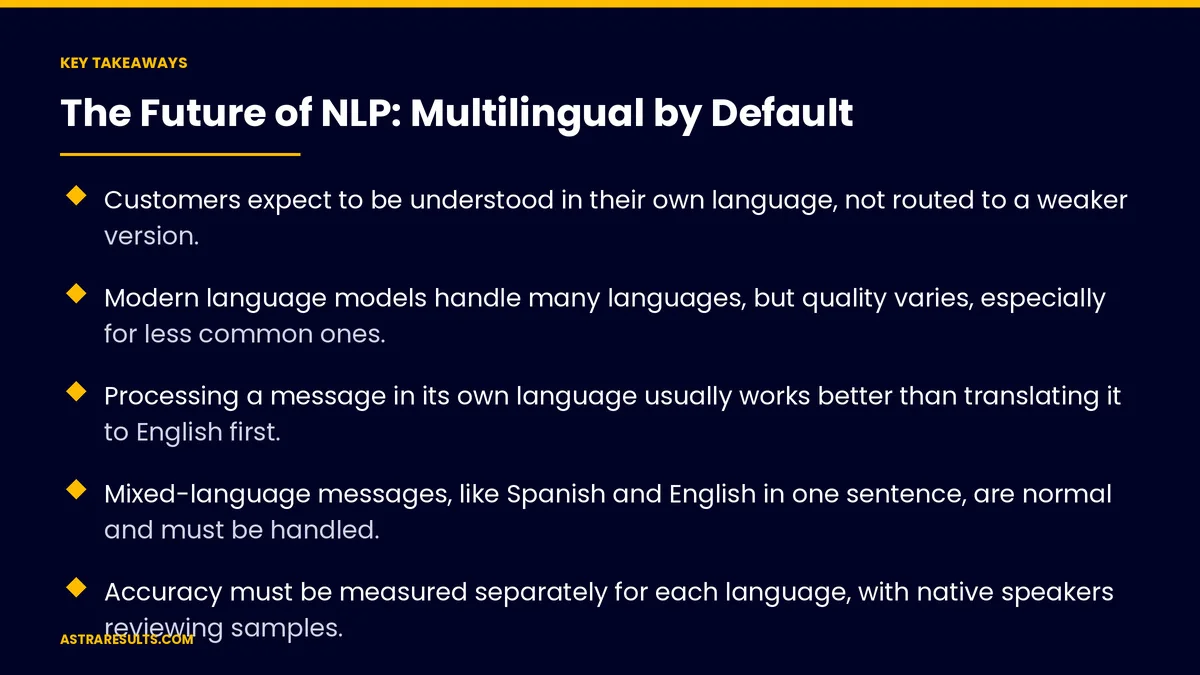
Key Takeaways
- Customers expect to be understood in their own language, not routed to a weaker version.
- Modern language models handle many languages, but quality varies, especially for less common ones.
- Processing a message in its own language usually works better than translating it to English first.
- Mixed-language messages, like Spanish and English in one sentence, are normal and must be handled.
- Accuracy must be measured separately for each language, with native speakers reviewing samples.
- Replies should be written for each audience, not translated word for word.
Published: October 22, 2026 | Reading Time: ~10 minutes | Category: Natural Language Processing
This guide explains what multilingual by default means for business language systems: processing each language natively, handling mixed-language messages, knowing where quality is weaker, and checking accuracy language by language. Put plainly: design for every language your customers use from the start, then measure each one, because quality isn't equal across them.
In This Playbook
- Why English-first systems fall short
- What multilingual by default means
- Quality isn't equal across languages
- Mixed-language messages
- Writing replies for each audience
- Channels and voice
- Checking accuracy by language
- Privacy and fairness
- Which numbers should multilingual NLP track?
- The first three months
Why English-first systems fall short
Translation adds errors. Translating a message to English, processing it and translating the reply back loses meaning at each step.
Tone gets lost. Formality, warmth and urgency don't always survive translation.
Some languages get left out. Systems built for English plus one translation often ignore everyone else.
Customers notice. A clumsy reply in their language can feel worse than no reply at all. The business case is covered in what changes when Spanish is a channel.
What multilingual by default means
Detect the language first. Every message is identified before anything else happens.
Understand it natively. Classify, extract and route the message in its own language where the model handles it well.
Reply in the same language. In the register the customer used.
Same quality bar. Every supported language is held to the same accuracy targets, and measured against them.
Planned from the start. Languages are part of the design, not a later add-on. The general pattern of understanding before generating is covered in GenAI + NLP.
Quality isn't equal across languages
Widely used languages do best. English, Spanish and Portuguese are usually handled well.
Less common languages can be weaker. Languages with less written material online, like Haitian Creole, may see more errors.
Dialects and regional words matter. Spanish from Cuba, Colombia, Venezuela and Mexico uses different words and expressions.
Test before you trust. Never assume a language works because the model claims to support it.
Have a fallback. When confidence is low, route the message to a person who speaks the language.
Mixed-language messages
Switching is normal. In Miami, many customers write "Hola, I need to reschedule mi cita for Friday."
Don't force one language. The system should understand the whole message, whatever the mix.
Reply in the customer's main language. Or match their mix where that fits the brand.
Watch the details. Names, addresses and product terms often stay in English inside a Spanish message.
Writing replies for each audience
Write, don't just translate. Replies should sound natural to native speakers.
Separate style guides. Tone, formality and common phrases for each language.
Formal or informal. Spanish, Portuguese and French choose between formal and informal "you." Decide which fits your brand in each.
Local formats. Dates, phone numbers, currencies and addresses written the way each audience expects, as also covered in Android apps for Latin American markets.
Channels and voice
Text channels first. Chat, email, SMS and WhatsApp are where most multilingual messages arrive, as covered in voice, chat, SMS and WhatsApp.
Voice is harder. Accents, background noise and mixed languages make speech recognition less accurate. Test with real callers.
Offer a human in every language you serve. Especially for complaints, health, legal and money questions.
Checking accuracy by language
Measure each language separately. Classification accuracy, extraction accuracy and reply quality for each.
Native speakers review samples. Weekly reviews catch errors automated checks miss.
Track escalations. How often each language needs a person, and why.
Compare satisfaction. Customer ratings by language reveal where the experience falls short.
Fix the weakest first. Improve the language with the biggest gap before adding new ones. The accuracy methods are covered in natural language processing for business.
Privacy and fairness
Same protections in every language. Consent notices, privacy terms and opt-outs in each language you serve.
No weaker service by language. Customers shouldn't get slower answers or fewer options because of the language they write in.
Sensitive topics need care. Health, legal and financial messages in any language should reach a qualified person when needed.
Which numbers should multilingual NLP track?
Messages by language. Volume and growth for each language.
Accuracy by language. Classification, extraction and reply quality.
Resolution by language. The share of conversations solved without escalation.
Response time by language. Whether some languages wait longer.
Satisfaction by language. Ratings and complaints for each.
The first three months
Days 1–30: map your languages
Count incoming messages by language, including mixed-language ones. List the languages to support and the channels they arrive on. Test current accuracy for each with native speakers.
Days 31–60: build native handling
Add language detection, native classification and replies for each supported language. Write a style guide per language. Set up routing to a person when confidence is low.
Days 61–90: measure and improve
Track accuracy, resolution, response time and satisfaction by language. Review samples weekly with native speakers. Fix the weakest language first, then plan the next one.
How Astra builds multilingual NLP
Astra Results Marketing builds language systems that understand every customer from the start. We detect each message's language, process it natively where quality allows, handle mixed English and Spanish, and route to a person when confidence is low.
Replies are written for each audience, not translated, and accuracy, resolution and satisfaction are measured for every language, with native speakers reviewing samples. Engagements begin with a language and channel review through our natural language processing team.
Related reading
Frequently asked questions
What does multilingual by default mean?
Designing language systems to detect, understand and reply in every language your customers use from the start, with each language held to the same accuracy targets, instead of building in English and translating later.
Is it better to translate messages into English first?
Usually not. Each translation step can lose meaning and tone. Processing a message in its own language, where the model handles that language well, generally gives better results.
Do AI language models work equally well in every language?
No. Widely used languages like English, Spanish and Portuguese usually perform well. Less common languages, such as Haitian Creole, can be weaker. Test each language with native speakers before relying on it.
How should systems handle Spanish and English mixed together?
Understand the whole message whatever the mix, reply in the customer's main language or match their mix where it fits the brand, and keep names, addresses and product terms accurate.
How do we check accuracy in each language?
Measure classification, extraction and reply quality separately for each language, have native speakers review samples weekly, and track escalations and satisfaction by language.
What should happen when the system isn't sure?
Route the conversation to a person who speaks the language, especially for complaints and health, legal or financial questions.
Ready for language AI that understands every customer? Astra Results Marketing builds multilingual language systems that detect, understand and reply in each customer's language, handle mixed English and Spanish, route to people when unsure and measure accuracy for every language. ▸ CALL (786) 321-2866 · ▸ REQUEST YOUR CONSULTATION





