 Rated 5 star on


The ML Stack Explained for Non-Engineers
Quick answer
A working machine learning system has six layers: data, features, training, testing, deployment and monitoring. Clean, connected data is the foundation. Features are the prepared inputs a model learns from. Predictions only help once they reach the people who act on them. Models drift as the world changes, so monitoring and retraining never stop.
When a team proposes a machine learning project, the conversation fills with terms like pipelines, features, training, deployment and drift. Owners nod along, approve a budget and hope. Most of the time, the model itself is the smallest part of the work. The rest is getting good data in, getting useful predictions out and keeping them accurate over time.
Key Takeaways
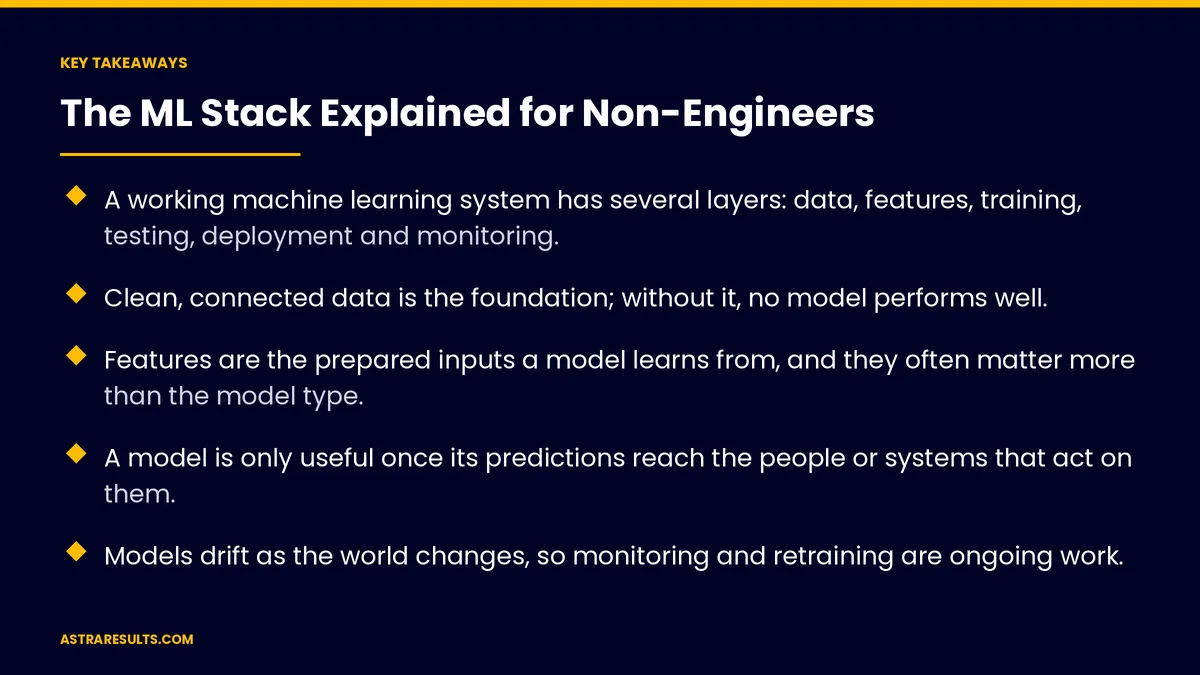
- A working machine learning system has several layers: data, features, training, testing, deployment and monitoring.
- Clean, connected data is the foundation; without it, no model performs well.
- Features are the prepared inputs a model learns from, and they often matter more than the model type.
- A model is only useful once its predictions reach the people or systems that act on them.
- Models drift as the world changes, so monitoring and retraining are ongoing work.
- Most projects fail from missing data, no owner, no path to use, or no monitoring, not from weak models.
Published: October 31, 2026 | Reading Time: ~10 minutes | Category: Machine Learning & Analytics
This guide walks through the layers of a machine learning system in plain terms: data, features, training, testing, deployment and monitoring. It also covers who does what, whether to build or buy each layer, and where projects usually break. Put plainly: the model is one layer of many, and most failures happen in the layers around it.
In This Playbook
- The stack at a glance
- Layer 1: data
- Layer 2: features
- Layer 3: training
- Layer 4: testing
- Layer 5: deployment
- Layer 6: monitoring
- Who does what
- Build or buy each layer
- Where projects break
- What should a machine learning project measure?
- The first three months
The stack at a glance
Data. Records from your systems: sales, customers, operations, sensors, messages.
Features. The cleaned, prepared inputs a model learns from.
Training. The model learns patterns from past examples.
Testing. Checking the model on data it hasn't seen.
Deployment. Putting predictions where people and systems use them.
Monitoring. Watching accuracy over time and retraining when it slips.
Think of a kitchen. Data is the groceries, features are the prep, training is developing the recipe, testing is the tasting, deployment is serving and monitoring is checking how diners react each week.
Layer 1: data
Where it comes from. Your CRM, point-of-sale, accounting, website, apps and operations tools.
Getting it together. Pipelines collect data from each system into one place, as explained in data pipelines explained.
Quality first. Duplicates, missing values and inconsistent formats ruin models. Most of the effort in many projects goes here, as covered in the foundation every AI project needs.
Enough history. Models need past examples of what you want to predict, such as orders, churn or late deliveries.
Layer 2: features
What they are. The specific inputs the model uses: days since last order, average order size, time of day, distance to the customer.
Why they matter. A simple model with well-chosen features often beats a complex model with poor ones.
Business knowledge helps. People who know the work can suggest which factors really drive the outcome.
Keep them consistent. Features must be calculated the same way when training and when predicting.
Layer 3: training
Learning from examples. The model studies past cases and their outcomes to find patterns.
Choosing a model type. From simple methods to more complex ones. Start simple and add complexity only if it helps.
Defining success. Decide what a good prediction means for the business before training starts.
Where explanations help. Simpler models are easier to explain, which matters when people must trust the result. The basics are covered in machine learning for operators.
Layer 4: testing
Test on unseen data. A model judged on the data it learned from will look better than it is.
Compare with today. Is the model better than the current rule of thumb or the manager's judgment?
Check groups. Accuracy should hold across customer types, locations and seasons, and must never rely on protected traits.
Run a pilot. Test in real conditions on a small scale, as covered in AI pilots that fail safely.
Layer 5: deployment
Predictions where work happens. In the CRM, the dispatch screen, the pricing tool or a daily report.
On a schedule or on demand. Nightly scores for every customer, or an instant prediction when an order arrives.
With reasons where possible. People act on predictions they understand, as with the scored lists in AI outbound scoring.
People stay in the loop. For decisions that matter, a person reviews and can override.
Layer 6: monitoring
Models drift. Customer habits, prices and markets change, and predictions slowly get worse.
Track accuracy. Compare predictions with what happened, every week or month.
Watch the inputs. If the incoming data changes, for example after a new product launch, the model may need updating.
Retrain on a schedule. Refresh the model with recent data, and test it before replacing the old one.
Alerts. Notify an owner when accuracy drops or data stops arriving.
Who does what
Business owner. Defines the question, judges success and decides how predictions are used.
Data engineer. Builds the pipelines and keeps data clean and flowing.
Data scientist or ML engineer. Prepares features, trains and tests models, and sets up deployment and monitoring.
The people who use it. Dispatchers, sales reps or managers who give feedback on whether predictions help.
Small teams can share roles. A partner can cover the technical layers while your team owns the question and the use.
Build or buy each layer
Data pipelines. Often a mix of ready-made connectors and custom work.
Model tools. Cloud platforms and ready-made tools speed up training and deployment for common problems.
Pre-built models. Some problems, like forecasting or text classification, have good existing tools.
Custom models. Worth it when your data and question are unique and the value is high.
Keep ownership. Your data, features and models should stay in accounts you control.
Where projects break
No clean data. The most common reason models never work well.
No owner. Nobody responsible for the question, the results or the follow-through.
No path to use. A model that works in testing but never reaches the people who decide.
No monitoring. Accuracy quietly falls until someone notices bad decisions.
Too much at once. Trying to predict everything instead of one valuable question, like the pricing models in price optimization.
What should a machine learning project measure?
Prediction accuracy. On new data, compared with the current method.
Business result. Revenue, cost, time or errors changed by using the predictions.
Adoption. How often people use or follow the predictions.
Data freshness. How current the inputs are.
Drift alerts. How often accuracy drops, and how fast it's fixed.
The first three months
Days 1–30: question and data
Pick one valuable question to predict. Name the business owner. Check that the data exists, with enough history, and clean the most important sources. Record how the decision is made today.
Days 31–60: build and test
Prepare features with input from the people who know the work. Train a simple model, test it on unseen data and compare it with the current method. Run a small pilot.
Days 61–90: deploy and monitor
Put predictions where people work, with reasons where possible. Set up accuracy tracking, alerts and a retraining schedule. Measure the business result against the baseline.
How Astra builds ML systems
Astra Results Marketing builds machine learning systems that work in all six layers, not just in the model. We start with one valuable question and clean data, prepare features with your team's knowledge, test against your current method and put predictions where people use them.
Every system has monitoring, alerts and a retraining plan, with data and models in accounts you own. Engagements begin with a data and question review through our machine learning and advanced analytics team.
Related reading
Frequently asked questions
What is the ML stack?
The layers that turn data into useful predictions: data collection and cleaning, features, model training, testing, deployment where people use the predictions, and monitoring to keep them accurate.
What are features in machine learning?
The prepared inputs a model learns from, such as days since a customer's last order or average order size. Well-chosen features often matter more than the type of model.
Why do machine learning projects fail?
Most fail from poor data, no clear owner, no path to put predictions in front of the people who decide, or no monitoring as accuracy slips, rather than from a weak model.
What does model drift mean?
Predictions getting less accurate over time as customer habits, prices and markets change. Monitoring and regular retraining keep models useful.
Do we need a data scientist on staff?
Not always. A partner can handle the technical layers while your team owns the business question, the decisions and the feedback.
How long does a first ML project take?
A focused project on one question, with data that already exists, can often reach a pilot within a few months. Starting with data cleanup is the usual first step.
Ready for machine learning that works beyond the demo? Astra Results Marketing builds every layer of the stack, from clean data and features to deployment and monitoring, starting with one valuable question and measuring the business result against your current method. ▸ CALL (786) 321-2866 · ▸ REQUEST YOUR CONSULTATION





