Rated 5 star on

Intelligent Support: Resolving, Not Deflecting
Quick answer
Intelligent support uses AI to resolve problems, not to keep customers away from people. Tickets fall into three tiers: resolved by software, prepared for an agent, or routed straight to a person. Agent assist and fast triage do the most work. Teams should track first-contact resolution, reopen rate and customer effort instead of deflection.
Support teams were sold AI as a way to make customers go away. Contain rate, avoided tickets, self-service percentage. Every metric of the first generation measured how many people the software stopped from reaching a human. Customers noticed. So did the agents who inherited the angry ones.
Key Takeaways
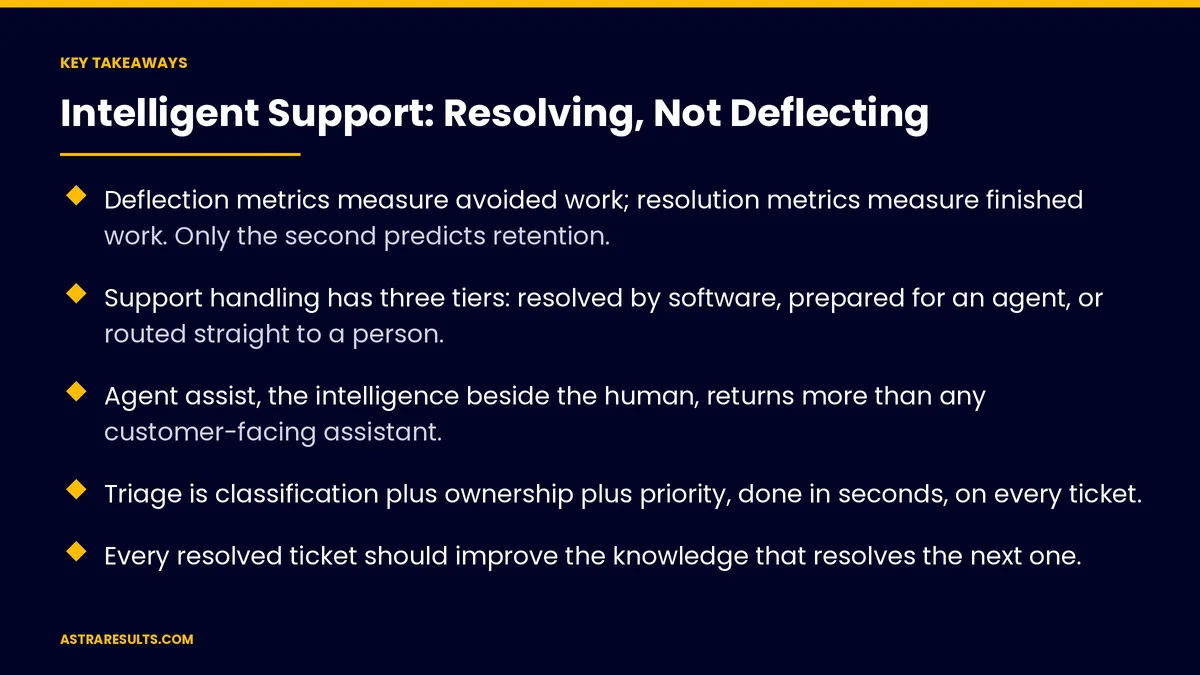
- Deflection metrics measure avoided work; resolution metrics measure finished work. Only the second predicts retention.
- Support handling has three tiers: resolved by software, prepared for an agent, or routed straight to a person.
- Agent assist, the intelligence beside the human, returns more than any customer-facing assistant.
- Triage is classification plus ownership plus priority, done in seconds, on every ticket.
- Every resolved ticket should improve the knowledge that resolves the next one.
- First-contact resolution, reopen rate and customer effort are the three numbers to run on.
Published: October 18, 2026 | Reading Time: ~12 minutes | Category: Customer Engagement
This piece is about the second generation, where the intelligence works for the support team rather than against the customer. It covers the three tiers of handling, what the software does beside the agent rather than in front of the customer, how triage and knowledge become a loop, and which metrics to retire.
Put plainly: the job of intelligent support is to raise first-contact resolution, and every other number is downstream of that.
Guidance for owners and support leaders. Nothing here is legal advice. Recorded conversations, data retention and disclosure of automated handling are governed by rules that vary by jurisdiction and industry and should be confirmed with counsel.
In This Playbook
- Support is a different job from intake
- Three tiers of handling
- Agent assist: the intelligence beside the human
- Triage: classification, ownership, priority
- The knowledge loop
- Root cause: the ticket that should not exist
- Metrics to retire and metrics to run on
- Where it fails
- The first three months
- What Astra does here
Support is a different job from intake
Who is calling. An existing customer with a problem, not a prospect with a question. They have already paid. Their patience is shorter and the cost of losing them is higher.
What they want. The thing fixed, on this contact, without repeating themselves. Not a ticket number, not a callback window, not a link to an article.
Why this matters for the design. Intake optimizes for speed and capture. Support optimizes for resolution and effort. The principle that resolution beats deflection is argued in customers answered, not deflected. This piece is about how a support team operates on it.
Three tiers of handling
Tier one: resolved by software. Where is my delivery, reset my access, change my appointment, resend a document. Known intent, known answer, known action, low risk of being wrong. The software confirms identity, does the thing and confirms it was done.
Tier two: prepared for an agent. The software gathers the account, the history, the likely cause and a draft response, then hands a ready case to a person who decides. Most tickets belong here. The agent's time goes to judgment rather than lookup.
Tier three: straight to a person. Complaints, safety, billing disputes above a threshold, anyone distressed, anyone who asks. Routed immediately, with the record attached, to someone with authority. No attempt to handle it first.
The rule for placing a ticket. Risk of being wrong, not frequency. A frequent question with a costly wrong answer stays in tier two. A rare question with a harmless wrong answer can live in tier one.
Agent assist: the intelligence beside the human
What it does. Summarizes the conversation so far. Pulls the account and every previous ticket. Suggests the likely cause from similar cases. Drafts a reply in the business's voice for the agent to edit. Fills the ticket fields the agent would otherwise type after the call.
Why it returns more than a customer-facing bot. It compounds on every ticket, including the ones a bot could never take. An agent who spends three minutes less per ticket on lookup and wrap-up handles more, resolves more on first contact and finishes the day less tired.
The generative work behind drafting and summarizing is covered in generative AI at work.
The guardrail. The agent sends, not the software. Drafts are drafts. A suggested cause is a suggestion. The human remains the author of record for anything a customer reads.
Triage: classification, ownership, priority
Classification. What is this ticket about, in the business's own categories, assigned the moment it arrives. Language models do this well when the categories are stable and the training examples are the business's own tickets, as described in natural language processing for business.
Ownership. Which queue, which team, which person if the account has one. Tickets that bounce between owners are the single largest source of slow resolution and reopens.
Priority. Urgency and impact, scored consistently. A customer with a service down and a deadline is not in the same queue as a customer asking about a feature, even if both wrote at 9:02.
The link to task flow. Triage produces work items with owners and due dates, which is the same discipline applied to internal work in work that moves itself. A ticket without an owner is a ticket that will be reopened.
The knowledge loop
Where knowledge comes from. Resolved tickets. Every time an agent fixes something, the fix is a candidate article, a candidate tier-one action or a correction to an existing answer. Knowledge that is written once and left alone decays within a quarter.
The loop. Ticket resolved. Resolution reviewed. Knowledge updated or created. Next ticket of the same kind resolves faster or moves down a tier. Measured by how many tickets moved tiers this month.
Who owns it. A named person with time allocated, not the whole team informally. Knowledge without an owner is the reason most self-service fails.
The data beneath it. Tickets, resolutions and outcomes have to be recorded consistently enough to learn from, which is the case for the foundation every AI project needs made at the scale of a support team.
Root cause: the ticket that should not exist
The best support ticket is the one that never arrives because the cause was removed. Support data is the most direct signal a business has about what is broken in the product, the process or the communication.
The practice. Monthly, the top ticket categories by volume are reviewed with whoever owns the cause: operations, product, billing, sales. Each category gets a decision. Remove the cause, communicate earlier, or accept and automate.
The measure. Tickets per hundred customers, month over month. A support team that is getting better at answering a question that should not exist is optimizing the wrong thing.
Metrics to retire and metrics to run on
Retire: contain rate. It rewards keeping people away from help. A customer who gave up is counted as a success.
Retire: tickets avoided. Unmeasurable, and usually estimated by the vendor selling the software.
Retire: average handle time on its own. Shorter contacts that reopen are worse than longer ones that resolve.
Run on: first-contact resolution. The share of tickets closed on the first interaction and not reopened within a set window.
Run on: reopen rate. The share of closed tickets the customer had to come back about.
Run on: customer effort. How hard the customer says it was to get the thing fixed, asked immediately after resolution.
Also track: agent hours returned. The wrap-up and lookup time given back by agent assist, counted the way automation KPIs are counted, against a baseline recorded first.
Where it fails
Over-automating tier one. A wrong action taken confidently, on the customer's account, is the fastest way to lose trust. Tier one grows slowly, one intent at a time, each proven.
Stale knowledge. An assistant confidently citing last year's policy. The loop exists to prevent this, and only works with an owner.
Handoff without context. The customer explains the problem to the software, then explains it again to the agent. Tier two exists so this never happens.
Optimizing the queue, not the cause. A faster queue for a problem the business could have removed is a cost saved instead of a problem solved.
The first three months
Days 1–30: baseline and tiering
Thirty days of tickets classified into the business's own categories. First-contact resolution, reopen rate and handle time recorded as the baseline. Each category assigned a tier on risk of being wrong. Knowledge owner named.
Days 31–60: agent assist and triage live
Summaries, account retrieval and drafting in front of agents on every ticket. Automatic classification, ownership and priority on arrival. The two or three lowest-risk tier-one intents live, read-only or single-action, each confirmed before the next.
Days 61–90: the loop and the review
Resolved tickets feeding knowledge weekly, with tier movements counted. First root-cause review with the owners of the top categories. First-contact resolution, reopen rate and agent hours compared to Day 1.
What Astra does here
Astra Results Marketing starts with the ticket history rather than the software, because the tiers, the categories and the baseline all come from what the business has already handled. Agent assist goes live before any customer-facing automation, since it returns more and risks less.
Tier one grows one intent at a time, each proven against the reopen rate. The knowledge loop and the root-cause review are set up as owned, scheduled practices, not features. Reporting runs on first-contact resolution, reopen rate and customer effort, against the baseline, and never on contain rate.
Engagements begin with a thirty-day ticket classification through our AI customer engagement team.
Related reading
Frequently asked questions
What is the difference between deflecting and resolving?
Deflection counts customers kept away from a human and treats a customer who gave up as a success. Resolution counts problems fixed on first contact and not reopened. Only resolution predicts whether the customer stays.
What are the three tiers of support handling?
Tier one is resolved by software: known intent, known action, low risk of being wrong. Tier two is prepared for an agent: account, history, likely cause and a draft, handed to a person who decides. Tier three goes straight to a person: complaints, disputes, distress, or anyone who asks.
What is agent assist?
Software working beside the agent rather than in front of the customer: summarizing the conversation, retrieving the account and history, suggesting a likely cause, drafting a reply and filling ticket fields. The agent edits and sends. It compounds on every ticket, including those no bot could take.
Which support metrics should be retired?
Contain rate, tickets avoided and handle time on its own. Replace them with first-contact resolution, reopen rate and customer effort, plus agent hours returned measured against a baseline.
How does the knowledge loop work?
Every resolved ticket is reviewed as a candidate article, tier-one action or correction. Knowledge is updated weekly by a named owner. The number of ticket categories that moved down a tier is counted each month.
Why review root causes?
Because the best ticket is one that never arrives. Support data shows what is broken elsewhere in the business. A monthly review with the owners of the top categories decides whether to remove the cause, communicate earlier, or accept and automate.
Ready to raise first-contact resolution? Astra Results Marketing classifies your ticket history, sets the three tiers on risk, puts agent assist in front of your team first, and reports on resolution and reopen rate against a baseline, never on contain rate. ▸ CALL (786) 321-2866 · ▸ REQUEST YOUR CONSULTATION