 Rated 5 star on

Shopify Partner Agencies: What to Expect
Quick answer
A Shopify partner agency should handle design, apps, migrations, speed, marketing and support after launch. A good engagement starts with discovery and a written scope. Your business should own the store, with the agency working through collaborator access. Themes and apps often carry monthly costs. Check reviews and past work before hiring.
Hiring an agency to build or grow a Shopify store can save months, or create a store you don't fully control. The difference usually comes down to what was agreed before work started: scope, ownership, apps, costs and support after launch. Knowing what to ask helps you choose well.
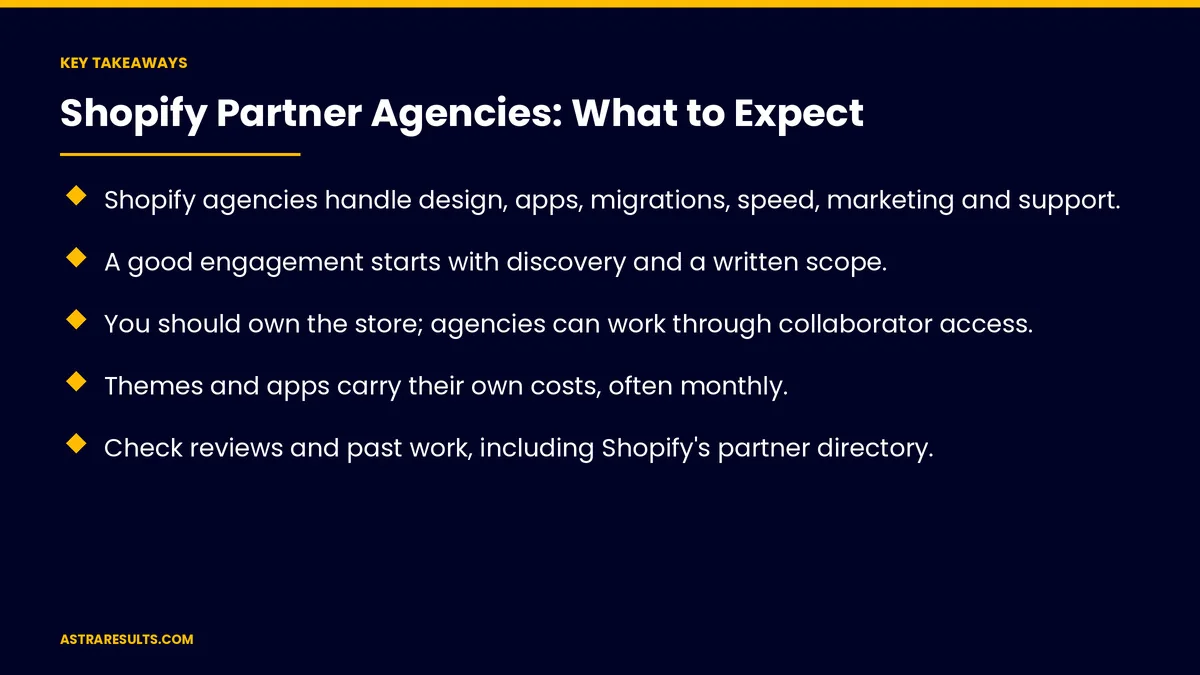
Key Takeaways
- Shopify agencies handle design, apps, migrations, speed, marketing and support.
- A good engagement starts with discovery and a written scope.
- You should own the store; agencies can work through collaborator access.
- Themes and apps carry their own costs, often monthly.
- Check reviews and past work, including Shopify's partner directory.
- Plan for support after launch, not just the build.
Published: October 22, 2026 | Reading Time: ~9 minutes | Category: E-Commerce Marketing
This guide covers what Shopify agencies typically do, how a good engagement runs, store ownership and collaborator access, apps and themes, costs to plan for, checking an agency's background, red flags and what to measure. Put plainly: agree on scope and ownership first, and keep the store in your name.
In This Playbook
- What Shopify agencies typically do
- How a good engagement runs
- Theme or custom design
- Ownership and access
- Apps and themes
- Costs to plan for
- What a strong store includes
- Checking an agency
- Red flags
- What should we measure after a Shopify project?
- The first three months with an agency
What Shopify agencies typically do
Store design. Customizing a theme or building a custom design.
Apps and integrations. Reviews, subscriptions, shipping, accounting and email tools.
Migrations. Moving products, customers and orders from another platform, as covered in migrating to Shopify.
Speed and SEO. Fast pages, clean structure and product data.
Marketing. Ads, email and conversion improvements.
Ongoing support. Updates, fixes and new features.
B2B ordering. Some stores add ordering for business customers, as in wholesaler ordering apps.
How a good engagement runs
Discovery. Your products, customers, goals and current problems.
Written scope. Pages, features, apps, integrations and what's excluded.
Timeline. Milestones for design, build, testing and launch.
Reviews along the way. You see designs and test the store before launch.
Launch checklist. Payments, shipping, taxes, redirects, tracking and test orders.
Training. Your team learns to manage products, orders and content.
Theme or custom design
Themes. Faster and lower cost, with design limits.
Custom design. More distinctive, with higher cost and maintenance.
The trade-offs are weighed in Shopify or custom for your brand.
Ownership and access
You own the store. The account should be in your business's name.
Collaborator access. Agencies can work in your store without your login.
Own your domain and accounts. Domain, email, payment and app accounts in your name.
Clear exit terms. What happens to designs, code and access if you switch agencies.
Apps and themes
Paid themes. A one-time or ongoing license cost.
App subscriptions. Many apps charge monthly; costs add up.
Fewer, better apps. Too many apps can slow the store.
Who pays. Apps and themes billed to your account, not the agency's.
Costs to plan for
Design and build. Based on scope, as covered in what an online store costs.
Monthly platform and app fees. Ongoing costs beyond the build.
Support retainers. Updates and improvements after launch.
Marketing spend. Separate from agency fees.
What a strong store includes
Product pages that convert. Photos, specs and proof, as covered in product pages that convert.
Search and filters. Helping shoppers find products, as covered in store search and filters.
Clean checkout. Fast, mobile-friendly and trustworthy.
Channel plan. How the store fits with marketplaces, as covered in marketplace presence.
Checking an agency
Past work. Live stores similar to yours.
References. Talk to past clients.
Partner directory. Shopify's official partner directory lists agencies with reviews.
Ask the right questions. About access, ownership and exit, as covered in what to ask before hiring a task management partner.
Red flags
Store in the agency's name. Ownership should be yours.
Vague scope. No written list of what's included.
App overload. Many paid apps without clear need.
No post-launch plan. Support that ends at launch.
Guaranteed sales promises. No agency controls results.
What should we measure after a Shopify project?
Conversion rate. Before and after the project.
Page speed. On mobile especially.
Monthly app costs. Against value.
Issues after launch. Bugs and how fast they're fixed.
Revenue from the store. The result that matters.
The first three months with an agency
Days 1–30: discovery and scope
Share goals, products and current problems. Agree on a written scope, timeline, app list and ownership terms, and set up collaborator access.
Days 31–60: design and build
Review designs, test features and approve the app list. Prepare content and product data.
Days 61–90: launch and support
Run the launch checklist, train your team and start post-launch support. Measure conversion, speed and issues against the baseline.
How does Astra work on Shopify stores?
Astra Results Marketing helps brands build and grow Shopify stores with clear scope and ownership. We plan design, apps and integrations, keep the store and accounts in your name, run careful launches and support the store after launch.
We measure conversion, speed and revenue, and keep app costs in check. Engagements begin with a store and goals review through our e-commerce marketing team.
Related reading
Frequently asked questions
What does a Shopify agency do?
Designs and builds stores, sets up apps and integrations, migrates data from other platforms, improves speed and SEO, runs marketing and supports the store after launch.
Who should own the Shopify store?
You should. Keep the store, domain, payment and app accounts in your business's name, and give agencies collaborator access.
Should we use a theme or a custom design?
Themes are faster and cost less; custom designs are more distinctive but cost more to build and maintain. Choose based on budget and brand needs.
What ongoing costs should we expect?
Platform fees, app subscriptions, any theme licenses, support retainers and marketing spend, in addition to the initial build.
How do we check an agency?
Review live stores they've built, talk to past clients and check Shopify's partner directory for reviews.
What are red flags when hiring a Shopify agency?
The store in the agency's name, vague scope, too many paid apps, no plan after launch and promises of guaranteed sales.
Ready for a Shopify store you fully own and can grow? Astra Results Marketing builds and grows Shopify stores with clear scope, accounts in your name, careful launches and support after launch. ▸ CALL (786) 321-2866 · ▸ REQUEST YOUR CONSULTATION





