 Rated 5 star on

E-Commerce Stores: Shopify or Custom for Your Brand
Quick answer
For most brands selling standard products to consumers, Shopify is the fastest and safest way to launch and run a store. A custom store fits configured products, complex B2B pricing or deep ERP links. A headless build pairs a custom front end with a proven platform. Compare total cost over three years.
The first big decision for an online store isn't the design. It's the platform underneath it. It decides how fast you launch, what checkout can do, which tools connect, what you pay monthly and how much work it takes to run. Most brands should start on Shopify. Some outgrow it, and a few should never start there.
Key Takeaways
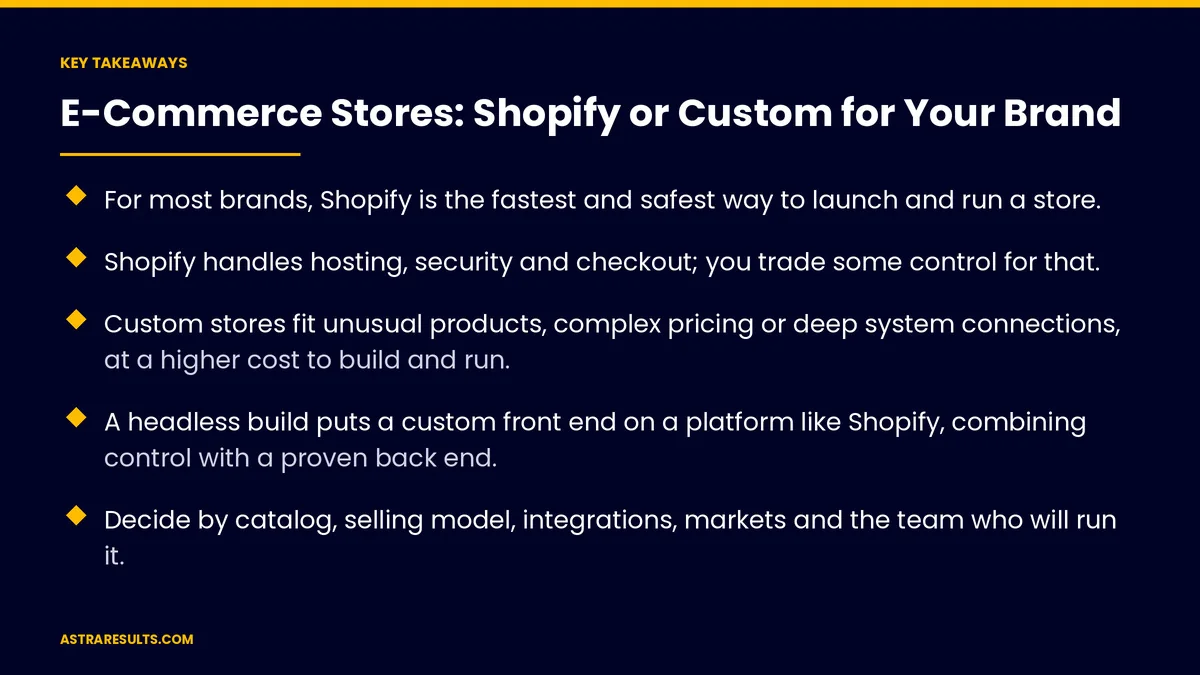
- For most brands, Shopify is the fastest and safest way to launch and run a store.
- Shopify handles hosting, security and checkout; you trade some control for that.
- Custom stores fit unusual products, complex pricing or deep system connections, at a higher cost to build and run.
- A headless build puts a custom front end on a platform like Shopify, combining control with a proven back end.
- Decide by catalog, selling model, integrations, markets and the team who will run it.
- Count total cost: platform, apps, payment fees, development and upkeep.
Published: October 1, 2026 | Reading Time: ~11 minutes | Category: E-Commerce Stores
This guide compares Shopify, a fully custom store and the middle path of a headless build. It covers what each does well, where each runs into limits, and the questions that decide it for your business. Put plainly: choose the platform for how you sell, not for how the store looks.
Platform plans, fees and features change often. Check current pricing and terms before you commit.
In This Playbook
- What you're really choosing
- Where Shopify fits
- Where does Shopify run into limits for a store?
- When a custom store makes sense
- The middle path: headless
- Questions that decide it
- What every store needs, on any platform
- Switching platforms
- Store numbers to track
- The first three months
- What Astra builds
What you're really choosing
A platform, not a theme. The platform handles products, carts, checkout, payments, orders and customer accounts. The theme only changes how it looks.
Who carries the risk. On a hosted platform, the provider keeps the store online, secure and compliant with card-payment rules. On a custom store, much of that is on you and your developers.
How fast you can change. Adding a product, a discount or a landing page should take your team minutes, not a developer's week.
What it connects to. Inventory, accounting, shipping, point of sale and your CRM. The way stores connect to them is covered in API integration.
Where Shopify fits
Fast to launch. A clean store can go live in weeks, with hosting, security and checkout already working.
A proven checkout. Shoppers know it and trust it, and it supports common payment methods out of the box.
Easy for your team. Staff can manage products, orders and discounts without a developer.
A large app ecosystem. Reviews, subscriptions, loyalty, shipping and email tools install in minutes.
Predictable running costs. A monthly plan plus payment fees and apps, with no servers to manage.
Good for most brands. If you sell standard products to consumers, Shopify does the job well. The growth side is covered in growing an online store.
Where does Shopify run into limits for a store?
Checkout changes. How much you can customize checkout depends on your plan and Shopify's rules. Unusual steps can be hard or impossible.
Complex products. Products with many options, measurements or configurations can strain the standard product model.
Complex pricing. Customer-specific prices, contract pricing and large wholesale catalogs need extra apps or a higher plan.
App costs add up. Each app is cheap. Twenty of them, each with its own fee and code, can slow the store and raise the monthly bill.
You rent the platform. You own your data and content, but Shopify sets the rules, the fees and the roadmap.
When a custom store makes sense
Products that need a configurator. Custom furniture, printed goods, equipment built to order, or anything priced by size and options.
Selling models Shopify doesn't fit. Complex B2B with account pricing, quotes and approvals, or marketplaces with many sellers. The account side of wholesale is covered in wholesaler engagement.
Deep system connections. When the store must work closely with an ERP, warehouse or pricing system in real time.
Very high scale with unusual needs. When the store's demands are so specific that a platform's limits cost more than building your own.
The trade-offs. Higher cost to build, ongoing upkeep, and more responsibility for security and uptime. Use an established payment processor so card data never touches your servers. The general rule is in custom software: build only what makes you different.
The middle path: headless
What it is. A custom-built front end, the pages shoppers see, connected to a platform like Shopify that handles products, checkout and orders behind it.
Why choose it. Full control over the shopping experience and speed, while keeping a proven checkout, payments and admin.
When it fits. Content-heavy brands, unusual browsing experiences, or stores that need very fast pages and custom layouts.
The cost. More development than a theme, and two systems to maintain. Worth it only when the front end is a real advantage.
Custom themes and apps. A lighter middle path: stay on standard Shopify, but build a custom theme or a private app for the one thing you need.
Questions that decide it
What do you sell? Standard products point to Shopify. Configured or made-to-order products may need custom work.
How do you sell? Direct to consumers, wholesale, subscriptions or all three. Each adds requirements.
What must the store connect to? Count the systems and how closely they must sync.
Where do you sell? Several currencies, languages and tax rules matter for Miami brands selling to Latin America. Plan for Spanish as a real store language, as covered in what changes when Spanish is a channel.
Who will run it? A small team needs a store they can manage without developers.
What's the full budget? Build plus three years of platform fees, apps, payment fees and upkeep.
What every store needs, on any platform
Fast pages. Especially product and collection pages on phones.
Clear product pages. Good photos, accurate specs, price, shipping time and reviews.
A short checkout. Few steps, guest checkout and the payment methods your customers use.
Shipping and returns, stated plainly. Before checkout, not hidden in a footer.
Order updates. Confirmation, shipping and delivery messages that prevent "where is my order" questions, as in e-commerce engagement.
Tracking. Sales, conversion and source measured from launch, using attribution across every channel.
Switching platforms
Plan the move. Products, customers, orders and content all need to come across cleanly.
Protect search traffic. Every old product and page address must redirect to its new one.
Test before switching. Run the new store side by side, place test orders and check every connection.
Pick a quiet time. Not before a holiday or a big sale.
Store numbers to track
Conversion rate. The share of visitors who buy, on phones and computers.
Checkout completion. The share who start checkout and finish it.
Average order value. And how it changes with bundles, shipping thresholds and offers.
Page speed. Load time for product and collection pages on mobile.
Total cost of ownership. Platform, apps, payment fees, development and upkeep together, per order.
Time to make changes. How long a new product, offer or page takes to go live.
The first three months
Days 1–30: decide the platform
Answer the six deciding questions with your team. List every product type, selling model, market and system the store must handle. Compare Shopify, headless and custom on total three-year cost. Choose, and plan the catalog and content.
Days 31–60: build the store
Set up products, collections, shipping, taxes, payments and both languages. Design product and checkout pages for phones first. Connect inventory, accounting and shipping. Install only the apps you need.
Days 61–90: launch and improve
Test orders, payments, emails and connections end to end. Launch at a quiet time. Track conversion, checkout completion, speed and cost per order, and fix the biggest drop-off first.
What Astra builds
Astra Results Marketing chooses the store platform with you based on how you sell, not how the store should look. For most brands that means a fast, well-built Shopify store. For brands with configured products, complex pricing or deep system needs, it means headless or custom.
Every store we build has fast pages, clear products, a short checkout, both languages where your market needs them, and tracking from day one, with the store and accounts in your business's name. Engagements begin with a platform review through our e-commerce stores team.
Related reading
Frequently asked questions
Should we build our store on Shopify?
For most brands selling standard products to consumers, yes. Shopify handles hosting, security and checkout, launches quickly and is easy for a small team to run. Consider headless or custom only if your products, pricing or system needs push past its limits.
When does a custom store make sense?
When you sell configured or made-to-order products, use complex B2B pricing and approvals, run a multi-seller marketplace, or need real-time links to an ERP or warehouse system that a platform can't support well.
What is a headless store?
A store with a custom-built front end connected to a platform like Shopify for products, checkout and orders. It gives full control over the shopping experience while keeping a proven checkout and admin, at a higher build and upkeep cost.
What does an online store cost to run?
Platform fees, payment processing fees, app subscriptions, development for changes, and upkeep. Compare the total over three years, divided by orders, rather than just the monthly plan price.
Can we sell to Latin America from a Miami store?
Yes, with planning for currencies, languages, taxes, shipping and returns. Treat Spanish as a full store language, with translated products and checkout, rather than relying on automatic translation.
How do we switch platforms without losing sales?
Move products, customers, orders and content carefully, redirect every old address, test the new store side by side with real test orders, and switch at a quiet time rather than before a peak season.
Ready to choose the right platform for how you sell? Astra Results Marketing compares Shopify, headless and custom on your products, selling model, markets and three-year cost, then builds a fast, bilingual store with a short checkout and tracking from day one. ▸ CALL (786) 321-2866 · ▸ REQUEST YOUR CONSULTATION





