 Rated 5 star on


Site Architecture for Companies With Many Services
Quick answer
A site with many services works best organized as categories, then services, then justified sub-services. Category hub pages explain each group and link to every service. Give each real service one strong page, and merge pages that overlap. Supporting guides answer questions and link to the right service. Keep menus simple and use breadcrumbs.
Companies that offer dozens of services often end up with websites that sprawl: pages added one at a time, buried in menus and competing with each other in search. Visitors can't find what they need, and search engines can't tell which page matters. A clear structure of categories, hubs and service pages fixes both.
Key Takeaways
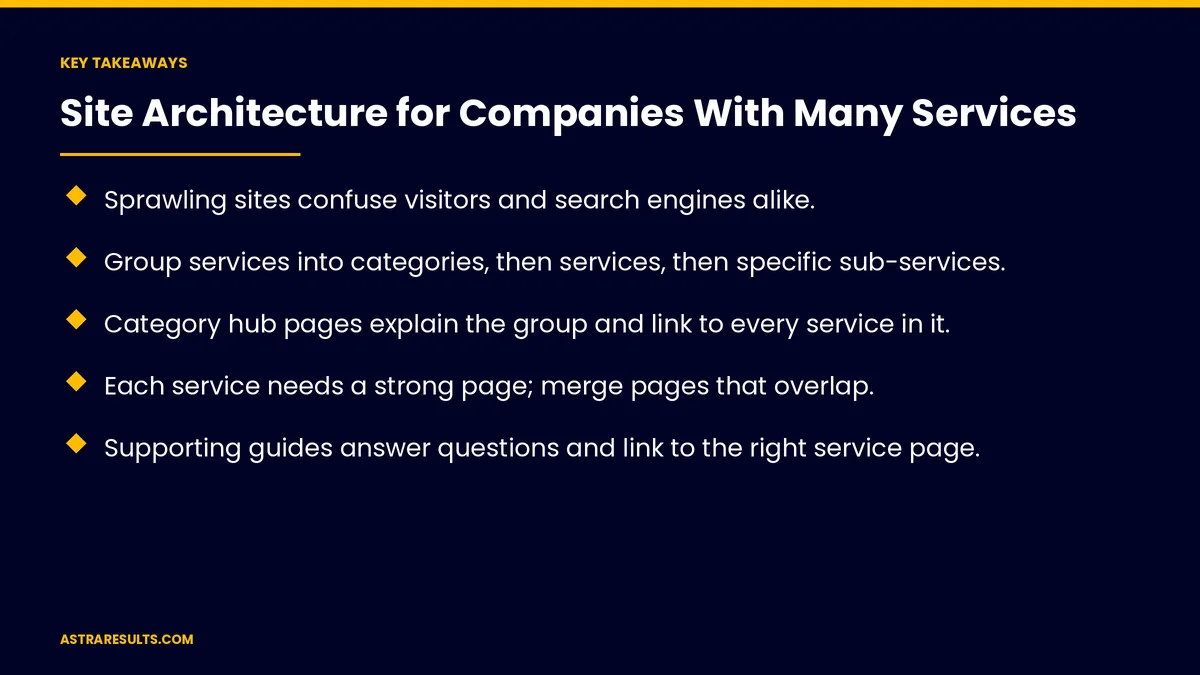
- Sprawling sites confuse visitors and search engines alike.
- Group services into categories, then services, then specific sub-services.
- Category hub pages explain the group and link to every service in it.
- Each service needs a strong page; merge pages that overlap.
- Supporting guides answer questions and link to the right service page.
- Link related services, use breadcrumbs and keep menus simple.
Published: October 12, 2026 | Reading Time: ~9 minutes | Category: Search Engine Optimization
This guide covers building a hierarchy, category hubs, strong service pages, avoiding overlap, supporting guides, internal links, navigation, locations and languages. Put plainly: group services into clear categories, give each a strong page and link everything so visitors and search engines can follow.
For many locations rather than many services, see site architecture for multi-location businesses.
In This Playbook
- Build a hierarchy
- Category hub pages
- Strong service pages
- Should each keyword variation get its own service page?
- Supporting guides
- Internal links
- How should menus be organized on a service-heavy site?
- Combining with locations
- Languages
- Markup
- Launching changes
- What to measure
- The first three months
Build a hierarchy
Categories. Broad groups, like heating, cooling and plumbing.
Services. Specific offerings within each category.
Sub-services. Only where demand and substance justify a page.
Shallow URLs. No more than three levels deep.
Category hub pages
Explain the category. What it covers and who it's for.
Link every service. With a short description of each.
Answer common questions. As covered in question-shaped headings.
Strong service pages
Real detail. What's included, how it works and what it costs.
Proof. Reviews, projects and credentials for that service.
A clear next step. Call, book or request a quote.
Should each keyword variation get its own service page?
One page per real service. Not per keyword variation.
Merge overlaps. Two pages chasing the same search compete with each other.
Remove or improve thin pages. Pages with little to say.
Supporting guides
Answer questions. Costs, timelines and comparisons.
Link to the service page. The guide supports; the service page converts.
Fill real gaps. Questions customers ask.
Internal links
Category to service. And back.
Related services. "Customers who need this often need that."
Guides to services. With descriptive link text.
How should menus be organized on a service-heavy site?
Simple menus. Categories first, services second.
Breadcrumbs. Home, category, service.
Search on the site. For companies with very many services.
Combining with locations
Only where it's real. Location-specific details, not swapped city names.
The location side is covered in site architecture for multi-location businesses.
Statewide reach is covered in AI SEO for Florida businesses.
Languages
Spanish versions. Of key categories and services, set up correctly, as covered in bilingual websites.
Markup
Service details marked up. For search engines and AI tools.
Breadcrumb markup. Matching the visible path.
Launching changes
Redirects for moved pages. Every old address mapped, as in the website launch checklist.
Give it time. As covered in how long SEO takes.
What to measure
Visits by category. And service.
Leads by service page. Calls, forms and bookings.
Pages competing for the same searches. Fewer over time.
Thin pages. Removed or improved.
AI mentions. For key services, as in the future of search.
The first three months
Month one: map
List every service page, group them into categories and find overlaps and thin pages.
Month two: restructure
Build category hubs, strengthen service pages, merge overlaps and add redirects for moved pages.
Month three: connect and measure
Add internal links and breadcrumbs, link guides to services and track visits and leads by service.
How Astra structures service-heavy sites
Astra Results Marketing restructures websites for companies with many services. We group services into clear categories, build hub and service pages, merge overlaps, link everything together and track leads by service.
Engagements begin with a site structure review through our search engine optimization team.
Related reading
Frequently asked questions
How should a site with many services be organized?
Into categories, then services, then specific sub-services where justified, with URLs no more than three levels deep.
What is a category hub page?
A page that explains a group of services and links to each one with a short description.
Should every keyword get its own page?
No. One page per real service. Pages chasing the same search compete with each other, so merge them.
How do guides fit in?
Guides answer questions and link to the service page, which handles conversion.
How should internal links work?
Categories link to services and back, related services link to each other and guides link to services.
What should we measure?
Visits and leads by category and service, competing pages, thin pages and AI mentions.
Ready for a website that makes every service easy to find? Astra Results Marketing groups services into clear categories, builds strong hub and service pages and links everything so visitors and search engines can follow. ▸ CALL (786) 321-2866 · ▸ REQUEST YOUR CONSULTATION





