 Rated 5 star on


Website Care Plans: What Ongoing Support Covers
Quick answer
A website care plan should cover updates, tested backups, security, uptime checks, small edits and renewals after launch. Backups only count once someone has restored one successfully. Forms and lead flows need testing every month, because broken forms lose leads silently. Redesigns usually fall outside the plan. Monthly reports should explain the work plainly.
A website isn't finished at launch. Its software needs updates, its forms need checking, and its security certificate and domain need renewing. Someone has to notice when it goes down at night. Most business owners find this out when something breaks: a form that stopped sending leads weeks ago, a hacked page, or a site that won't load.
Key Takeaways
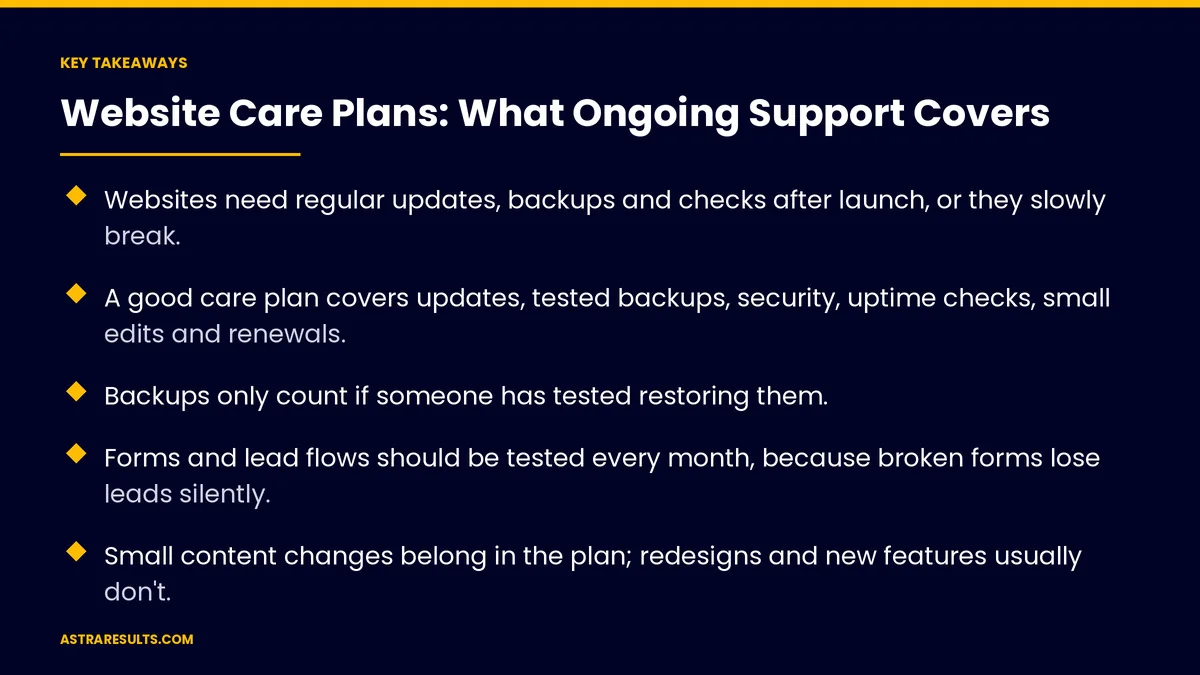
- Websites need regular updates, backups and checks after launch, or they slowly break.
- A good care plan covers updates, tested backups, security, uptime checks, small edits and renewals.
- Backups only count if someone has tested restoring them.
- Forms and lead flows should be tested every month, because broken forms lose leads silently.
- Small content changes belong in the plan; redesigns and new features usually don't.
- Monthly reports should show what was done and what was found, in plain language.
Published: October 26, 2026 | Reading Time: ~10 minutes | Category: Website Care Plans
A website care plan is ongoing support that handles all of that on a schedule. This guide covers what a good plan includes, what it usually doesn't, who needs one and how to choose. Put plainly: a care plan keeps the site you paid for working, safe and current, so problems are caught before customers find them.
In This Playbook
- Why websites need ongoing care
- What a good care plan includes
- Backups that work
- Security, briefly
- Uptime and speed
- Forms, leads and connections
- What's usually not included
- Who needs a care plan
- How to choose a plan
- How do we measure a website care plan?
- The first three months
Why websites need ongoing care
The software keeps changing. Website platforms, plugins, themes and the servers they run on release updates and security fixes all the time.
Things break quietly. A form stops sending, a page loses its images, a payment link fails. Nobody notices until a customer complains or leads dry up.
Renewals expire. Domains, security certificates and hosting have renewal dates. Missing one can take the site offline or show visitors a security warning.
Attackers look for old software. Sites that aren't updated are the easiest to break into.
Your business changes. Hours, prices, staff, services and offers need to stay current on the site.
What a good care plan includes
Software updates. The platform, plugins and theme kept current, tested so updates don't break the site.
Backups. Automatic, regular backups stored somewhere other than the website's own server.
Restore tests. Someone restores a backup on a schedule to prove it works.
Security monitoring. Checks for malware, suspicious logins and changes nobody made, with protection against common attacks.
Uptime monitoring. Automatic checks every few minutes, with an alert when the site goes down.
Form and lead checks. Test submissions every month to confirm every form reaches the right person.
Small content edits. A set amount of time each month for text, photo, price and hours changes.
Renewals. Domain, security certificate and hosting renewals tracked and handled before they lapse.
Monthly reports. What was updated, what was found, what was fixed.
Support. A clear way to ask for help and agreed response times.
Backups that work
Daily for most sites. More often for stores and sites that take bookings or orders.
Stored off the server. If the server fails or is hacked, backups on the same server go with it.
Kept for weeks. Some problems are found late. Older copies let you go back before the problem started.
Restored on a schedule. A backup that has never been restored is a hope, not a plan.
Taken before every update. So any update that causes trouble can be undone in minutes.
Security, briefly
Updates first. Most break-ins use known holes in old software.
Strong logins. Unique passwords, two-step login for admin accounts and removing old users.
Monitoring and cleanup. Watching for malware and cleaning it fast if it appears.
Protection at the front door. A firewall or protection service that blocks common attacks before they reach the site.
Uptime and speed
Know before customers do. An alert to a named person within minutes of the site going down.
Fix the cause. Hosting problems, expired renewals and broken updates are the usual reasons.
Watch speed over time. Pages get slower as images and plugins pile up. Check key pages each month.
Keep the site light. Remove unused plugins and oversized images during routine care.
Forms, leads and connections
Test every form monthly. Submit each one and confirm it arrives in the right inbox or system.
Check phone links and booking. Tap-to-call numbers, booking widgets and chat should all work on phones.
Watch the connections. Links to your CRM, booking or email tools break when either side changes, as covered in API integration.
Check landing pages too. Pages used for ads must keep loading fast and converting, as described in landing pages.
What's usually not included
Redesigns. A new look or a rebuilt site is a separate project, like the process in website development.
New features. A new booking system, store or member area is quoted separately.
Large content projects. Writing many new pages or a full blog program.
Marketing work. SEO campaigns, ads and social media are separate services, though a care plan keeps the site healthy for them.
Check the limits. A good plan states exactly what's included, how many edit hours, and what extra work costs.
Who needs a care plan
Businesses that rely on the site for leads. If forms, calls or bookings come through it, downtime costs money.
Stores. Orders, payments and stock must keep working every day. Store platforms differ, as covered in Shopify or custom.
Sites built on platforms with many plugins. More moving parts mean more updates and more ways to break.
Teams without a developer. Someone needs to own the site's health.
Less needed for simple hosted sites. Some hosted platforms handle updates and security themselves. You still need backups, form checks and edits.
How to choose a plan
Clear list of what's included. Updates, backups, restore tests, security, uptime, forms, edits, renewals, reports.
Response times in writing. How fast they answer and fix problems, by how serious they are.
Accounts in your name. Hosting, domain and site access registered to your business, never only to the provider.
Reports you can read. Plain language, not a list of plugin names.
A named contact. One person who knows your site.
Price depends on the site. More pages, plugins, traffic and edit time cost more.
How do we measure a website care plan?
Uptime. The share of time the site is available, and how fast outages are fixed.
Updates applied. Current versus out-of-date software each month.
Backup and restore tests. Done on schedule, with results recorded.
Form tests passed. Every form working, every month.
Response times. How fast support answers and resolves requests.
Speed. Load times for key pages, tracked monthly.
The first three months
Days 1–30: audit and secure
Check software versions, backups, security, renewals, forms and speed. Move hosting, domain and access under your business's name. Set up off-server backups, uptime monitoring and security protection. Fix urgent risks first.
Days 31–60: settle the routine
Apply updates safely, with a backup before each one. Run the first restore test. Test every form and connection. Agree on edit hours, response times and a named contact.
Days 61–90: report and improve
Send the first monthly report in plain language. Remove unused plugins and fix slow pages. Track uptime, form tests and response times, and plan the next quarter's improvements.
How does Astra keep websites healthy?
Astra Results Marketing runs website care plans on a schedule, not only when something breaks. We start with an audit, move every account under your business's name, and set up off-server backups, uptime monitoring and security protection.
Each month we apply updates safely, test backups and every form, handle renewals, make your small content changes and send a plain-language report. Support has agreed response times and one named contact. Engagements begin with a website health audit through our website care plans team.
Related reading
Frequently asked questions
What is a website care plan?
Ongoing support for a website after launch: software updates, tested backups, security monitoring, uptime checks, form tests, small content edits, renewals, monthly reports and help when something goes wrong.
Do we need a care plan for a simple website?
If the site brings in leads, calls, bookings or orders, yes. Even simple sites need backups, renewals, form checks and occasional edits. Some hosted platforms handle updates and security, which can make a lighter plan enough.
What's the difference between a backup and a tested backup?
A backup is a saved copy of the site. A tested backup is one someone has restored to prove it works. Until a backup has been restored successfully, you don't know it will save you.
Are redesigns included in a care plan?
Usually not. Care plans cover keeping the current site healthy and making small edits. Redesigns, new features and large content projects are separate work, quoted on their own.
Who should own the hosting and domain?
Your business. Hosting, domain and website access should be registered in your name, with the care plan provider given access. That way you keep control if you ever change providers.
How often should forms be tested?
At least monthly, and after every update. Broken forms lose leads silently, often for weeks before anyone notices.
Ready to stop finding out about website problems from customers? Astra Results Marketing audits your site, moves every account under your business's name, and runs updates, tested backups, security, uptime checks, form tests, small edits and renewals on a schedule, with a plain-language report each month. ▸ CALL (786) 321-2866 · ▸ REQUEST YOUR CONSULTATION





