 Rated 5 star on


Website Development: From Brief to Launch Day
Quick answer
A website project succeeds when key decisions are made early and in the right order. Start with a brief that names visitors, actions and measures. Plan the sitemap and content before design. Build speed, accessibility, SEO and both languages in from the start. Test forms, redirects and tracking before launch, then watch the numbers.
Most website projects that go wrong go wrong early. The brief was vague, nobody owned the content, and the design was approved before anyone knew what each page had to do. The build then fixes problems that should have been decided in week one. A good site starts with clear decisions, made in the right order.
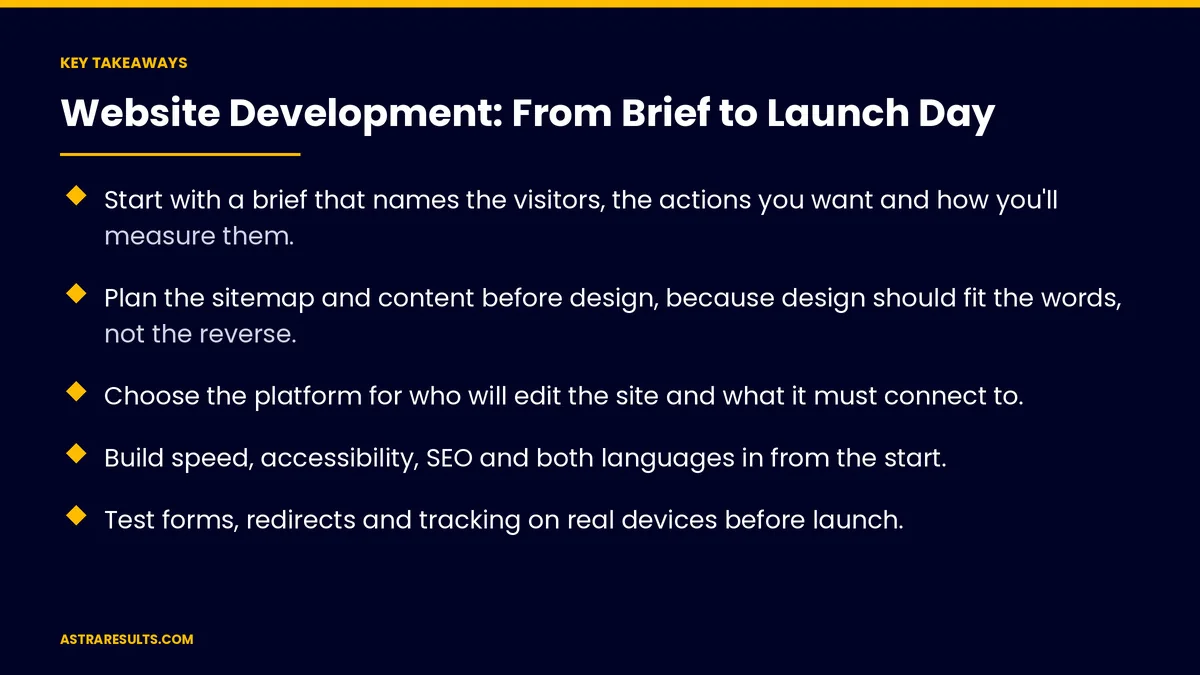
Key Takeaways
- Start with a brief that names the visitors, the actions you want and how you'll measure them.
- Plan the sitemap and content before design, because design should fit the words, not the reverse.
- Choose the platform for who will edit the site and what it must connect to.
- Build speed, accessibility, SEO and both languages in from the start.
- Test forms, redirects and tracking on real devices before launch.
- Launch is the start: watch the numbers for the first weeks and fix what they show.
Published: October 21, 2026 | Reading Time: ~11 minutes | Category: Website Development
This guide walks through website development from the first brief to launch day and the weeks after it. It covers goals and audience, the sitemap, content, design, building, SEO, speed, accessibility and testing. Put plainly: decide what each page must do before anyone designs it.
In This Playbook
- Start with the brief
- Plan the sitemap
- Write the content first
- Design for the actions
- Choose the platform
- Build it right from the start
- What should we test before a website launch?
- Launch day and after
- What to measure
- The first three months
Start with the brief
Who visits. The two or three types of people the site is for: new customers, returning clients, job seekers, partners. Write what each one needs to find.
What you want them to do. Call, book, request a quote, buy, apply. One main action per type of visitor.
How you'll measure it. Calls, form submissions, bookings or sales from the site, tracked from day one. The method is in attribution across every channel.
What must connect. Booking tools, CRM, payments, chat, forms. List them now, because they shape the build.
Who decides. One person who approves each stage. Committees slow projects and blur pages.
Languages. In Miami, decide early whether the site runs in English and Spanish, and how. It affects the structure, not just the text, for the reasons in what changes when Spanish is a channel.
Plan the sitemap
List every page and its job. Home, services, locations, about, contact, and any landing pages for ads. Each page gets one sentence describing what it must achieve.
One page per service. People search for specific services. A page for each one does better in search and converts better than one long services page.
Location pages if you serve several areas. Each with real local detail, not the same text with a city name swapped in.
Keep it shallow. Important pages should be one or two clicks from the home page.
Plan for redesigns. If you're replacing a site, list every existing page and where it will go. Old pages need redirects to new ones, or you lose search traffic.
Write the content first
Content drives design. A designer can only lay out words that exist. Placeholder text hides problems until it's too late.
Write for the visitor's question. What is it, who is it for, what does it cost, how do I start? Answer those plainly on each service page.
Short paragraphs, clear headings. Most visitors scan. Make the page easy to skim on a phone.
Proof near the action. Reviews, licenses, results and photos close to the call or form, not buried on another page.
One owner for content. A named person gathers it, approves it and keeps it current after launch.
Design for the actions
Phones first. Most visitors arrive on a phone. Design the mobile page first, then the desktop.
The main action is always visible. A clear call button or form on every page, without hunting for it.
Consistent and simple. Fewer fonts, fewer colors and a clear layout make pages faster and easier to use. The principles are covered in websites that sell.
Real photos where possible. Your team, your work and your location build more trust than stock images.
Test the design with people. Show a few real customers the key pages before building them all.
Choose the platform
Who will edit it. If your team will update pages often, choose a platform they can use without a developer.
What it must connect to. Booking, CRM, payments and other tools. The connections are covered in API integration.
What it must do. A simple marketing site, a store, a member area or a custom tool each point to different platforms.
Who owns it. The site, the hosting, the domain and the accounts should be registered to your business.
Don't over-build. Most business sites don't need a custom platform. Choose the simplest one that does the job well.
Build it right from the start
Speed. Compressed images, light code and good hosting. Slow pages lose visitors and rank lower.
Accessibility. Readable text, enough contrast, keyboard use, alt text on images and labels on form fields. It helps every visitor and reduces legal risk.
SEO basics. A clear title and description for every page, one main heading, clean web addresses, a sitemap file and structured data where it fits. The wider strategy is in SEO for growth companies.
Both languages properly. Separate, linked pages for English and Spanish, with the right language tags, not an automatic translation widget.
Forms that reach someone. Every form goes to a named person or system, with a confirmation to the visitor. A lead that arrives fast and is answered fast is the point, as in speed to lead.
Tracking. Calls, forms, bookings and purchases measured from launch day.
What should we test before a website launch?
Every form. Submit each one and confirm it reaches the right inbox or system.
Every redirect. Old addresses lead to the right new pages.
Real devices. iPhones, Android phones, tablets and computers, in different browsers.
Speed and accessibility checks. Run them on key pages and fix the worst problems.
Content review. Phone numbers, addresses, hours, prices and spelling, checked by the content owner.
Tracking. Test conversions fire correctly before real traffic arrives.
Launch day and after
Launch at a quiet time. Early in the week, not before a holiday or a big campaign.
Check search tools. Submit the sitemap and watch for crawl errors.
Update your listings. Your Google Business Profile and directories should point to the right pages, as covered in Google Business Profile for Miami practices.
Watch the first weeks closely. Traffic, rankings, calls, forms and errors. Fix broken links and missed redirects fast.
Plan the upkeep. Updates, security, backups and content changes continue after launch. A site that isn't maintained slowly breaks.
What to measure
Leads from the site. Calls, forms and bookings per month, by page and source.
Conversion rate. The share of visitors who take the main action.
Speed. Page load times on mobile for key pages.
Search visibility. Rankings and organic traffic for your main services and locations.
Errors. Broken links, failed forms and pages missing from search.
The first three months
Days 1–30: brief, sitemap and content
Write the brief with visitors, actions and measures. Plan the sitemap with one sentence per page. Gather and write the content, in English and Spanish if needed. List every integration and every old page that needs a redirect.
Days 31–60: design and build
Design the key pages for phones first and test them with real customers. Build on the chosen platform with speed, accessibility, SEO basics and tracking included. Connect forms and tools to the right people and systems.
Days 61–90: test, launch and learn
Test every form, redirect and device. Launch at a quiet time, submit the sitemap and update your listings. Watch leads, conversion, speed and errors for the first weeks, and fix what the numbers show.
How Astra builds websites
Astra Results Marketing starts every website with a brief that names the visitors, the actions and how they'll be measured. Content and the sitemap come before design, and every page has a written job.
We design for phones first, choose the simplest platform your team can run, and build in speed, accessibility, SEO, both languages and tracking from the start. Everything is tested before launch and watched closely after it, with the site and accounts registered to your business. Engagements begin with a brief workshop through our website development team.
Related reading
Frequently asked questions
What should a website brief include?
The types of visitors, the main action you want each to take, how you'll measure it, the tools the site must connect to, the languages it needs, and the one person who approves each stage.
Why write content before design?
Because design should fit the words. Placeholder text hides problems with length, structure and missing information until the build, when fixing them costs more. Real content lets the designer plan each page around what it must say.
Which platform should we use?
The simplest one your team can edit without a developer that connects to your tools and does what the site needs. Most business sites don't need a custom platform. Keep the site, hosting, domain and accounts in your business's name.
What happens to SEO when we replace our website?
You keep it if every old page redirects to the right new page, titles and content carry over, and the new site is fast and well structured. Missing redirects are the most common cause of lost traffic after a relaunch.
How should a bilingual site be built?
With separate, linked English and Spanish pages, the right language tags and content written for each audience, not an automatic translation widget. Plan it in the sitemap, because it affects structure as well as text.
What should we do after launch?
Submit the sitemap, update your Google Business Profile and listings, and watch traffic, rankings, leads and errors closely for the first weeks. Then plan ongoing updates, security, backups and content changes.
Ready to build a website that works from day one? Astra Results Marketing starts with a brief that names your visitors and actions, writes content before design, and builds a fast, accessible, bilingual site with SEO and tracking in place and every account in your business's name. ▸ CALL (786) 321-2866 · ▸ REQUEST YOUR CONSULTATION





