 Rated 5 star on

Yield Management: Filling Fixed Capacity at the Best Price
Quick answer
Yield management fills fixed, expiring capacity such as parking, seats, tours and appointments for the most revenue. Forecast demand by hour, day, season and local events. Use a few clear price tiers with booking limits. Deposits, reminders and waitlists recover no-shows. Decide early what happens to unsold slots, and measure revenue per available slot.
A parking garage has the same spaces at 7 a.m. and during a stadium game. A charter boat has the same seats on a rainy Tuesday as on a holiday weekend. When capacity is fixed and expires, each empty slot is revenue lost for good. Yield management is how you fill it well.
Key Takeaways
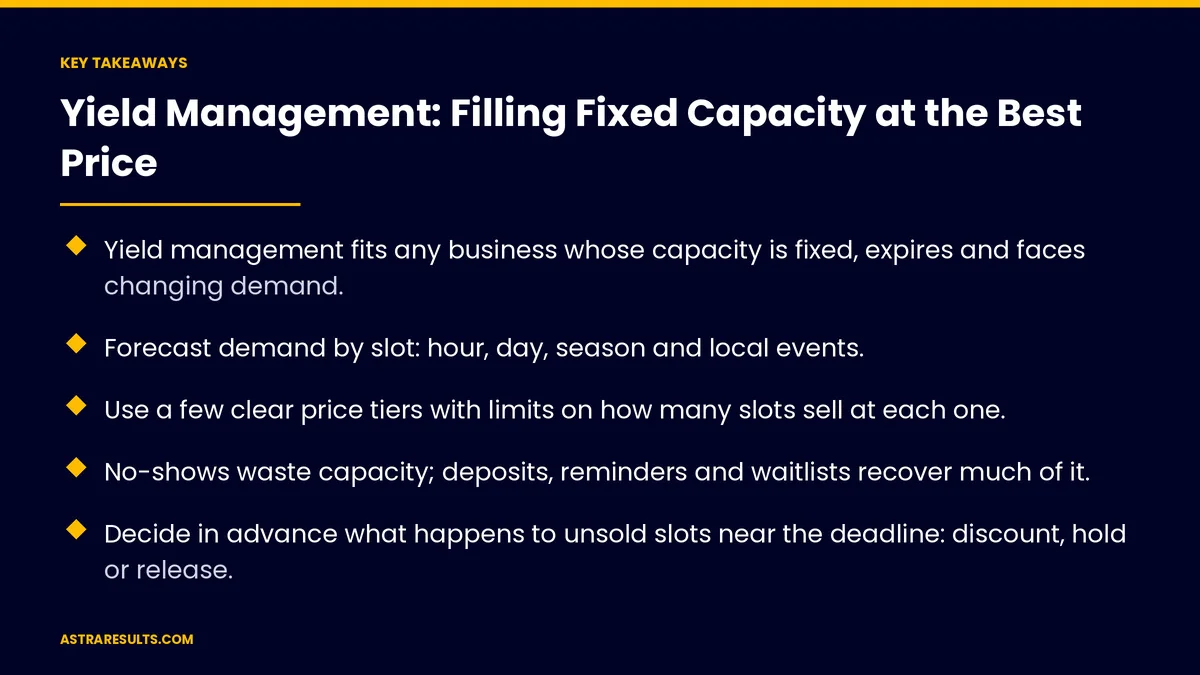
- Yield management fits any business whose capacity is fixed, expires and faces changing demand.
- Forecast demand by slot: hour, day, season and local events.
- Use a few clear price tiers with limits on how many slots sell at each one.
- No-shows waste capacity; deposits, reminders and waitlists recover much of it.
- Decide in advance what happens to unsold slots near the deadline: discount, hold or release.
- Measure revenue per available slot, not just how full you are.
Published: October 7, 2026 | Reading Time: ~10 minutes | Category: Yield Management
This guide explains yield management for businesses that sell fixed time slots and spaces: parking, venues, tours and charters, classes, coworking, marinas and appointments. It covers forecasting by slot, price tiers, booking limits, no-shows and last-minute decisions. Put plainly: sell every slot before it expires, to the customer who values it most, without turning away the regulars.
Ticket and lodging prices must be shown with mandatory fees upfront, and some industries limit how prices can change. Confirm your approach with counsel.
In This Playbook
- What yield management means
- Who it's for
- Forecast demand by slot
- Price tiers and booking limits
- No-shows and cancellations
- Last-minute decisions
- Keep customers' trust
- How do we measure yield management results?
- The first three months
What yield management means
Getting the most from fixed capacity. Spaces, seats, slots and berths that can't be stored and sold later.
Price and availability together. It decides how much to charge for each slot and how many slots to sell at each price.
Close cousin of revenue management. Hotels usually call it revenue management, as covered in revenue management. The same ideas apply to any business that sells time and space.
Not just price changes. Booking limits, deposits, waitlists and release rules often matter more than the price itself.
Who it's for
Parking. Rates by hour, day and event, with spaces held for monthly customers.
Venues and events. Seats priced by section and timing, filled before showtime.
Tours and charters. Every departure has a fixed number of seats.
Classes and studios. Fitness classes, workshops and courses with set capacity, like the bookings in fitness studio intake.
Coworking and meeting rooms. Desks and rooms sold by the hour or day.
Marinas, golf and courts. Slips, tee times and court bookings.
Appointments. Clinics, salons and services with fixed slots. In healthcare, yield means better scheduling, deposits and reminders, not raising prices.
Forecast demand by slot
Use your booking history. Which hours, days and seasons fill first, and which stay empty.
Track booking pace. How fast slots for future dates are filling, compared with past periods.
Mark the calendar. Games, concerts, conventions, holidays and school breaks. In South Florida, weather and season shift demand too.
Know who books when. Regulars, members, tourists and last-minute buyers book on different timelines.
Improve with data. Clean booking records feed better forecasts, as explained in data pipelines explained. Machine learning can sharpen them further, as covered in machine learning for operators.
Price tiers and booking limits
A few clear tiers. For example, early, standard and peak. Too many tiers confuse customers.
Limits on each tier. Only a set number of slots sell at the early price. When they're gone, the next tier opens.
Protect your best slots. Hold some peak-time capacity for customers who will pay more or book later.
Reward flexibility. Lower prices for off-peak times move demand to quieter slots.
Members and regulars. Reserve capacity or keep set rates for loyal customers, so yield doesn't drive them away.
Show the full price. For live-event tickets, the FTC's fee rule requires the total price, including mandatory fees, upfront.
No-shows and cancellations
No-shows waste capacity twice. The slot sits empty, and someone else couldn't book it.
Deposits and cancellation windows. A small deposit or clear cancellation policy reduces no-shows.
Reminders. Messages before the booking with an easy way to cancel or reschedule free up slots in time to resell. Text and WhatsApp reminders are covered in voice, chat, SMS and WhatsApp.
Waitlists. When someone cancels, the next person is offered the slot automatically, as with the waitlists in restaurant engagement.
Overbook only with care. If no-shows are predictable, selling slightly more than capacity can make sense, with a plan for when everyone shows up.
Last-minute decisions
Set rules in advance. Decide what happens to unsold slots at set points before the deadline.
Discount. Lower the price to fill the slot, if a discount won't teach customers to wait.
Hold. Keep the price if late buyers usually pay full rate.
Release. Return held capacity to general sale when the group or member demand doesn't appear.
Don't train customers to wait. Regular last-minute discounts teach people to book late. Use them sparingly and through the right channels.
Keep customers' trust
Explain the tiers. Customers accept higher prices for peak times when the logic is clear.
No surprise fees. Show the total price upfront.
Look after regulars. Members and repeat customers should feel rewarded, not punished.
Know the limits. Price-gouging laws restrict increases during declared emergencies in Florida and other states. Some industries, like healthcare, limit price changes entirely.
How do we measure yield management results?
Revenue per available slot. Total revenue divided by all slots offered, sold or not. It combines fill rate and price.
Fill rate by slot. Which hours and days fill, and which don't.
Average price by tier. Whether tiers and limits are working.
No-show rate. Before and after deposits and reminders.
Late resale. Canceled slots that were resold in time.
Regular customer retention. Whether loyal customers stay as pricing changes.
The first three months
Days 1–30: map capacity and demand
List every slot, space or seat you sell, and record a year of bookings by time and date. Measure fill rate, no-shows and revenue per available slot. Build an events calendar.
Days 31–60: tiers, limits and no-show rules
Set a few price tiers with booking limits and protected peak capacity. Add deposits or cancellation windows, reminders and a waitlist. Reserve capacity or rates for members and regulars.
Days 61–90: last-minute rules and review
Write rules for discounting, holding or releasing unsold slots. Track revenue per available slot, no-shows and regular customer retention, and adjust tiers and limits from the results.
Where Astra fits in
Astra Results Marketing helps businesses with fixed capacity fill every slot well. We forecast demand by slot from your own bookings and local events, set clear price tiers with booking limits, and protect capacity for regulars and peak demand.
We reduce no-shows with deposits, reminders and waitlists, set last-minute rules in advance and measure revenue per available slot. Engagements begin with a capacity review through our yield management team.
Related reading
Frequently asked questions
What is yield management?
A way of selling fixed capacity that expires, such as parking spaces, seats, slots or berths, to get the most revenue from it. It combines price tiers, booking limits, no-show rules and last-minute decisions based on forecast demand.
How is yield management different from revenue management?
They use the same ideas. Revenue management is the usual term in hotels and hospitality; yield management is often used for time slots and spaces in parking, venues, tours, classes and appointments.
Which businesses use yield management?
Parking operators, venues and event organizers, tour and charter companies, fitness studios, coworking spaces, marinas, golf courses and appointment-based services.
How do booking limits work?
You set a number of slots for each price tier. When the lower-priced slots sell out, the next tier opens. This fills capacity early while saving some for customers who book later or pay more.
How can we reduce no-shows?
Use deposits or clear cancellation windows, send reminders with an easy way to cancel or reschedule, and offer freed slots to a waitlist automatically.
Can we raise prices whenever demand rises?
Not always. Price-gouging laws limit increases during declared emergencies in Florida and other states, some industries restrict price changes, and live-event tickets must show total prices upfront. Confirm your approach with counsel.
Ready to fill every slot before it expires? Astra Results Marketing forecasts demand by slot, sets clear price tiers and booking limits, cuts no-shows with deposits, reminders and waitlists, and measures revenue per available slot while keeping your regulars loyal. ▸ CALL (786) 321-2866 · ▸ REQUEST YOUR CONSULTATION





