 Rated 5 star on

Revenue Management: Right Price, Right Customer, Right Time
Quick answer
Revenue management prices and sells capacity that expires, such as rooms, rental nights and tables. It runs on a cycle of forecasting demand, setting rates, controlling availability and measuring results. Prices go down as well as up. Measure net revenue after channel costs. Hotels and short-term rentals must show total prices, including mandatory fees, upfront.
A hotel room left empty tonight earns nothing, ever. The same is true of a rental night, a restaurant table at 8 p.m. or a seat at an event. When what you sell expires and demand rises and falls, the price you charge and who you sell to decide your revenue. Revenue management is the discipline of getting both right.
Key Takeaways
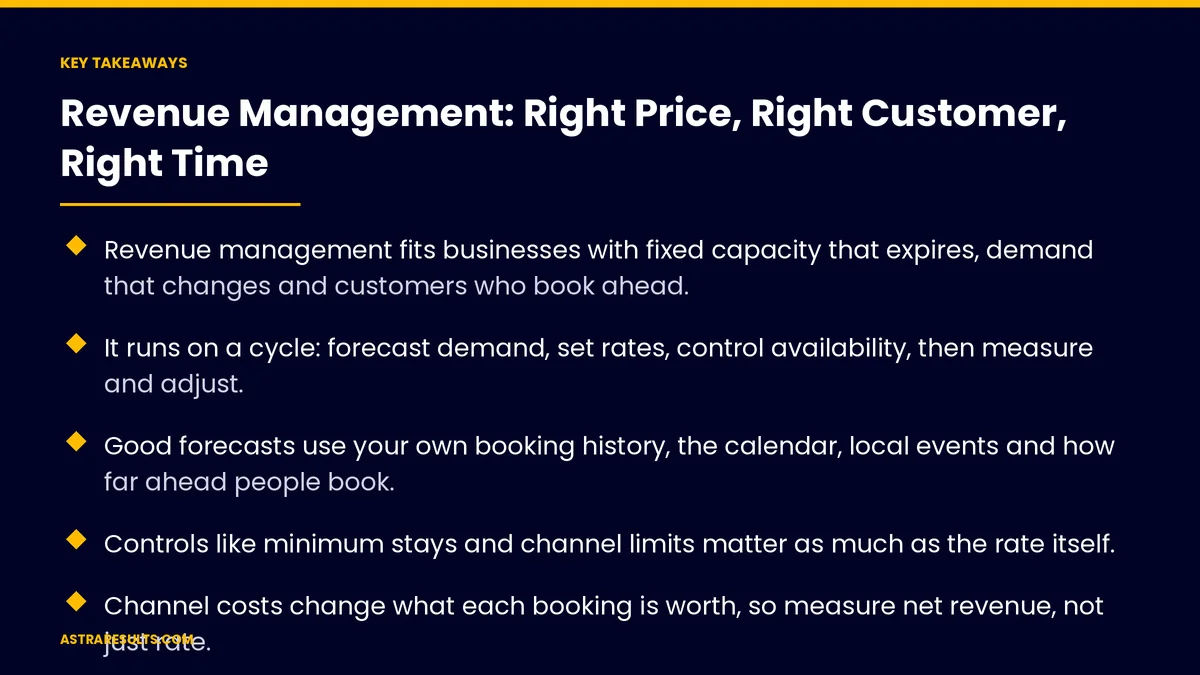
- Revenue management fits businesses with fixed capacity that expires, demand that changes and customers who book ahead.
- It runs on a cycle: forecast demand, set rates, control availability, then measure and adjust.
- Good forecasts use your own booking history, the calendar, local events and how far ahead people book.
- Controls like minimum stays and channel limits matter as much as the rate itself.
- Channel costs change what each booking is worth, so measure net revenue, not just rate.
- Total prices, including mandatory fees, must be shown upfront for hotels and short-term rentals.
Published: October 7, 2026 | Reading Time: ~11 minutes | Category: Revenue Management
This guide explains what revenue management is, which businesses it fits, and how it works: forecasting demand, setting rates, controlling what you sell and through which channels, and measuring the results. Put plainly: sell each unit to the right customer, at the right price, at the right time, through the right channel.
Pricing and fee disclosure are regulated. Hotels and rentals must show total prices, including mandatory fees, upfront. Confirm your pricing practices with counsel.
In This Playbook
- What revenue management is
- Which businesses it fits
- Forecast demand
- Set rates
- Control what you sell
- Manage channels
- Price clearly
- Measure the results
- The first three months
What revenue management is
A way of pricing and selling perishable capacity. Rooms, rental nights, tables, seats and appointments that are lost if not sold in time.
Born in airlines. Airlines developed it in the 1980s to sell the same seats at different prices to different travelers. Hotels and many other businesses adopted it.
More than raising prices. It's about matching price and availability to demand: charging more when demand is high, filling gaps when it's low, and saving capacity for the most valuable bookings.
A repeating cycle. Forecast, price, control, measure, adjust. Every day or week, not once a year.
Which businesses it fits
Fixed capacity. You can't add rooms, tables or seats overnight.
Perishable inventory. Unsold capacity can't be stored for later.
Changing demand. Weekends, seasons, holidays and events move demand up and down.
Different customer groups. Leisure, business, groups and locals book differently and value different things.
Advance bookings. Customers commit ahead, so you can see demand building.
Common fits. Hotels, short-term rentals, restaurants with reservations, event venues, car rentals and tours. Businesses that sell fixed time slots, like parking or appointments, use the same ideas, often called yield management.
Forecast demand
Start with your history. Past bookings by date, day of week, season, room type and channel.
Watch the booking pace. How fast reservations are arriving for future dates, compared with the same point last year.
Add the calendar. Holidays, school breaks, conventions, festivals and sports events. In Miami, major events reshape demand for whole weeks.
Know your lead times. How far ahead each customer group usually books.
Use better tools as you grow. Machine learning can improve forecasts by learning from many factors at once, as explained in machine learning for operators. Clean, connected data comes first, as covered in data pipelines explained.
Set rates
Rates follow demand. Higher when demand is strong, lower when you need to fill gaps, always within limits you set.
Floors and ceilings. A lowest price you won't go below and a highest price that keeps your reputation intact.
Different rates for different needs. Flexible rates, advance-purchase rates and package rates suit different guests.
Watch the market. Know what comparable properties charge, but set prices from your own demand and costs.
Use your own data. Pricing tools that pool competitors' private data have drawn legal scrutiny. Base decisions on your own information and public market rates.
Control what you sell
Availability by rate. Close lower rates when demand is strong; open them when you need bookings.
Length-of-stay rules. Minimum stays on peak nights protect against one-night gaps around high-demand dates.
Overbooking, carefully. Selling a few more units than you have can offset expected cancellations, but only with a plan for guests you can't accommodate.
Group and block limits. Decide how much capacity groups can take on dates when individual guests would pay more.
Cancellation policies. Stricter on peak dates, more flexible when you need to win bookings.
Manage channels
Every channel has a cost. Booking sites charge commission; your own site has marketing costs; direct calls cost staff time.
Net revenue matters. A booking at a lower rate through your own site can be worth more than a higher rate through a booking site.
Grow direct bookings. Win searches for your own name and give guests a reason to book direct, as covered in hotel direct bookings.
Answer fast. Guests asking about availability book elsewhere if they wait, as covered in hotel intake.
Keep rates in sync. Rates and availability should update across every channel at once.
Price clearly
Show the total price. Since May 2025, the FTC's rule on unfair or deceptive fees requires hotels, short-term rentals and the platforms that sell them to show the total price, including mandatory fees, upfront (FTC guidance).
What can be left out. Government taxes and fees, and optional extras, may be excluded from the headline total, but must be disclosed before payment.
Match the experience. Prices, photos and descriptions should match what guests get, as covered in hotel creative that matches the room.
Trust is revenue. Guests who feel tricked by fees leave reviews that cost more than the fee earned.
Measure the results
RevPAR. Revenue per available room: rooms revenue divided by rooms available. It combines occupancy and average rate in one number.
ADR and occupancy. Average daily rate and the share of rooms sold, read together.
Net revenue per booking. After commissions and channel costs.
Pace against last year. Bookings on the books for future dates compared with the same point last year.
For restaurants. Revenue per available seat hour shows how well tables and time are used.
Forecast accuracy. How close forecasts came to actual demand, so the process improves.
The first three months
Days 1–30: data and baseline
Gather at least a year of booking history by date, channel and customer group. Record current RevPAR, ADR, occupancy and net revenue by channel. Build an events calendar. Check that every price shown includes mandatory fees.
Days 31–60: forecast and rules
Build a demand forecast by date from history, pace and events. Set rate floors and ceilings, length-of-stay rules for peak dates and group limits. Start reviewing rates and availability weekly.
Days 61–90: control and improve
Open and close rates by demand, shift effort toward direct bookings, and compare forecasts with actual results. Track RevPAR, net revenue and pace against the baseline, and refine the rules.
How Astra approaches revenue management
Astra Results Marketing helps hotels, rentals and restaurants manage revenue with their own data. We build demand forecasts from your booking history, pace and local events, set rate floors, ceilings and stay rules, and manage availability across channels with net revenue in mind.
Prices are shown in full, including mandatory fees, and results are measured in RevPAR, net revenue and forecast accuracy. Engagements begin with a revenue review through our revenue management team.
Related reading
Frequently asked questions
What is revenue management?
A way of pricing and selling capacity that expires, such as rooms, rental nights, tables or seats. It forecasts demand, sets rates, controls availability and channels, and measures results, so each unit is sold to the right customer at the right price and time.
Which businesses benefit from revenue management?
Businesses with fixed capacity that expires, demand that changes, different customer groups and advance bookings: hotels, short-term rentals, restaurants with reservations, venues, car rentals and tours.
Is revenue management just raising prices?
No. It also means filling gaps when demand is low, saving capacity for the most valuable bookings, setting stay rules and choosing channels by net revenue. Prices go down as well as up.
What is RevPAR?
Revenue per available room: rooms revenue divided by rooms available. It combines occupancy and average daily rate into one number that shows how well a hotel turns its capacity into revenue.
Do hotels have to show resort fees upfront?
Under the FTC's rule on unfair or deceptive fees, in effect since May 2025, hotels and short-term rentals must show the total price including mandatory fees upfront. Government taxes and optional extras can be excluded from that total but must be disclosed before payment.
Can we use competitors' data to set prices?
Base pricing on your own data and publicly available market rates. Tools that pool competitors' private pricing data have drawn antitrust scrutiny, so check with counsel before using any shared-data pricing service.
Ready to sell each room, night or table at the right price? Astra Results Marketing builds demand forecasts from your own data, sets rates, stay rules and channel limits, shows prices in full and measures results in RevPAR and net revenue. ▸ CALL (786) 321-2866 · ▸ REQUEST YOUR CONSULTATION





