Rated 5 star on

Swift: Native iOS Done Properly
Quick answer
Native iOS is justified when the Apple ecosystem is part of the value, when interface quality is the product, or when the app has to still run well in eight years. Wallet, Watch, widgets and Handoff are features customers genuinely use. Build native when the platform is the point, not because native sounds more serious.
Most business apps do not need to be native. That is the honest starting point, and it is why the cross-platform argument wins. But a category exists where native iOS is not an indulgence: apps where the Apple ecosystem is the value, where the interface is the product, or that will still run in eight years.
Key Takeaways
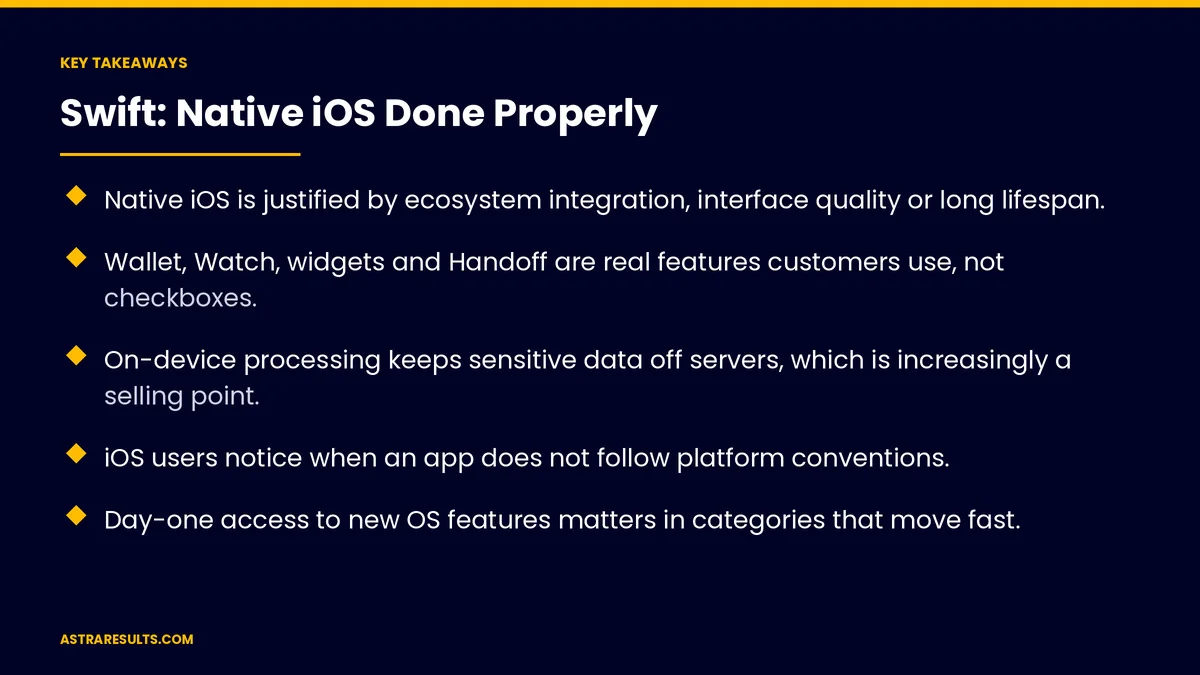
- Native iOS is justified by ecosystem integration, interface quality or long lifespan.
- Wallet, Watch, widgets and Handoff are real features customers use, not checkboxes.
- On-device processing keeps sensitive data off servers, which is increasingly a selling point.
- iOS users notice when an app does not follow platform conventions.
- Day-one access to new OS features matters in categories that move fast.
- Native costs more to build and often less to maintain over a long life.
Published: September 24, 2026 | Reading Time: ~13 minutes | Category: Swift
This guide is about that category. What Swift and the Apple platform give you that a framework cannot, which ecosystem features are worth building for, why iOS users have different expectations, and what it costs to do properly over time. The takeaway that matters: build native when the platform is the point, not because native sounds better.
Guidance for owners and operators. Nothing here is legal or technical advice. App Store policies, privacy disclosure requirements and platform rules change and must be verified before relying on them.
In This Playbook
- When native iOS is the right call
- What the ecosystem offers
- On-device processing and the privacy argument
- Platform conventions, and why iOS users notice
- App Store: review, privacy and the rules
- Cost and timeline
- Swift and the modern toolchain
- When to build iOS first
- The first three months
When native iOS is the right call
- The ecosystem is the value. The app is better because it works with Wallet, Watch, widgets, Siri, CarPlay or Handoff, and those integrations are the reason customers choose it.
- The interface is the product. Apps where the quality of interaction is what people are paying for, and the last ten percent of polish is not cosmetic.
- Performance is at the edge. Continuous camera work, on-device machine learning, real-time graphics, or very large data sets rendered smoothly.
- The app will live a long time. Eight or ten years of maintenance favors the platform's own tools over a framework whose migrations accumulate, the mechanics of which are in the upgrade tax.
- The audience is iOS-heavy. Some customer bases are overwhelmingly on iPhone, and the Android build would serve a small minority.
- When it is not the right call. A straightforward information-and-input app needed on both platforms, which is most business apps, as covered in the cross-platform decision.
What the ecosystem offers
These are the features that justify the choice, and they are not equally useful.
- Wallet. Passes, tickets, loyalty cards and keys that live where customers already look. For events, hospitality, transport and membership businesses, this alone can justify native.
- Apple Pay. Lower friction at checkout than any form, with the conversion difference that implies.
- Watch. Useful for glanceable information and quick actions — a delivery driver's next stop, a gym check-in, an alert that needs acknowledging. Not useful for anything that requires reading.
- Widgets and Live Activities. Information on the home or lock screen without opening the app, which is where time-sensitive services belong.
- Siri and Shortcuts. Voice and automation entry points for repeated actions.
- Handoff and Continuity. Starting on one device and continuing on another, which matters for anything with a desktop counterpart.
- The practical filter. Build for the two or three that the customer would use, and skip the rest rather than collecting integrations.
On-device processing and the privacy argument
An advantage that has become commercially relevant.
- What it means. Machine learning that runs on the phone rather than sending data to a server: image analysis, text recognition, classification, and increasingly language processing.
- Why it matters commercially. Sensitive data never leaves the device, which is a real answer to a customer's privacy question rather than a policy paragraph, the mechanics of which are in confidentiality decisions.
- Where it fits. Document scanning, identity verification, health and fitness data, anything a customer would hesitate to upload.
- The practical benefits. Works offline, no per-request cost, no latency.
- The trade-off. On-device models are smaller and less capable than server models, and older devices are slower. The architecture often ends up hybrid: on-device where privacy or latency matters, server where capability does.
Platform conventions, and why iOS users notice
- The expectation. iPhone users have used consistent patterns for years. Navigation, gestures, typography and spacing that deviate feel wrong before anyone can say why.
- Where apps give themselves away. Back navigation that does not behave like the platform's, non-standard controls, incorrect typography, and animation that does not match the system's timing.
- Why it matters commercially. In consumer categories, an app that feels foreign is downloaded, judged and deleted. In business categories the tolerance is higher, but the impression still forms.
- Accessibility. The platform's accessibility tooling is strong and expected to be supported. Beyond the legal dimension, it affects a meaningful share of users.
- Dark mode and dynamic type. Not optional in 2026. An app that ignores the user's display settings reads as unmaintained.
App Store: review, privacy and the rules
- Review. Usually fast, occasionally not, and stricter than the alternative store on several dimensions. Rejections near a launch date are a planning risk. The current requirements are set out in Apple's own review guidelines and should be checked directly (App Store Review Guidelines).
- Privacy disclosures. Detailed declarations of what data is collected, how it is used and whether it is linked to the user, shown on the listing. They must be accurate, and inaccuracy is a compliance problem rather than a marketing one.
- Tracking permission. Cross-app tracking requires explicit user permission, and most users decline. Any measurement plan built on it should assume that.
- Account deletion. Apps with account creation must offer in-app deletion.
- Payments. Digital goods and subscriptions have specific rules about payment handling. Physical goods and services generally do not, and confusing the two causes rejections.
- The practical rule. Requirements change; verify current policy before building anything that depends on it.
Cost and timeline
- Higher build cost than cross-platform for the same app on two platforms, because it is one of two builds.
- Lower build cost than cross-platform if only iOS is needed, since the framework overhead buys nothing.
- Smaller talent pool than the web-adjacent frameworks, which affects hiring and rates, set out in the hiring advantage.
- Lower long-term maintenance in many cases: no framework migrations, first-party tooling, and platform updates that are usually additive.
- The comparison to run. Build plus five years of maintenance, on the realistic assumption that a successful app lives at least that long.
Swift and the modern toolchain
- Swift itself. Apple's language, now mature, designed for safety in ways that prevent whole categories of crashes.
- The interface layer. The modern declarative approach builds interfaces faster than the older framework and is where the platform is heading, though some complex cases still reach for the older tooling. A competent team uses both where appropriate rather than treating it as a religious question.
- What this means for a business owner. The distinction matters less than whether the team is current. An app built on patterns from a decade ago is harder to maintain regardless of language.
- The migration question. An existing older iOS app can be modernized incrementally rather than rewritten, which is the right call.
When to build iOS first
- The audience skews iPhone. Check the actual analytics rather than assuming.
- The budget allows one platform now. Building one well beats building two badly.
- The ecosystem features are central. Wallet, Watch or Apple Pay being the reason the app exists.
- The revenue is there. In many categories iOS users spend more per head, which affects which platform to prove the concept on.
- The counter-case. A field workforce on company Android devices, or a market where Android dominates. Follow the users, not the convention, according to workforce versus customer apps.
The first three months
Days 1–30: justify and scope
The reason for native written down — ecosystem, interface, performance or lifespan — and tested against the cross-platform alternative. The two or three ecosystem features that customers would use, selected. Privacy disclosures drafted from the actual data collection. Supported iOS versions and devices agreed.
Days 31–60: build to convention
The core app built following platform patterns, with dark mode, dynamic type and accessibility from the start rather than retrofitted. On-device processing where privacy or latency justifies it. Real devices across the supported range in testing.
Days 61–90: submit and prepare for life
Store submission with time budgeted for rejection. Crash and performance monitoring. The maintenance plan, named owner and OS-release cadence agreed, on the assumption of annual platform updates.
How Astra builds native iOS
Astra Results Marketing requires a reason for native before recommending it, and says so when cross-platform is the better answer for the budget. When native fits, the build follows platform conventions rather than porting another platform's patterns, supports dark mode, dynamic type and accessibility from the first week, and selects only the ecosystem features customers would use.
Privacy disclosures are drafted from the real data collection rather than aspirationally, and the estimate compares build plus five years of maintenance. Engagements begin with a platform and ecosystem assessment through our UI/UX development and design team.
Related reading
Frequently asked questions
When is native iOS worth the extra cost?
When the Apple ecosystem is the value — Wallet, Watch, widgets, Siri, CarPlay or Handoff being why customers choose the app; when the interface quality is the product and polish is not cosmetic; when performance is at the edge with continuous camera work, on-device machine learning or real-time graphics; when the app will live eight to ten years; or when the audience is overwhelmingly on iPhone.
Which ecosystem features matter?
Wallet, for events, hospitality, transport and membership businesses, can justify native on its own. Apple Pay reduces checkout friction measurably. Watch is useful for glanceable information and quick actions, not for anything requiring reading. Widgets and Live Activities suit time-sensitive services. The filter is building the two or three customers would use and skipping the rest rather than collecting integrations.
What is the privacy advantage of on-device processing?
Machine learning that runs on the phone — image analysis, text recognition, classification, increasingly language processing — means sensitive data never leaves the device, which is a real answer to a customer's privacy question rather than a policy paragraph. It also works offline with no per-request cost or latency. The trade-off is that on-device models are smaller and less capable, so architectures end up hybrid.
Why do platform conventions matter so much on iOS?
Because iPhone users have used consistent patterns for years and notice deviation before they can articulate it: back navigation that behaves wrongly, non-standard controls, incorrect typography, animation that misses the system's timing. In consumer categories a foreign-feeling app is downloaded, judged and deleted. Dark mode and dynamic type are not optional — ignoring display settings reads as unmaintained.
What App Store requirements should a business know about?
Review is fast but stricter than the alternative store, so rejections near a launch date are a planning risk. Privacy disclosures must accurately describe what is collected and how. Cross-app tracking requires permission most users decline, so measurement plans should assume that. Apps with account creation must offer in-app deletion. Digital goods and subscriptions have specific payment rules that physical goods and services generally do not.
Does native cost more than cross-platform?
More to build if both platforms are needed, since it is one of two builds; less if only iOS is needed, because framework overhead buys nothing. The talent pool is smaller, which affects hiring and rates. Long-term maintenance is lower — no framework migrations, first-party tooling, and platform updates that are usually additive. The comparison to run is build plus five years of maintenance.
READY TO FIND OUT WHETHER NATIVE IS JUSTIFIED? Astra Results Marketing requires a reason for native before recommending it, selects only the ecosystem features your customers would use, and compares build plus five years of maintenance. Astra Results Marketing · 1101 Brickell Ave, Miami, FL 33131 · +1 (786) 321-2866 · [email protected] Find us on Google · Yelp ▸ CALL (786) 321-2866 · ▸ REQUEST YOUR CONSULTATION