 Rated 5 star on

Android Apps for Latin American Markets
Quick answer
Android usually comes first in Latin America, where about four in five mobile phones in South America run Android. Test on older versions and on low or mid-range phones. Keep the app small, light on data and usable offline. Support each country's payment methods, write Spanish and Portuguese per market, and add WhatsApp links for support.
An app tested on the newest phones over fast office Wi-Fi can fail quietly in Bogotá, Lima or São Paulo. Customers there may use older phones, pay for every megabyte, prefer local payments and expect to reach you on WhatsApp. If your customers are in Latin America, the app has to be built for their phones, not yours.
Key Takeaways
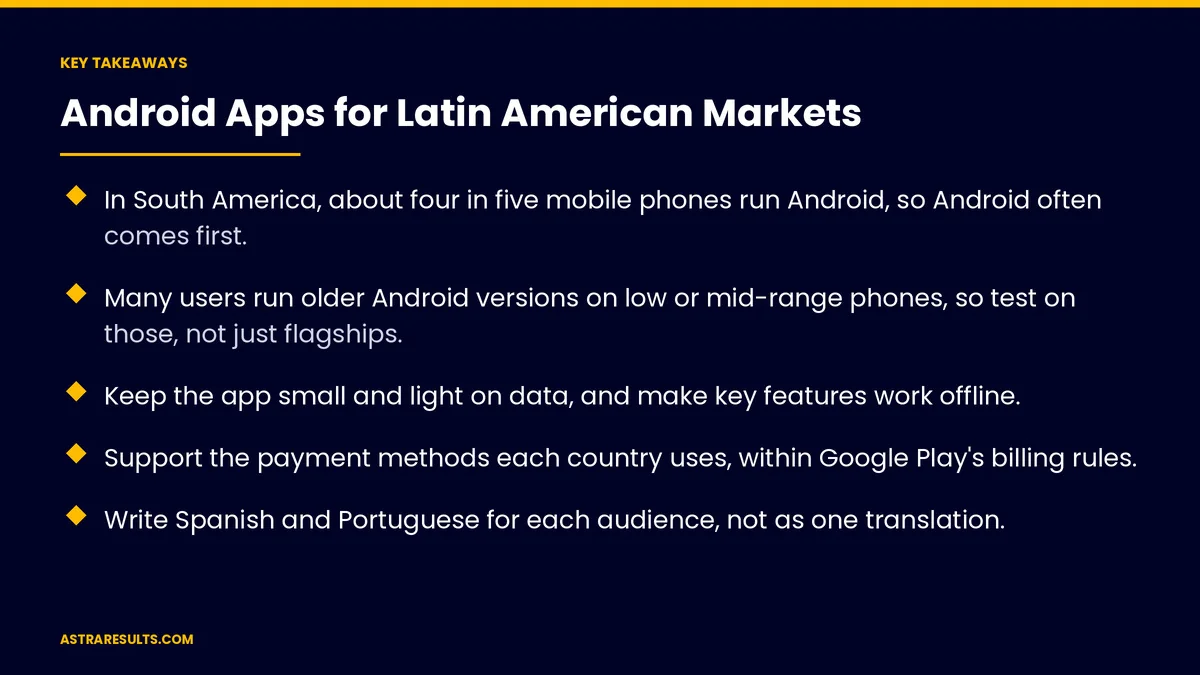
- In South America, about four in five mobile phones run Android, so Android often comes first.
- Many users run older Android versions on low or mid-range phones, so test on those, not just flagships.
- Keep the app small and light on data, and make key features work offline.
- Support the payment methods each country uses, within Google Play's billing rules.
- Write Spanish and Portuguese for each audience, not as one translation.
- Link to WhatsApp for support and sharing, and follow each country's privacy rules.
Published: October 3, 2026 | Reading Time: ~10 minutes | Category: Android App Development
This guide covers how to build Android apps for Latin American markets: device range, data use, payments, language, WhatsApp, privacy and testing. Put plainly: design for the phone your customer owns and the network they're on.
Payment, privacy and tax rules differ by country. Confirm the rules for each market you serve with local counsel.
In This Playbook
- Why Android comes first
- Build for the whole range of phones
- Keep it light on data
- Payments people use
- Language done right
- WhatsApp is part of the app
- Do privacy laws differ across Latin American markets?
- Launch and keep it working
- Market numbers to track
- The first three months
Why Android comes first
It's the phone most people carry. In South America, Android runs about 81% of mobile phones, according to StatCounter (South America mobile OS share).
iPhone users still matter. For premium products or business buyers, the share on iPhone can be higher. Check your own customer data.
Cross-platform may still fit. If you need both platforms, one cross-platform app can serve both, as weighed in native, cross-platform or web.
Start where your customers are. If most of them are on Android, build and test Android first. The wider Android picture is in Android apps for the workforce and the customer.
Build for the whole range of phones
Older Android versions are common. StatCounter's data shows a large share of South American Android users still on Android 13 or earlier. Support the versions your customers use, not only the latest.
Limited storage. Many phones have little free space. Large apps get skipped or deleted first.
Less memory and slower chips. Screens should load quickly and animations should stay light.
Different screen sizes. Test small and large screens, and both portrait and landscape where it matters.
Test on real devices. Low and mid-range phones from the brands popular in each country, not just the newest models.
Keep it light on data
Data costs money. Many users have prepaid plans and watch every megabyte.
Small app size. Remove unused libraries and compress images. A smaller download gets installed more often.
Load only what's needed. Images sized for the phone, and content loaded as people scroll, not all at once.
Work offline. Let people view key information and fill in forms without a signal, then sync later.
Handle slow networks. Clear messages when the connection drops, and automatic retries instead of errors.
Let users choose. Options to download large files only on Wi-Fi.
Payments people use
Local methods matter. Customers may expect instant bank transfers like Pix in Brazil, PSE in Colombia, cash vouchers like OXXO in Mexico, or wallets like Mercado Pago.
Cards aren't universal. Many customers don't have credit cards, or prefer not to use them online.
Know Google Play's rules. Digital goods and subscriptions sold inside an app often must use Google Play billing. Physical goods and real-world services can usually use other processors. Check the current rules for your case.
Use established processors. Choose payment partners that support the methods each country uses, and never store card data yourself. Connections are covered in API integration.
Show local prices. Prices in the local currency, with taxes and fees clear before checkout.
Language done right
Spanish isn't one language for apps. Words, tone and forms of address vary. Mexico, Colombia, Argentina and Peru each have their own expressions, and some markets use vos.
Portuguese for Brazil. Brazil needs Brazilian Portuguese, written for that audience.
Write, don't just translate. Copy written by native speakers for each market reads better and builds trust. The principles are in what changes when Spanish is a channel.
Local formats. Dates, currencies, phone numbers and addresses formatted the way each country uses them.
Leave room for longer text. Spanish and Portuguese often run longer than English. Design screens so text doesn't get cut off.
WhatsApp is part of the app
People expect it. Across much of Latin America, WhatsApp is how people talk to businesses.
Support links. A button that opens a WhatsApp chat with your support team.
Sharing. Easy sharing of orders, invoices or listings to WhatsApp.
Notifications by consent. Updates sent on WhatsApp only to customers who agreed, following its business rules.
Don't make WhatsApp the only door. Keep in-app help and email for customers who prefer them.
Do privacy laws differ across Latin American markets?
Privacy laws differ. Brazil's LGPD and laws in other countries set rules for collecting and using personal data.
Collect only what you need. Ask for tax IDs, documents or location only when the service requires it.
Explain permissions. Say why the app needs the camera, location or contacts before asking.
Store data responsibly. Know where data is stored and who can access it.
Check with local counsel. Rules for payments, taxes, consumer rights and data change by country and over time.
Launch and keep it working
Release by country. Google Play lets you choose the countries where the app is available. Start with one or two markets.
Watch reviews by country. Problems often show up in one market first.
Track crashes on older phones. Stability on low-end devices is where many apps fail.
Plan regular updates. New Android versions and changing store rules need ongoing care, as covered in app maintenance.
Market numbers to track
Installs and uninstalls by country. High uninstall rates often point to size, speed or data problems.
Crash-free sessions by device type. Especially on older and low-end phones.
Data used per session. Kept as low as practical.
Payment success by method. Which methods customers choose, and where payments fail.
Ratings by country and language. A signal of how well each market is served.
Retention. The share of users still active after 30 and 90 days.
The first three months
Days 1–30: research and plan
Choose your first markets. Check which phones, Android versions and payment methods your customers use there. Plan language versions for each market, data-light design, offline features and WhatsApp links. Review privacy rules with local counsel.
Days 31–60: build and test
Build with small app size and light data use. Add local payment methods within Google Play's rules. Write the copy with native speakers for each market. Test on real low and mid-range phones and slow connections.
Days 61–90: launch and learn
Release in your first one or two countries. Track crashes by device, data use, payment success, ratings and retention. Fix the biggest problems, then plan the next market.
Where Astra fits in
Astra Results Marketing builds Android apps for Latin American customers from our base in Miami. We design for the phones people own and the networks they use: small, light on data, working offline, and tested on real low and mid-range devices.
Apps support the payment methods each country uses, speak Spanish and Portuguese written for each market, and connect to WhatsApp where customers expect it, with privacy rules checked by country. Engagements begin with a market and device review through our Android app development team.
Related reading
Frequently asked questions
Should we build for Android first in Latin America?
Usually, yes. In South America about four in five mobile phones run Android, according to StatCounter. Check your own customer data, though: premium products and business buyers may have a higher share on iPhone.
Which Android versions should we support?
The ones your customers use. A large share of South American Android users still run Android 13 or earlier, so test on older versions and on low and mid-range phones, not only the newest models.
How do we make an app work on expensive or slow data?
Keep the download small, load images sized for the phone, load content as people scroll, make key features work offline, and handle dropped connections with clear messages and automatic retries.
Which payment methods should we support?
The ones each country uses, such as instant transfers like Pix in Brazil and PSE in Colombia, OXXO cash vouchers in Mexico, and wallets like Mercado Pago. Digital goods sold in the app often must use Google Play billing, so check the rules for your case.
Is one Spanish translation enough for all of Latin America?
Usually not. Vocabulary, tone and forms of address vary by country. Write copy with native speakers for each market, use Brazilian Portuguese for Brazil, and format dates, currencies and addresses locally.
Should the app connect to WhatsApp?
In most Latin American markets, yes. Add WhatsApp links for support and sharing, send WhatsApp updates only to customers who agreed, and keep in-app help and email for those who prefer them.
Ready to build an app for the phones your customers own? Astra Results Marketing builds Android apps for Latin American markets that are small, light on data and tested on real devices, with local payments, Spanish and Portuguese written for each country, and WhatsApp where customers expect it. ▸ CALL (786) 321-2866 · ▸ REQUEST YOUR CONSULTATION





