Rated 5 star on

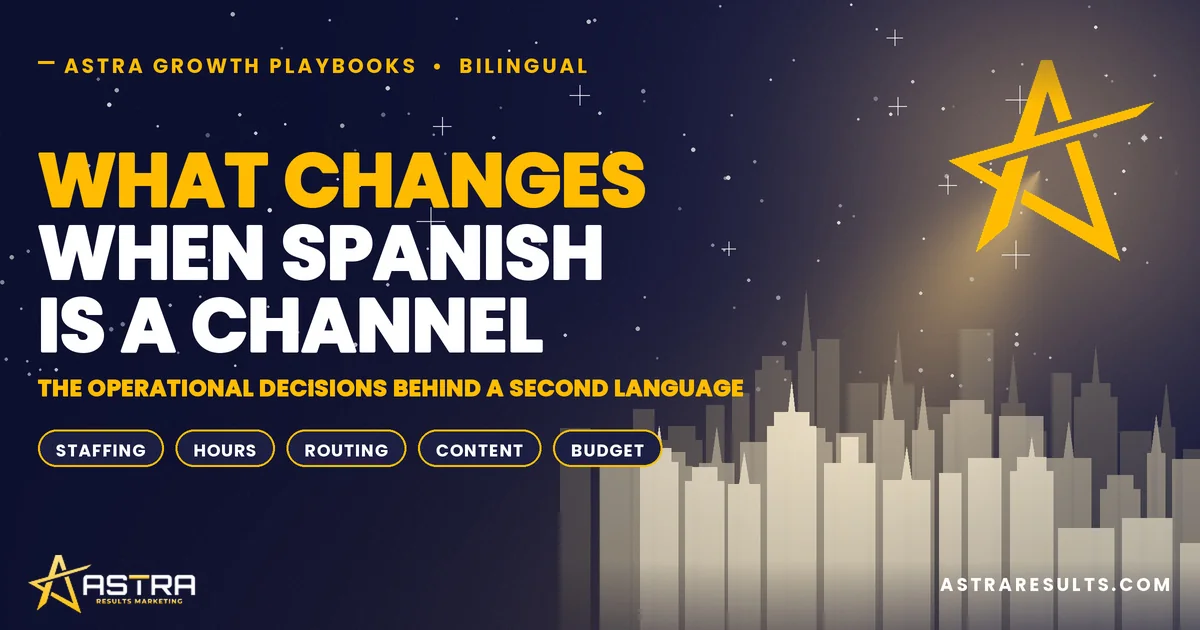
What Changes When Spanish Is a Channel
Quick answer
Coverage comes first: a Spanish campaign running at hours when nobody answers in Spanish wastes the spend and produces a bad review. Routing has to identify the language before the conversation starts, follow-up has to continue in that language, content needs a writer rather than a translator, and the channel needs its own budget line.
Deciding to treat Spanish as a channel rather than a translation is the easy part. The consequences are operational, and they arrive in a specific order: someone has to answer the phone, someone has to write the words, someone has to own the number, and something has to give in the budget.
Key Takeaways
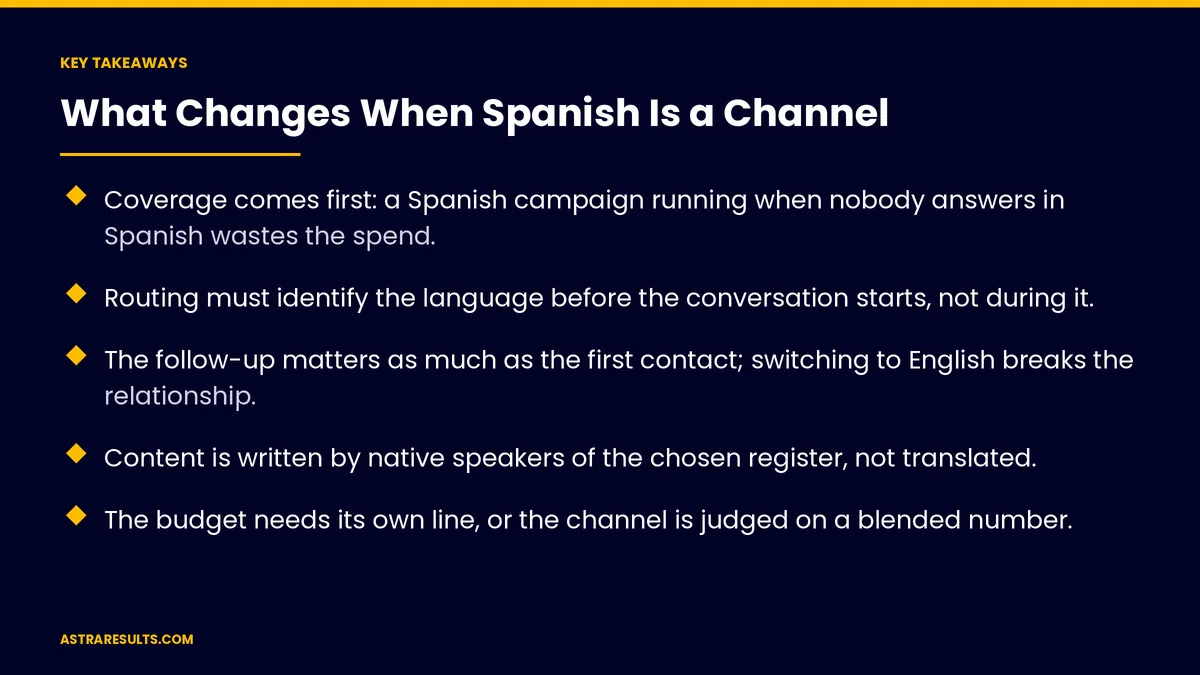
- Coverage comes first: a Spanish campaign running when nobody answers in Spanish wastes the spend.
- Routing must identify the language before the conversation starts, not during it.
- The follow-up matters as much as the first contact; switching to English breaks the relationship.
- Content is written by native speakers of the chosen register, not translated.
- The budget needs its own line, or the channel is judged on a blended number.
- The failure order is predictable: coverage, then follow-up, then content, then measurement.
Published: September 29, 2026 | Reading Time: ~12 minutes | Category: Bilingual
This piece is about those consequences. Not why Spanish deserves its own strategy — that argument is made elsewhere — but what changes in staffing, routing, content production and reporting once the decision is taken, and which of those changes breaks first when it is skipped. The short version: the decision is a marketing one; the work is operational.
Guidance for owners and operators. Nothing here is legal or employment advice. Language access requirements, hiring practices and compensation questions vary by jurisdiction and industry and should be reviewed with counsel.
In This Playbook
- Coverage: the decision that must come first
- Routing: knowing the language before answering
- The follow-up, which breaks more than first contact
- Content: who writes it and in which Spanish
- Budget: its own line or nothing
- Reputation in a second language
- What breaks first when this is skipped
- Getting started: the first quarter
- What Astra does here
Coverage: the decision that must come first
- The principle. Spanish-language demand generation should not run during hours when nobody can respond in Spanish.
- Why it is absolute. A Spanish-speaking caller who reaches an English-only response has been paid for and lost, and the impression left is worse than never having advertised, as detailed in why translated campaigns fail.
- The three ways to cover it. A bilingual person on the team, a bilingual answering service with the business's own script, or AI intake operating natively in Spanish with escalation to a bilingual human.
- The practical sequencing. Establish coverage, then turn on the campaigns. Not the reverse, which is the most common order and the most expensive.
- The hours question. Coverage has to match campaign hours, including evenings and weekends if the campaigns run then, as covered in answering in seconds.
- The workable option. If coverage cannot be arranged yet, run Spanish campaigns only during covered hours and say so in the schedule.
Routing: knowing the language before answering
- The problem. A bilingual person who answers every call in English and switches when needed loses the first ten seconds of every Spanish conversation, and those seconds set the tone.
- The fix. Spanish campaigns route to a Spanish number or a Spanish-tagged form, so whoever answers knows before speaking.
- Web forms. A hidden field carrying the campaign language into the CRM, so the follow-up is in the right language too.
- Messaging channels. WhatsApp is the default channel for much of this audience, and a business without it is absent from where the conversation would happen.
- The CRM field. Preferred language recorded on the record, used by every subsequent message, quote and reminder.
- What this prevents. The customer having to ask whether anyone speaks Spanish, which is the moment they start considering the next business.
The follow-up, which breaks more than first contact
- The pattern. The first conversation goes well in Spanish, and then the quote arrives in English, or the reminder does, or the review request.
- What it communicates. That the Spanish was a lure rather than a service, which damages more than never having offered it.
- What needs a Spanish version. The quote, the confirmation, the reminder, the follow-up sequence, the review request, the reactivation message, and the invoice where practical.
- Who writes them. A native speaker once, as templates, rather than translating each one under time pressure.
- The maintenance cost. Every new template is now two templates. That is a real operational cost and should be acknowledged rather than discovered.
Content: who writes it and in which Spanish
- The register decision. Which variety of Spanish the business speaks, decided deliberately and documented, since a Miami audience spans many countries of origin.
- Who writes. A native speaker of that register, with review by someone from the customer base. Not a translator working from English, and not machine translation without native review.
- What gets written natively. Ad copy, landing pages, intake scripts, service pages, review responses, and the content intended to be found and cited, as explored in content answer engines quote.
- What the keyword research looks like. Built from scratch, from how the business's own Spanish-speaking customers describe the problem — recorded calls and reviews are the source, not a translated keyword list.
- The voice document. A separate Spanish voice guide, because tone, formality and warmth do not map across languages, as set out in brand voice as a document.
Budget: its own line or nothing
- Why separation matters. A Spanish effort inside a blended budget cannot be evaluated, and when results are questioned the smaller line gets cut on a hunch.
- What separation requires. Separate campaigns, separate tracking numbers, a language field on every lead, and a cost per closed customer computed by language.
- What the numbers show. Lower acquisition cost, comparable or better conversion where intake is native, and higher referral rates — though every business should verify this with its own data rather than assume it.
- Where the money comes from. Usually a reallocation rather than an increase, and the straight comparison is Spanish acquisition cost against English acquisition cost at the margin.
- The reporting requirement. Both languages in the same review, on the same definitions, as covered in attribution by segment.
Reputation in a second language
- Reviews. Spanish speakers read Spanish reviews first. A business with many English reviews and none in Spanish appears unreviewed to that reader.
- Solicitation. In Spanish, from Spanish-speaking customers, through the channel they used.
- Responses. Every Spanish review answered in Spanish, in register, which also signals to future readers that the business operates in the language.
- Referral behavior. Recommendation carries more weight and travels through family networks and messaging apps, so making a referral easy to forward matters more than a formal program.
- The compounding effect. Spanish reviews improve Spanish-language visibility, which improves Spanish-language enquiries, which produces more Spanish reviews.
What breaks first when this is skipped
In order, and predictably.
- Coverage breaks first. Leads arrive and are not answered in the language they arrived in.
- Then the follow-up. The relationship starts in Spanish and continues in English.
- Then the content. Translated pages that do not match how anyone searches, producing traffic that does not convert.
- Then measurement. Without a language field the business cannot tell whether any of it worked, and concludes the market is weak.
- The diagnosis that follows. "We tried Spanish and it did not work" almost always means coverage was never arranged, as set out in the intake leak.
Getting started: the first quarter
Days 1–30: coverage and routing
Coverage arranged for every hour campaigns will run. Spanish number and tagged forms live. Language field added to the CRM. Register decided and documented. Native writer and community reviewer identified.
Days 31–60: content and follow-up
Intake script, ad copy and core pages written natively. The full follow-up set translated into Spanish templates. Keyword research rebuilt from the business's own customer language.
Days 61–90: launch and measure
Spanish campaigns launched in their own campaign group with their own budget. Review solicitation in Spanish started. The first cost per closed customer by language computed and compared.
What Astra does here
Astra Results Marketing arranges coverage before launching demand, because a Spanish campaign running into an English-only response wastes the spend and the impression. Routing identifies the language before anyone answers, and the follow-up set — quote, reminder, review request, reactivation — exists in Spanish as templates rather than being translated under pressure.
Copy is written by native speakers of the register the business chose, keyword research is rebuilt from the business's own customers rather than translated, and the channel carries its own budget line and its own cost per closed customer. Engagements begin with a coverage and register assessment through our social media marketing team.
Related reading
Frequently asked questions
What has to be in place before Spanish campaigns launch?
Coverage. A Spanish-speaking caller who reaches an English-only response has been paid for and lost, and the impression is worse than never advertising. Coverage can be a bilingual person, a bilingual answering service using the business's own script, or AI intake operating natively in Spanish with escalation to a bilingual human — and it has to match the hours the campaigns run.
Why does routing matter?
Because a bilingual person answering every call in English and switching when needed loses the first ten seconds of every Spanish conversation, and those seconds set the tone. Spanish campaigns should route to a Spanish number or Spanish-tagged form, with the language carried into the CRM so every subsequent message uses it. It prevents the customer having to ask whether anyone speaks Spanish.
What breaks more often than the first conversation?
The follow-up. The call goes well in Spanish and then the quote arrives in English, or the reminder, or the review request — which communicates that the Spanish was a lure rather than a service. The quote, confirmation, reminder, follow-up sequence, review request and reactivation message all need Spanish versions, written once as templates by a native speaker.
Who should write the Spanish content?
A native speaker of the register the business has chosen, reviewed by someone from the customer base — not a translator working from English and not machine translation without native review. Keyword research is rebuilt from scratch using how the business's own Spanish-speaking customers describe the problem, drawn from recorded calls and reviews rather than a translated keyword list.
Why does the budget need its own line?
Because an effort inside a blended budget cannot be evaluated, and when results are questioned the smaller line gets cut on a hunch. Separation means separate campaigns, separate tracking numbers, a language field on every lead, and cost per closed customer computed by language — with both languages reported in the same review on the same definitions.
What does "we tried Spanish and it did not work" mean?
That coverage was never arranged. The failure order is predictable: coverage breaks first, so leads are not answered in the language they arrived in; then the follow-up switches to English; then translated content fails to match how anyone searches; and then, without a language field, the business cannot tell whether any of it worked and concludes the market is weak.
READY TO RUN SPANISH AS A CHANNEL RATHER THAN A TRANSLATION? Astra Results Marketing arranges coverage before launching demand, routes by language before anyone answers, builds the Spanish follow-up set as templates, and reports cost per closed customer by language. Astra Results Marketing · 1101 Brickell Ave, Miami, FL 33131 · +1 (786) 321-2866 · [email protected] Find us on Google · Yelp ▸ CALL (786) 321-2866 · ▸ REQUEST YOUR CONSULTATION