 Rated 5 star on


Before You Sign With a Data Partner
Quick answer
Before signing with a data partner, get ownership of your data, code and pipeline setup in writing. Keep database and tool accounts in your business's name. Ask for documentation of every pipeline and data source. Understand security, monitoring and support. Know the total cost, and how you would leave if you needed to.
A data partner builds the pipelines, databases and reports your business will rely on for years. If the arrangement goes wrong, you can end up with data you can't access, pipelines nobody understands or costs that keep climbing. The time to prevent that is before signing.
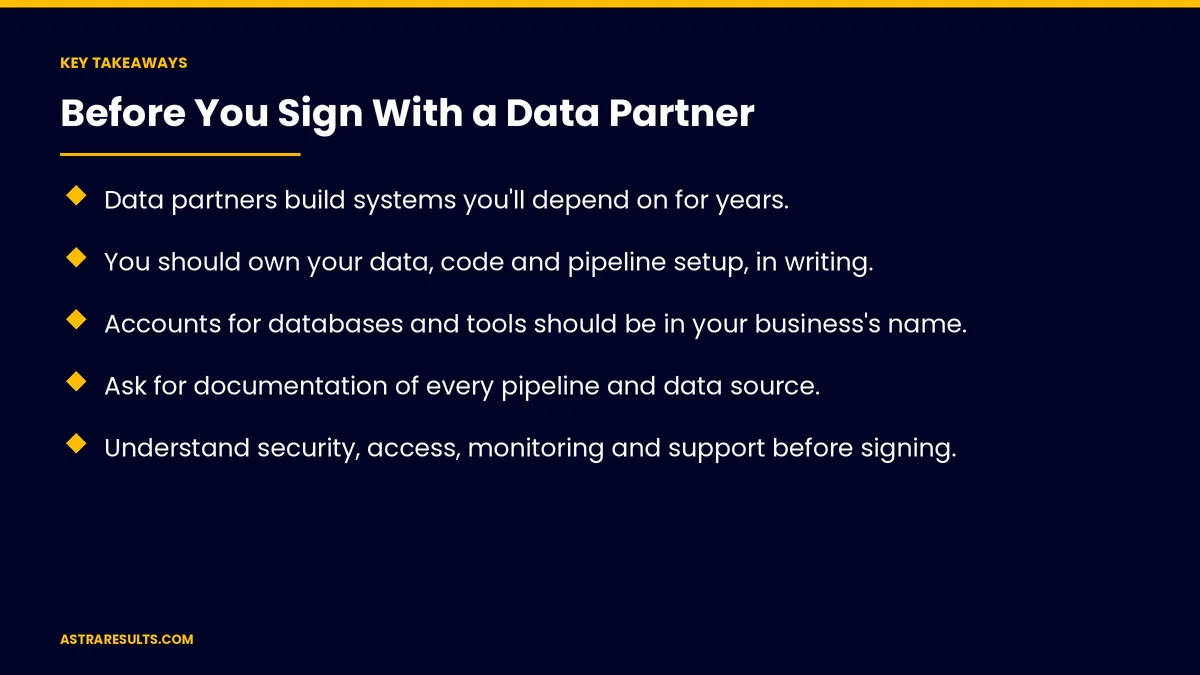
Key Takeaways
- Data partners build systems you'll depend on for years.
- You should own your data, code and pipeline setup, in writing.
- Accounts for databases and tools should be in your business's name.
- Ask for documentation of every pipeline and data source.
- Understand security, access, monitoring and support before signing.
- Know the total cost and how you'd leave if you needed to.
Published: October 2, 2026 | Reading Time: ~8 minutes | Category: Data Engineering
This guide covers ownership of data and code, accounts in your name, documentation, security, data quality, support, costs, leaving cleanly, references and red flags. Put plainly: own your data and code, get everything documented and know how you'd leave before you start.
For the same discipline with other partners, see choosing an ML partner.
In This Playbook
- Ownership of data and code
- Whose name should your data accounts be in?
- Documentation
- Security and access
- Data quality
- Monitoring and support
- Costs
- What does a clean exit from a data partner need?
- References
- Red flags
- What to measure after signing
- The first three months with a partner
Ownership of data and code
Your data is yours. Stated clearly in the contract.
Code and setup are yours. Pipelines, scripts and configurations.
The details are covered in owning your code.
Whose name should your data accounts be in?
Databases and cloud accounts. Registered to your business.
Tool subscriptions. In your name or transferable.
Admin access for you. Not only the partner.
Documentation
Every pipeline explained. What it moves, when and why, as covered in data pipelines explained.
Data sources listed. With owners and refresh schedules.
Definitions written down. What each metric means.
Security and access
Least access. People and tools get only what they need.
Sensitive data protected. Customer and payment details limited.
Access reviews. Regular checks of who can see what.
Data quality
Quality checks built in. Freshness and completeness, as covered in data KPIs.
Problems reported. Not hidden.
Monitoring and support
Alerts when pipelines break. As covered in when integrations break.
Response times. Stated in the agreement.
Who to call. Named contacts.
Costs
Setup. One-time work.
Monthly fees. Partner support and tools.
Computing and storage. Usage-based costs that grow with data.
Right-sized. As weighed in is data engineering right for your size and data warehouse vs data lake.
What does a clean exit from a data partner need?
Handover plan. Documentation, access and training.
Data export. In standard formats.
Notice period. Clear and reasonable.
References
Similar clients. Same size and industry.
Systems they built. Still running well.
How problems were handled. Ask directly.
Red flags
Accounts only in their name. You can't access your own data.
No documentation. Knowledge lives only with them.
Vague costs. Usage charges with no estimates.
No exit plan. Leaving looks hard by design.
Similar warning signs appear in how to choose a web design partner.
What to measure after signing
Data freshness. Reports updated on time.
Pipeline failures. And time to fix.
Costs against estimate. Monthly.
Documentation kept current. Reviewed quarterly.
Report trust. Teams using the numbers.
The first three months with a partner
Month one: set the terms
Confirm ownership in writing, set up accounts in your name, agree on documentation, support and costs.
Month two: build
Build the first pipelines with documentation, quality checks and alerts from the start.
Month three: review
Check freshness, failures, costs and documentation, and confirm the exit plan still works.
How Astra works as a data partner
Astra Results Marketing works as a data partner with ownership and exit built in. Your data, code and accounts stay in your name, every pipeline is documented and monitored and costs are estimated up front.
Engagements begin with a data review through our data engineering team.
Related reading
Frequently asked questions
What should we ask a data partner before signing?
Who owns the data and code, whose name the accounts are in, how pipelines are documented, security, support, costs and how you'd leave.
Who should own the data and pipelines?
Your business, in writing, including code, configurations and accounts.
Why does documentation matter?
Without it, only the partner understands your systems, which makes changes and exits hard.
What costs should we expect?
Setup, monthly support and tool fees and usage-based computing and storage costs.
What are red flags?
Accounts only in the partner's name, no documentation, vague costs and no exit plan.
What should we measure after signing?
Data freshness, pipeline failures, costs against estimate, documentation and report trust.
Choosing a data partner? Astra Results Marketing keeps your data, code and accounts in your name, documents every pipeline and estimates costs before you sign. ▸ CALL (786) 321-2866 · ▸ REQUEST YOUR CONSULTATION





