 Rated 5 star on

Choosing an ML Partner: 12 Questions
Quick answer
The most important question for an ML partner is which business decision the model will improve. A good partner checks your data before promising accuracy. Every model should beat a simple baseline. Predictions must reach the people who act, with reasons. Ask about drift, ownership and running costs, then start with a pilot you can stop.
Machine learning partners all promise better forecasts, smarter scoring and big savings. The hard part is telling which ones will deliver results you can use and which will hand you an impressive model nobody acts on. The right questions, asked before signing, reveal how a partner thinks about your data, your decisions and what happens after launch.
Key Takeaways
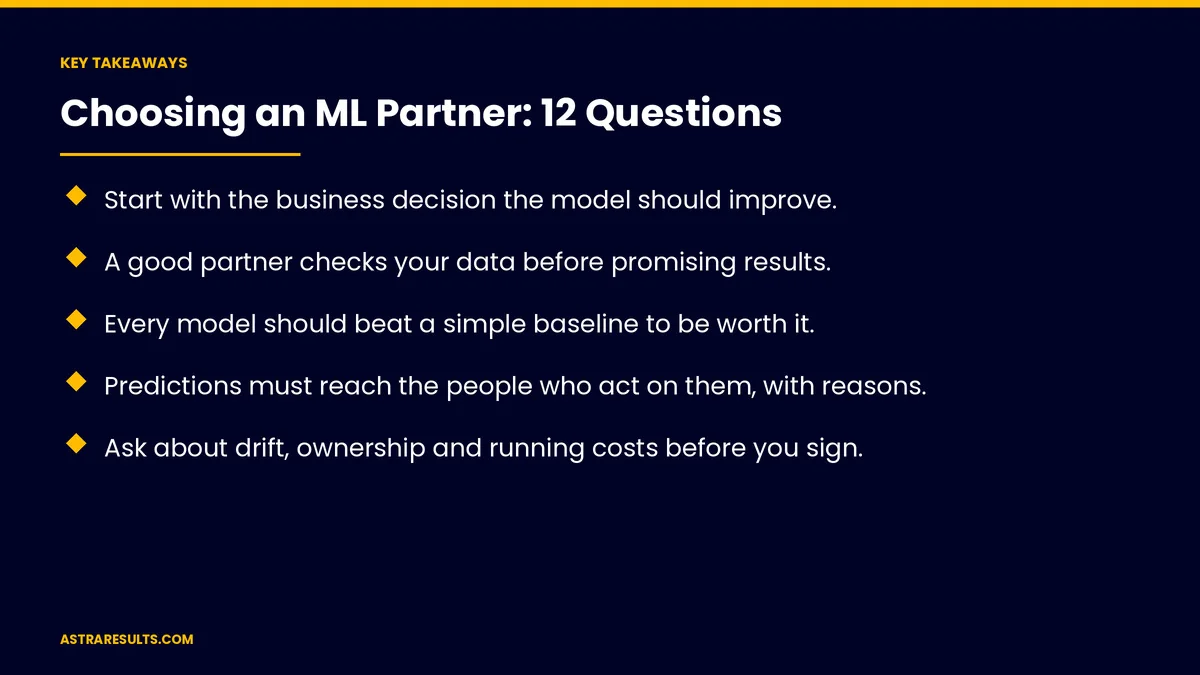
- Start with the business decision the model should improve.
- A good partner checks your data before promising results.
- Every model should beat a simple baseline to be worth it.
- Predictions must reach the people who act on them, with reasons.
- Ask about drift, ownership and running costs before you sign.
- Run a pilot with a clear way to stop if results fall short.
Published: October 3, 2026 | Reading Time: ~9 minutes | Category: Machine Learning & Analytics
This guide covers twelve questions to ask a machine learning partner, what good answers sound like, red flags and how to compare partners. Put plainly: choose the partner who starts with your decision and your data, not with their algorithms.
In This Playbook
- 1. Which decision will the model improve?
- 2. Do we have enough data, and how will you check?
- 3. What baseline must the model beat?
- 4. How will you measure accuracy?
- 5. How will predictions reach the people who act?
- 6. How will you explain predictions?
- 7. How will you check for bias?
- 8. What happens when the model drifts?
- 9. Who owns the model, code and data?
- 10. What will it cost to run and maintain?
- 11. Can you show similar work with results?
- 12. What does a pilot look like?
- Comparing partners
- What to measure after hiring
- The first three months with a partner
1. Which decision will the model improve?
Good answer. A specific decision, such as which accounts to call or how much stock to order.
Red flag. "We'll find insights in your data."
Start with the decision, as covered in machine learning for operators.
2. Do we have enough data, and how will you check?
Good answer. A short data review before any promises.
Red flag. Accuracy claims before seeing your data.
Data quality matters, as covered in data KPIs.
3. What baseline must the model beat?
Good answer. A simple rule or average, such as each account's usual order gap, as in wholesaler reorder prediction.
Red flag. No comparison at all.
4. How will you measure accuracy?
Good answer. On data the model hasn't seen, and on real results after launch.
Red flag. Only accuracy on the data used to build it.
5. How will predictions reach the people who act?
Good answer. In dashboards, CRM or apps people already use, as weighed in ML vs business intelligence.
Red flag. A separate report nobody opens.
6. How will you explain predictions?
Good answer. The main reasons behind each prediction, in plain language.
Red flag. "The model is too complex to explain."
7. How will you check for bias?
Good answer. Regular checks across groups where decisions affect people, such as hiring or credit.
Red flag. No plan, or "the data is neutral."
8. What happens when the model drifts?
Good answer. Accuracy monitoring and a retraining plan.
Red flag. "Once it's built, it's done."
9. Who owns the model, code and data?
Good answer. You do, in writing, as covered in owning your code.
Red flag. Models locked inside the partner's platform with no export.
10. What will it cost to run and maintain?
Good answer. Hosting, data updates, monitoring and retraining, estimated up front.
Red flag. Only the build price.
Make the case, as covered in the business case for predictive analytics.
11. Can you show similar work with results?
Good answer. Comparable projects, measured outcomes and references.
Red flag. Demos only.
Industry fit matters, as covered in why generic AI fails on specific workflows.
12. What does a pilot look like?
Good answer. One decision, a time limit, clear measures and a way to stop, as covered in AI pilots that fail safely.
Red flag. A large contract before any proof.
For vision projects, see a 90-day computer vision pilot.
Comparing partners
Score each answer. Clear, specific and open about limits.
Weigh the baseline and pilot answers most. They reveal realism.
Understand the parts. As covered in the ML stack explained.
What to measure after hiring
Beat the baseline. By a meaningful margin.
Decisions changed. Actions taken because of predictions.
Business results. Revenue, costs or time saved.
Accuracy over time. Watching for drift.
Cost to run. Against the estimate.
The first three months with a partner
Days 1–30: decision and data
Agree on the decision, review the data and set the baseline the model must beat.
Days 31–60: build and test
Build the model, test on data it hasn't seen and show predictions with reasons where people already work.
Days 61–90: pilot and decide
Run the pilot, compare against the baseline and decide to expand, adjust or stop.
How Astra works as an ML partner
Astra Results Marketing starts with your decision and your data. We check data before promising results, beat a simple baseline, explain predictions in plain language, plan for drift and keep the model and code in your name.
Engagements begin with a data and decision review through our machine learning and advanced analytics team.
Related reading
Frequently asked questions
What's the most important question to ask an ML partner?
Which business decision the model will improve. Partners who start with your decision, not their tools, deliver results you can use.
Why does a baseline matter?
A model is only worth its cost if it beats a simple rule or average by a meaningful margin.
Should a partner promise accuracy up front?
Not before reviewing your data. Early promises are a red flag.
Who should own the model?
You should, in writing, along with the code and data, with the ability to export it.
What ongoing costs should we expect?
Hosting, data updates, accuracy monitoring and retraining as conditions change.
How should we start?
With a time-limited pilot on one decision, clear measures and a way to stop if results fall short.
Ready for an ML partner that starts with your decision? Astra Results Marketing reviews your data first, beats a simple baseline, explains predictions in plain language and keeps the model and code in your name. ▸ CALL (786) 321-2866 · ▸ REQUEST YOUR CONSULTATION





