 Rated 5 star on

Data Warehouse vs Data Lake
Quick answer
Most small and growing businesses should start with a data warehouse. A warehouse holds cleaned, organized data ready for reports and dashboards. A data lake holds raw data of any type for later analysis. Lake storage is cheaper, but processing raw data takes work. Without organization, lakes fill with data nobody trusts.
When businesses outgrow spreadsheets and want their data in one place, two terms come up: data warehouse and data lake. Both store data from many systems, but they're built for different jobs. A warehouse holds organized data for reports; a lake holds raw data for later analysis.
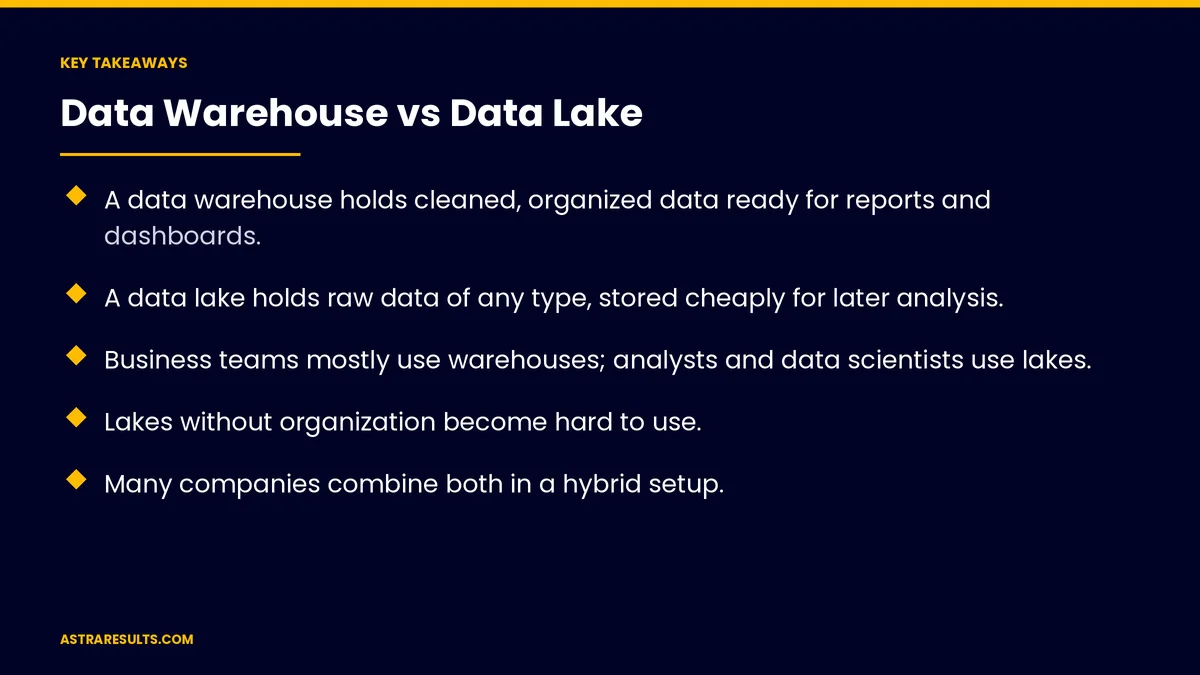
Key Takeaways
- A data warehouse holds cleaned, organized data ready for reports and dashboards.
- A data lake holds raw data of any type, stored cheaply for later analysis.
- Business teams mostly use warehouses; analysts and data scientists use lakes.
- Lakes without organization become hard to use.
- Many companies combine both in a hybrid setup.
- Most small and growing businesses should start with a warehouse.
Published: October 8, 2026 | Reading Time: ~8 minutes | Category: Data Engineering
This guide covers data warehouses and data lakes: what each is, who uses each, what goes in, costs, upkeep, the hybrid approach, security, which fits your size and what to measure. Put plainly: start with a warehouse for reliable reports, and add a lake only when you need raw data for deeper analysis.
In This Playbook
- What a data warehouse is
- What a data lake is
- Who uses a data warehouse and who uses a data lake?
- What goes in
- Costs
- Upkeep
- How do a data lake and a warehouse work together?
- Security
- Which fits your size
- What to measure
- The first three months
What a data warehouse is
Organized data. Cleaned and structured before it's stored.
Ready for reports. Dashboards and questions answered quickly.
Consistent definitions. Revenue means the same thing everywhere.
What a data lake is
Raw data. Stored as it arrives.
Any type. Tables, files, logs, documents and images.
Organized later. Shaped when someone needs it.
Who uses a data warehouse and who uses a data lake?
Warehouse. Owners, managers, finance and sales teams.
Lake. Analysts and data scientists building models.
Reports before predictions. As weighed in ML vs business intelligence.
What goes in
Warehouse. Sales, customers, orders, billing and support records.
Lake. Everything above, plus raw files, website logs and documents.
Moved by pipelines. As covered in data pipelines explained.
Costs
Storage. Lakes store large amounts cheaply.
Computing. Queries and processing cost money in both.
Setup work. Warehouses need more design up front; lakes need more work later.
Upkeep
Warehouse. Keep definitions and connections current.
Lake. Keep files organized and labeled, or it turns into a swamp.
Data quality. As covered in data KPIs and clean inputs first.
How do a data lake and a warehouse work together?
Both together. Raw data lands in a lake, organized data flows to a warehouse.
One platform. Some tools combine both, often called a lakehouse.
For larger needs. Usually not where small businesses start.
Security
Access by role. Teams see what they need.
Sensitive data protected. Customer and payment details limited.
Lakes need extra care. Raw data can include things nobody meant to keep.
Which fits your size
Small businesses. A warehouse or reporting database for key reports, as weighed in is data engineering right for your size.
Growing businesses. A warehouse, with a lake only for specific needs.
Data-heavy companies. A hybrid, as in SaaS data.
Choosing a partner. As in before you sign with a data partner.
Simple predictions often need only warehouse data, as in predictive analytics for small businesses.
What to measure
Report trust. Same numbers across teams.
Time to answer. Questions answered in minutes.
Data freshness. How current the data is.
Storage and computing costs. Month over month.
Data in use. Unused data is cost without value.
The first three months
Month one: questions first
List the questions you need answered and the systems holding the data.
Month two: build the warehouse
Connect key systems, agree on definitions and build reports for the top questions.
Month three: decide on a lake
Add a lake only if you need raw files, logs or documents for deeper analysis.
How Astra chooses between warehouse and lake
Astra Results Marketing helps businesses choose where their data should live. We start from the questions you need answered, build a warehouse for reliable reports and add a lake only when deeper analysis needs raw data.
Engagements begin with a data review through our data engineering team.
Related reading
Frequently asked questions
What's the difference between a data warehouse and a data lake?
A warehouse holds organized data ready for reports; a lake holds raw data of any type for later analysis.
Which one do small businesses need?
Usually a warehouse or reporting database for key reports. A lake comes later, if at all.
Is a data lake cheaper?
Storage is cheaper, but organizing and processing raw data later takes work and computing costs.
What is a lakehouse?
A setup that combines a lake and a warehouse on one platform, usually for larger data needs.
What goes wrong with data lakes?
Without organization and labels, they fill with data nobody can find or trust.
What should we measure?
Report trust, time to answer, data freshness, storage and computing costs and how much data is used.
Not sure where your data should live? Astra Results Marketing starts with the questions you need answered, builds a warehouse for reliable reports and adds a lake only when it pays off. ▸ CALL (786) 321-2866 · ▸ REQUEST YOUR CONSULTATION





