 Rated 5 star on


Care Plan or Freelancer: Comparing the Options
Quick answer
The right choice depends on how much your website does for the business. A trusted freelancer can suit a simple site with few changes. A care plan suits sites that bring in leads or sales daily, with backup coverage and monitoring. In-house staff fit larger sites with constant changes. Always keep accounts in your business's name.
Every business website needs care: updates, backups, security, small fixes and the odd emergency. Many businesses rely on the freelancer who built the site. Others pay for an agency care plan, hire someone in-house or handle it themselves. Each can work. The right choice depends on how much your site matters to revenue and what happens when something breaks.
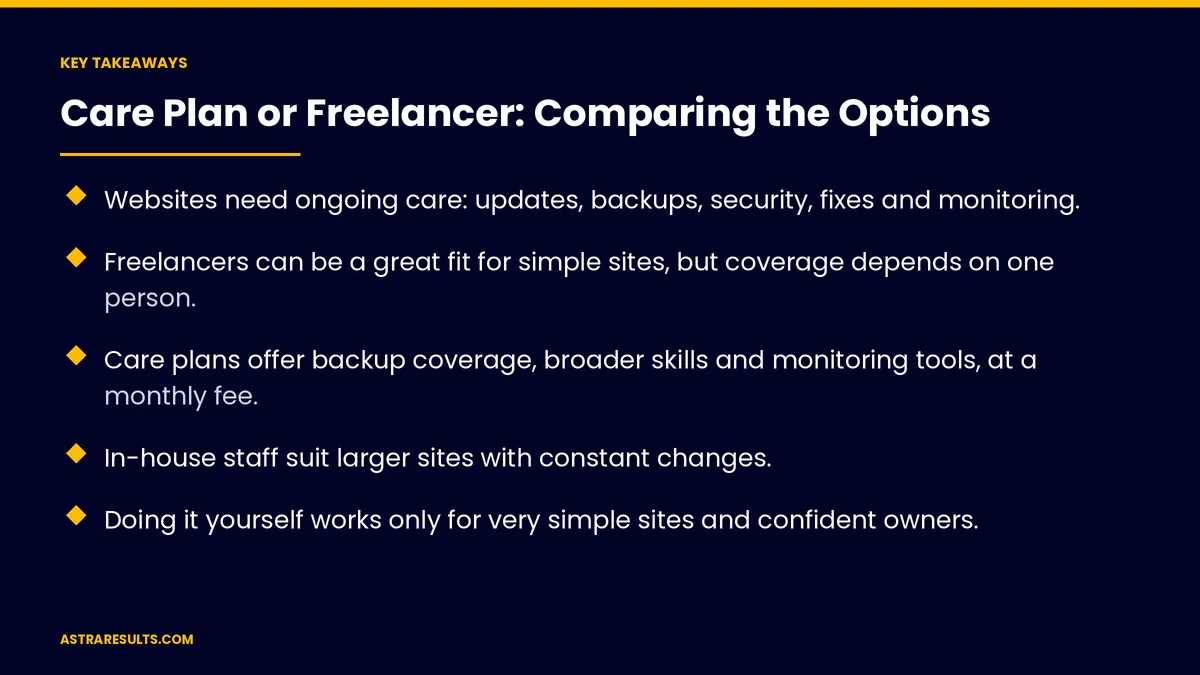
Key Takeaways
- Websites need ongoing care: updates, backups, security, fixes and monitoring.
- Freelancers can be a great fit for simple sites, but coverage depends on one person.
- Care plans offer backup coverage, broader skills and monitoring tools, at a monthly fee.
- In-house staff suit larger sites with constant changes.
- Doing it yourself works only for very simple sites and confident owners.
- Whatever you choose, keep accounts and logins in your business's name.
Published: October 9, 2026 | Reading Time: ~8 minutes | Category: Website Care Plans
This guide compares the four common options on coverage, skills, response times, tools, cost and who holds the keys to your site, then explains which fits which kind of business. Put plainly: match the care to what downtime would cost you.
In This Playbook
- What ongoing care does every website need?
- Option 1: a freelancer
- Option 2: an agency care plan
- Option 3: in-house staff
- Option 4: doing it yourself
- Comparing what matters
- Who holds the keys
- A hybrid approach
- Questions to ask any option
- What should we measure in website maintenance?
- The first three months
What ongoing care does every website need?
Software updates. The platform, themes and plugins.
Backups. Regular, tested and stored off the site.
Security. Monitoring, patches and protection against attacks, as covered in security and maintenance after launch.
Uptime monitoring. Knowing when the site goes down.
Small fixes and changes. Text, images, forms and broken links.
Moves and upgrades. Changing hosts or domains safely, as covered in moving hosts or domains.
Emergency help. When the site is hacked or stops working.
The full list is covered in what ongoing support covers.
Option 1: a freelancer
Strengths. Personal relationship, often lower cost, and deep knowledge if they built the site.
Weaknesses. One person means gaps during vacations, illness or busy periods.
Skills. Strong in some areas, perhaps design, but not always security or hosting.
Best for. Simple sites with few changes and a trusted freelancer who responds reliably.
Option 2: an agency care plan
Strengths. A team for backup coverage, a broader mix of skills and monitoring and backup tools included.
Weaknesses. A monthly fee, and a less personal relationship than one freelancer.
Response times. Usually set in writing, with urgent issues handled faster.
Best for. Sites that bring in leads or sales every day, online stores and sites with several connected tools. Typical costs are covered in care plan pricing.
Option 3: in-house staff
Strengths. Someone who knows your business and is available every day.
Weaknesses. Salary and benefits, and one person rarely covers every skill.
Best for. Larger sites with constant changes, often with outside help for security or hosting.
Option 4: doing it yourself
Strengths. Lowest direct cost and full control.
Weaknesses. Takes your time, and mistakes with updates or security can be costly.
Best for. Very simple sites and owners comfortable with the platform.
Comparing what matters
Coverage. Who answers when the site breaks on a holiday weekend?
Skills. Design, development, security, hosting and search.
Response times. Written commitments, or best effort?
Tools. Monitoring, backups and security scanning.
Cost. Monthly fees against the cost of downtime and lost leads.
Accountability. A written agreement covering scope and response, as covered in what a good maintenance contract covers.
Who holds the keys
Accounts in your name. Domain, hosting, website platform and analytics.
Logins you can access. Stored in a password manager you control.
A common risk. A freelancer who registered the domain in their own name, or a provider who controls hosting.
Check today. Make sure you could hand the site to someone else tomorrow.
A hybrid approach
Care plan plus freelancer. The care plan handles updates, security and backups; the freelancer handles design changes.
In-house plus specialist. Staff manage content while a specialist handles security and hosting.
Clear roles. Write down who does what to avoid gaps or overlap.
Questions to ask any option
What's included, and what costs extra?
How fast do you respond to urgent issues?
Who covers when you're unavailable?
How are backups made, stored and tested? The details are covered in backups and restores.
Can we leave easily with all our accounts and files?
What should we measure in website maintenance?
Uptime. How often and how long the site is down.
Response times. For urgent and routine requests.
Update status. Software kept current.
Security incidents. Attacks, malware or breaches.
Site results. Leads and sales, as covered in website KPIs.
The first three months
Days 1–30: check your current setup
List who looks after the site today, what they do and what's missing. Confirm that domain, hosting and platform accounts are in your name. Estimate what a day of downtime would cost.
Days 31–60: compare options
Ask each option the questions above, including your current freelancer. Compare coverage, skills, response times, tools and cost against the cost of downtime.
Days 61–90: decide and set up
Choose the option or hybrid that fits, put the agreement in writing and move logins to a password manager you control. Set up uptime monitoring and tested backups.
How Astra looks after websites
Astra Results Marketing offers website care plans for businesses whose sites drive leads and sales. We handle updates, tested backups, security monitoring, uptime alerts and small fixes, with response times in writing.
We work alongside your freelancer or in-house team where that fits, and your accounts always stay in your name. Engagements begin with a site and support review through our website care plans team.
Related reading
Frequently asked questions
Is a freelancer or a care plan better?
It depends on your site. A trusted freelancer can suit a simple site with few changes. A care plan suits sites that bring in leads or sales daily, offering backup coverage, broader skills and monitoring tools.
What's the main risk with a freelancer?
Coverage depends on one person, so vacations, illness or busy periods can leave gaps. Some freelancers also hold domain or hosting accounts in their own name.
Can we use a care plan and a freelancer together?
Yes. A common split has the care plan handle updates, security and backups while the freelancer handles design changes. Write down who does what.
When does in-house make sense?
For larger sites with constant changes, where someone is needed every day. Many in-house teams still use outside specialists for security or hosting.
Can we look after the website ourselves?
For very simple sites and owners comfortable with the platform, yes. Mistakes with updates or security can be costly, so keep tested backups.
What should we check first?
That your domain, hosting, platform and analytics accounts are in your business's name, and that you can access every login.
Ready for website care that matches what your site is worth? Astra Results Marketing offers care plans with updates, tested backups, security monitoring and written response times, working alongside your freelancer or team, with accounts kept in your name. ▸ CALL (786) 321-2866 · ▸ REQUEST YOUR CONSULTATION





