 Rated 5 star on

Custom Portals for Clients, Patients and Partners
Quick answer
Build a custom portal when the same questions eat staff time daily and off-the-shelf portals don't fit your process. Start with the three things each group asks for most, such as status, documents and invoices. Use secure sign-in with roles. Patient portals handling health data must follow HIPAA. Track calls avoided and time saved.
When clients call to ask where their project stands, patients email for a form or partners wait on a document, staff spend hours answering the same questions. A portal lets them log in and find it themselves: status, documents, messages and payments in one secure place. Built well, it saves time on both sides.
Key Takeaways
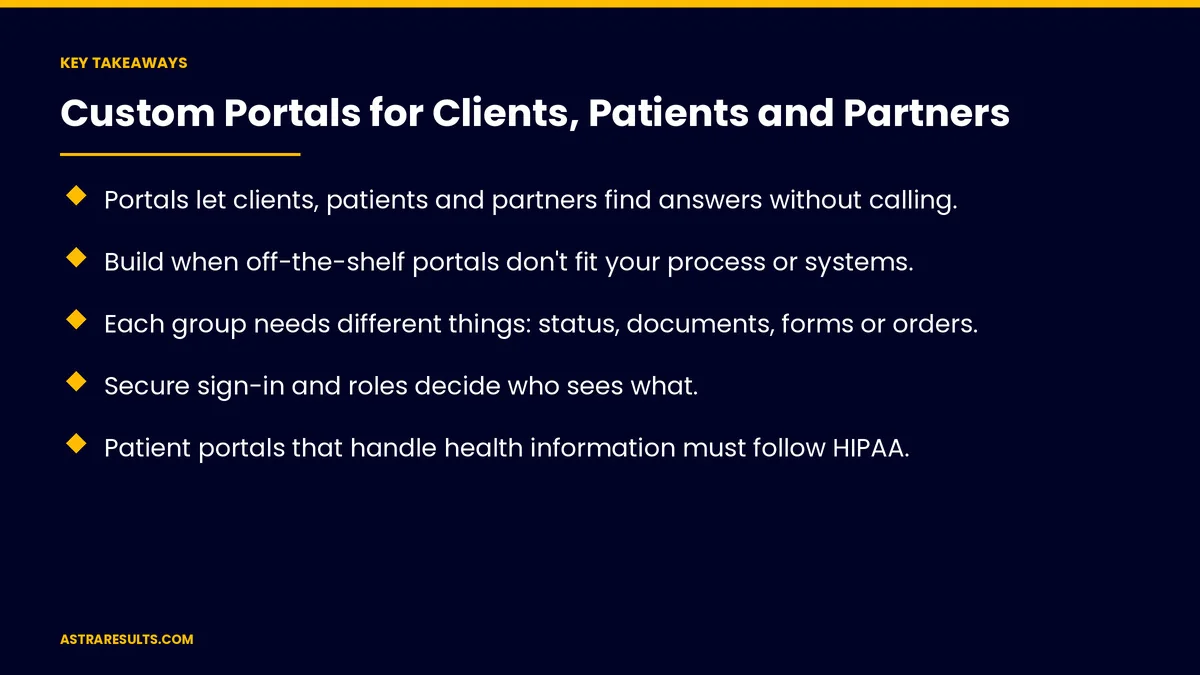
- Portals let clients, patients and partners find answers without calling.
- Build when off-the-shelf portals don't fit your process or systems.
- Each group needs different things: status, documents, forms or orders.
- Secure sign-in and roles decide who sees what.
- Patient portals that handle health information must follow HIPAA.
- Measure calls avoided, portal use and time saved.
Published: October 5, 2026 | Reading Time: ~9 minutes | Category: Custom Software
This guide covers custom portals: when to build one, what clients, patients and partners each need, sign-in and access, documents, status and messages, payments, privacy rules, connecting your systems, adoption and what to measure. Put plainly: give each group the few things they ask for most, behind secure sign-in, with the right privacy rules.
This is general information, not legal advice. Review privacy obligations, especially for health information, with counsel.
In This Playbook
- When should a business build a custom portal?
- What do clients, patients and partners each need from a portal?
- Sign-in and access
- Documents
- Status and messages
- Payments
- Privacy rules
- Connect your systems
- Adoption
- What to measure
- The first three months
When should a business build a custom portal?
The same questions every day. Status, documents and balances.
Off-the-shelf doesn't fit. Your process or systems are different, as weighed in when off-the-shelf stops fitting.
Email chains and spreadsheets. Replaced by one place, as in replacing spreadsheets.
What do clients, patients and partners each need from a portal?
Clients. Project status, invoices, documents and messages.
Patients. Appointments, forms, results where allowed and secure messages.
Partners. Orders, inventory, shared documents and performance reports.
Start small. The three things each group asks for most.
Sign-in and access
Secure sign-in. Strong passwords, passkeys or two-step verification.
Roles. Each person sees only their own records.
Company accounts. Partners may need several users with different rights.
Access checked on every request. As covered in API security.
Documents
Upload and download. Contracts, reports and forms.
Electronic signatures. Sign without printing.
Version history. The latest file, with earlier ones kept.
Status and messages
Clear status. Where each project, order or case stands.
Secure messages. Instead of email for sensitive topics.
Notifications. By email or text when something changes, with consent.
Payments
Invoices and balances. Visible at any time.
Pay online. Through a secure processor, as covered in integrating payment processors.
Receipts. Stored in the portal.
Privacy rules
Health information. Patient portals that handle protected health information must follow HIPAA safeguards.
Vendor agreements. Hosting, email and other vendors that handle health information need business associate agreements.
Financial and legal clients. Extra care with confidential records.
Minimal data. Collect and show only what's needed.
Audit trails. Who viewed or changed what, and when.
Connect your systems
CRM, billing and scheduling. Portal data comes from the systems you already use.
Older systems. Connected carefully, as covered in modernizing legacy software.
Mobile access. A responsive site or companion app, as in SaaS companion apps.
Adoption
Invite clearly. A simple welcome with first steps.
Point people to it. Staff reply with portal links instead of attachments.
Spanish and other languages. For the people you serve.
What to measure
Calls and emails avoided. For status and documents.
Active users. Share of clients, patients or partners logging in.
Online payments. Share of invoices paid in the portal.
Time saved. Staff hours each week.
Satisfaction. Short surveys after key tasks.
The first three months
Days 1–30: discovery
List the questions each group asks most, map your systems and review privacy obligations with counsel, as covered in custom software discovery.
Days 31–60: build the core
Build secure sign-in, roles, status, documents and messages, connected to your existing systems.
Days 61–90: launch and grow
Invite a first group, add payments and signatures and track calls avoided and active users.
How Astra builds custom portals
Astra Results Marketing builds secure portals for clients, patients and partners. We start with the questions each group asks most, set up sign-in and roles, connect your systems and follow privacy rules, including HIPAA for health information.
Engagements begin with a portal discovery through our custom software team.
Related reading
Frequently asked questions
What is a client or patient portal?
A secure website or app where clients, patients or partners log in to see status, documents, messages and payments.
When should we build a custom portal?
When the same questions take staff time every day and off-the-shelf portals don't fit your process or systems.
What should a portal include first?
The three things each group asks for most, such as status, documents and invoices.
Do patient portals need to follow HIPAA?
Portals that handle protected health information must follow HIPAA safeguards, and vendors handling that information need business associate agreements.
How do we get people to use the portal?
Invite them clearly, have staff reply with portal links and offer it in the languages they speak.
How do we measure success?
Calls and emails avoided, active users, online payments, staff time saved and satisfaction.
Ready to stop answering the same questions every day? Astra Results Marketing builds secure portals that give clients, patients and partners what they need, connected to your systems and built with the right privacy rules. ▸ CALL (786) 321-2866 · ▸ REQUEST YOUR CONSULTATION





