 Rated 5 star on

What Custom Software Costs Over Five Years
Quick answer
Custom software costs far more than the build over five years. Hosting, upkeep, changes, support and staff time continue every year and add up to a large share of the total. Off-the-shelf costs grow too, through seats, add-ons and workarounds. Compare both over the same five years. A small first version keeps costs down.
The build quote is the number everyone remembers, but it's only the first year of the cost. Custom software also needs hosting, security updates, fixes and new features as the business changes. Off-the-shelf tools have hidden costs too: rising subscriptions, add-ons and the staff hours lost to workarounds. A fair decision compares both over five years.
Key Takeaways
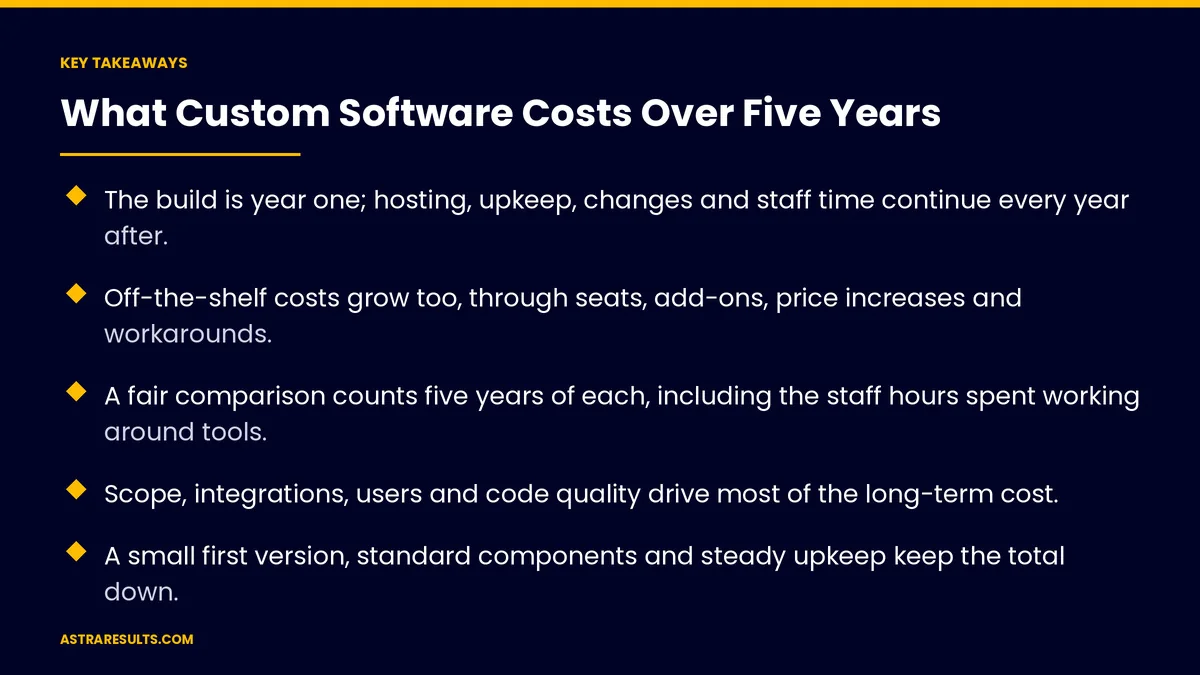
- The build is year one; hosting, upkeep, changes and staff time continue every year after.
- Off-the-shelf costs grow too, through seats, add-ons, price increases and workarounds.
- A fair comparison counts five years of each, including the staff hours spent working around tools.
- Scope, integrations, users and code quality drive most of the long-term cost.
- A small first version, standard components and steady upkeep keep the total down.
- Owning the code and documentation protects you if you change partners.
Published: October 24, 2026 | Reading Time: ~9 minutes | Category: Custom Software
This guide breaks down what custom software costs to own over five years, what drives the number up or down, how to compare it fairly with buying, and how to keep the total under control. Put plainly: compare five years of owning against five years of renting, including the cost of the work your team does around the tool.
In This Playbook
- Year one: the build
- Years two to five: owning it
- What drives the five-year total
- The cost of buying instead
- Comparing fairly
- Keeping the total down
- Protecting the investment
- Which custom software cost numbers should we track?
- The first three months
Year one: the build
Discovery. A short paid phase to define the problem and scope, as covered in custom software discovery.
Design and development. Screens, workflows, data and connections to your other systems.
Testing. Making sure it works with real data and real users.
Data migration. Moving records from spreadsheets or the old system.
Training and rollout. Getting your team to use it.
Keep the first version small. Build what fixes the main problem first, as covered in scoping an MVP.
Years two to five: owning it
Hosting and services. Servers, databases, backups, email and other services, billed monthly.
Upkeep. Security patches, library updates and fixes so the software keeps working.
Changes. New features, reports and adjustments as the business grows.
Support. Someone to answer questions and fix problems quickly.
Monitoring. Alerts and logs that catch problems early.
Staff time. An internal owner who manages priorities and the partner.
The same pattern applies to apps, as covered in app maintenance costs.
What drives the five-year total
Scope. More features and screens mean more to build and maintain.
Integrations. Each connection to another system needs care when either side changes.
Users and data volume. More users and records can raise hosting and support costs.
Code quality. Well-tested, documented code is cheaper to change for years.
Rate of change. A business that changes its process often will spend more on updates.
The cost of buying instead
Subscriptions. Often priced per user, rising as the team grows.
Price increases. Vendors raise prices and move features into higher plans.
Add-ons and integrations. Extra tools and connectors to fill gaps.
Workarounds. Staff hours spent copying data, keeping side spreadsheets and fixing errors. Count these the way automation KPIs count hours.
Switching costs. Moving data and retraining if you ever leave.
Comparing fairly
Same time frame. Five years for both options.
Count everything. Build, hosting, upkeep, changes and staff time for custom; subscriptions, add-ons, integrations and workaround hours for buying.
Include the hybrid. Often the best answer is standard tools underneath with a small custom layer on top, as covered in when off-the-shelf stops fitting.
Value, not just cost. Faster work, fewer errors and better service can outweigh a higher total.
Revisit yearly. Compare actual spend with the plan and adjust.
Keeping the total down
Start small. Build the core, prove it, then add.
Use standard parts. Proven tools for payments, email and sign-in instead of building your own.
Choose integrations carefully. Simple connectors where they work, custom code where it matters, as weighed in integration platforms vs custom API work.
Steady upkeep. Regular small updates cost less than rare large rescues.
Automated tests. Catch problems before release and make changes cheaper.
Documentation. So any team can maintain it.
Protecting the investment
Own the code. Your contract should give you the source code and the right to change it.
Own the accounts. Hosting, domains and services registered to your business.
Keep documentation current. Updated with every major change.
Avoid lock-in. Use common technologies other developers know.
Which custom software cost numbers should we track?
Actual versus planned cost. By year and by category.
Hours saved. Staff time returned compared with the old process.
Errors removed. Mistakes before and after.
Change speed. How long new features take to deliver.
Support response. How fast issues are handled.
The first three months
Days 1–30: build the comparison
List the costs of your current tools, add-ons and workaround hours. Estimate five years of build, hosting, upkeep and changes for a custom option and a hybrid option.
Days 31–60: decide and scope
Compare the totals and the value each option brings. If building, scope a small first version and agree on ownership, documentation and upkeep terms.
Days 61–90: start and track
Begin the build or setup, track spend against the plan, and set a yearly review of costs and results.
How Astra prices custom software
Astra Results Marketing prices custom software over its full life, not just the build. We compare five years of owning against five years of buying, including the staff hours your team spends on workarounds, and often recommend a hybrid of standard tools and a focused custom layer.
We keep first versions small, use standard parts where they fit and plan steady upkeep, with the code, accounts and documentation in your name. Engagements begin with a cost and workflow review through our custom software team.
Related reading
Frequently asked questions
Is the build the biggest cost of custom software?
It's the biggest single cost in year one, but hosting, upkeep, changes, support and staff time continue every year. Over five years they add up to a large share of the total.
What does off-the-shelf software really cost?
Subscriptions that grow with users and price increases, plus add-ons, integrations, switching costs and the staff hours spent on workarounds when the tool doesn't fit.
How do we compare custom and off-the-shelf fairly?
Use the same five-year time frame, count every cost for both, include workaround hours, consider a hybrid option, and weigh the value each brings, not just the price.
What makes custom software expensive to own?
Large scope, many integrations, poor code quality, little documentation and a fast-changing process. Small, well-built software with steady upkeep costs much less over time.
How can we keep long-term costs down?
Start with a small first version, use standard components for payments and sign-in, choose integrations carefully, keep up with small updates, add automated tests and keep documentation current.
Who should own the code?
You should. Get the source code and the right to change it in your contract, keep accounts in your name and maintain documentation so another team could take over.
Ready to see what custom software really costs over five years? Astra Results Marketing compares five years of owning against five years of buying, including workaround hours, recommends custom, off-the-shelf or a hybrid, and keeps long-term costs down with small first versions and steady upkeep. ▸ CALL (786) 321-2866 · ▸ REQUEST YOUR CONSULTATION





