 Rated 5 star on

Industry AI + Automation: The Process Layer
Quick answer
The process layer means mapping how a case moves from start to finish before choosing AI tools. Sort each step by type. Use rules for clear decisions, AI for messy inputs and people for judgment calls. A workflow tool tracks every case. Send unusual cases to an exception queue with a named owner.
Many AI projects start with a tool and look for a place to use it. One task gets faster while the work around it stays slow. Better results come from the process layer: mapping how a case moves from start to finish, then placing rules, AI and people where each fits best.
Key Takeaways
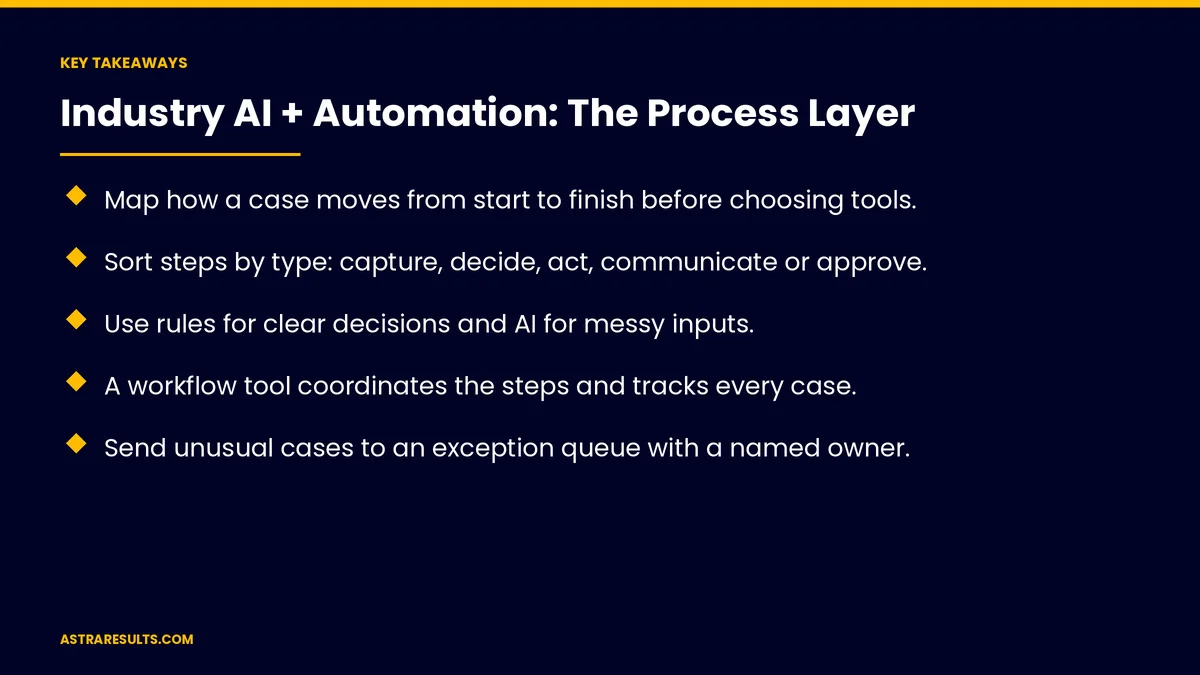
- Map how a case moves from start to finish before choosing tools.
- Sort steps by type: capture, decide, act, communicate or approve.
- Use rules for clear decisions and AI for messy inputs.
- A workflow tool coordinates the steps and tracks every case.
- Send unusual cases to an exception queue with a named owner.
- Measure cycle time, handoffs, errors and cost per case.
Published: October 14, 2026 | Reading Time: ~9 minutes | Category: Industry-Specific AI
This guide covers the process layer: mapping the process, sorting steps by type, choosing rules or AI for each step, coordinating the steps, handling exceptions, placing human checkpoints, connecting systems, industry examples and measuring by case. Put plainly: map the whole process first, then decide step by step where rules, AI and people belong.
Taking actions through agents is covered in the action layer.
In This Playbook
- Map the process
- Sort steps by type
- When should a process step use rules instead of AI?
- Coordinate the steps
- Handle exceptions
- Where should people stay in an automated process?
- Connect the systems
- Industry examples
- Start with one process
- What to measure
- The first three months
Map the process
As it runs today. Every step, who does it and how long it takes.
Where cases wait. Waiting time is often longer than working time.
As it should run. The simplest path that still meets your rules.
Built around your process, as covered in industry-specific AI.
Sort steps by type
Capture. Information comes in: forms, emails, calls and documents.
Decide. Approve, route, price or flag.
Act. Update a record, schedule a job or send a document.
Communicate. Tell the customer, the team or a partner.
Approve. A person signs off.
When should a process step use rules instead of AI?
Rules. Clear decisions with structured inputs.
AI. Reading messy inputs, drafting messages and summarizing.
Both. AI turns a document into clean data; rules decide what happens next, as weighed in GenAI vs traditional automation.
People. Judgment calls and sensitive decisions.
Coordinate the steps
A workflow tool. Moves each case from step to step.
One status per case. Everyone sees where it stands.
Timers. Alerts when a case waits too long.
Hand off routine follow-ups. As covered in delegating to software.
Handle exceptions
An exception queue. Unusual cases go to a person.
A named owner. Someone responsible for clearing it.
Learn from exceptions. Common ones become new rules.
Where should people stay in an automated process?
Before money moves. Payments, refunds and pricing.
Before customers hear bad news. Denials, delays or changes.
Before records change in bulk. Large updates reviewed first.
Connect the systems
Each step reads and writes data. CRM, accounting, scheduling and documents.
Monitor every connection. As covered in when integrations break.
Industry examples
Insurance. Quote requests captured, risks checked by rules, documents read by AI, binding approved by people, as in insurance agency AI.
Logistics. Shipment updates captured, exceptions flagged, customers told, as in logistics AI.
Home services. Requests captured, jobs scheduled around weather, changes approved, as in home services agents.
Wholesale. Reorders predicted by account and sent to reps, as in wholesaler ML.
Start with one process
Pick one with volume and pain. Many cases, many delays.
Make the case. For text-heavy steps, as in the business case for NLP.
Pilot safely. As covered in AI pilots that fail safely.
Size the effort. As weighed in is custom AI right for your size.
What to measure
Cycle time. From first contact to done.
Handoffs per case. Fewer is usually better.
Error rate. Mistakes that need rework.
Cost per case. Including review time.
Exception rate. Share of cases needing a person, as covered in automation KPIs.
The first three months
Days 1–30: map
Choose one process, map every step as it runs today, measure waiting and working time and design the simpler version.
Days 31–60: build
Assign rules, AI or people to each step, set up the workflow tool, exception queue and checkpoints and connect the systems.
Days 61–90: run and improve
Run real cases, track cycle time, errors and exceptions and turn common exceptions into new rules.
How Astra designs the process layer
Astra Results Marketing designs AI and automation around whole processes. We map how cases move, choose rules, AI or people for each step, set up workflow tools, exception queues and checkpoints and measure results by case.
Engagements begin with a process review through our industry-specific AI team.
Related reading
Frequently asked questions
What is the process layer?
The design of how a case moves from start to finish, with rules, AI and people placed at the steps where each fits best.
Why map the process before choosing AI tools?
Because speeding up one step doesn't help if cases still wait before and after it. Mapping shows where time is lost.
How do we decide between rules and AI for a step?
Use rules for clear decisions with structured inputs, AI for messy inputs and drafting, and people for judgment calls.
What is an exception queue?
A list of unusual cases sent to a named person, so they don't stall the whole process.
Where should people stay involved?
Before money moves, before customers hear bad news and before records change in bulk.
How do we measure success?
Cycle time, handoffs per case, error rate, cost per case and exception rate.
Ready to speed up a whole process, not just one step? Astra Results Marketing maps your process, places rules, AI and people where each fits, sets up workflow tools and exception queues and measures results by case. ▸ CALL (786) 321-2866 · ▸ REQUEST YOUR CONSULTATION





