 Rated 5 star on

E-Commerce Agents: Returns Processed Automatically
Quick answer
An AI agent can process most online store returns automatically, while people handle exceptions. It reads requests, applies your written policy and sends labels. Refunds happen within limits you set, and larger ones need approval. Fraud signals are flagged for staff to decide. Start with simple, clearly eligible returns.
Returns are a daily chore for online stores. Each one means reading a message, checking policy, sending a label, inspecting the item and issuing a refund. In busy seasons, returns pile up and customers wait. An AI agent can handle most of that work, while people handle exceptions and approve anything above set limits.
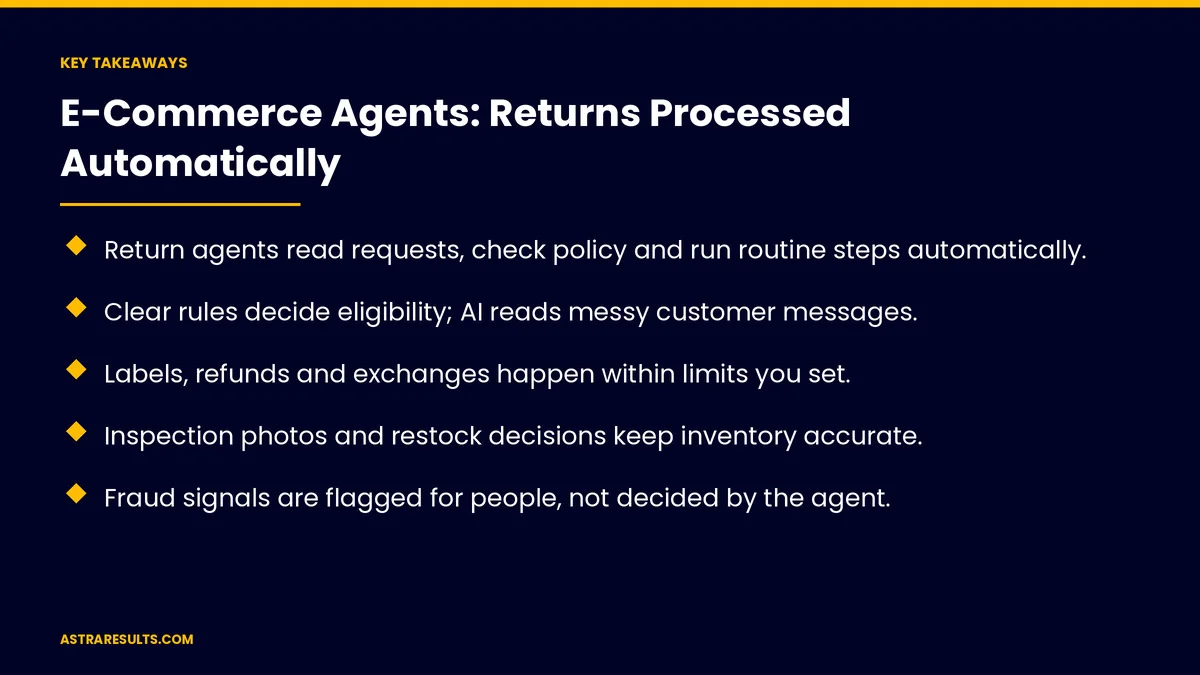
Key Takeaways
- Return agents read requests, check policy and run routine steps automatically.
- Clear rules decide eligibility; AI reads messy customer messages.
- Labels, refunds and exchanges happen within limits you set.
- Inspection photos and restock decisions keep inventory accurate.
- Fraud signals are flagged for people, not decided by the agent.
- Large refunds and exceptions need approval, with logs and a stop button.
Published: October 8, 2026 | Reading Time: ~9 minutes | Category: Custom AI Agents
This guide covers return agents for online stores: the steps they handle, reading requests, checking policy, labels and refunds within limits, inspection, restocking, fraud signals, customer updates, accounting, guardrails and what to measure. Put plainly: let the agent run routine returns by your rules, and keep people on exceptions and large refunds.
For AI across catalog and support, see e-commerce brand AI.
In This Playbook
- The steps agents handle
- Reading requests
- How does a return agent decide if a return is eligible?
- Labels and refunds within limits
- Inspection
- Restocking
- What return fraud signals should an agent flag?
- Customer updates
- Accounting
- Guardrails
- What to measure
- The first three months
The steps agents handle
Read the request. From a returns portal, chat or email.
Check eligibility. Window, condition and final-sale rules.
Choose the outcome. Refund, exchange or store credit, as the customer prefers and policy allows.
Send the label. With clear instructions.
Track the package. And update the customer.
Complete the return. After inspection.
Reading requests
Messy messages. "It's too small and the color looks different" becomes size and color reasons.
Order matching. Find the order from an email, name or order number.
Missing details. Ask a short follow-up question.
AI reads, rules decide, as weighed in GenAI vs traditional automation.
How does a return agent decide if a return is eligible?
Written rules. Return window, condition, final-sale items and fees.
Same answer every time. Rules applied consistently.
A clear posted policy. Customers see the rules before buying.
Labels and refunds within limits
Labels sent automatically. For eligible returns.
Refunds up to a set amount. Issued after inspection or on carrier scan, as you choose.
Exchanges and store credit. Offered first where policy allows.
Above the limit. Sent to a person for approval.
Inspection
Photos on arrival. Condition recorded.
Match to the reason. Damaged, wrong item or changed mind.
Disputes. Sent to a person with the photos attached.
Restocking
Restock, refurbish or dispose. Based on condition.
Inventory updated. Right away.
Across locations. Moved where it sells, as in retail inventory agents.
What return fraud signals should an agent flag?
Frequent returners. Unusual patterns flagged.
Wrong or empty packages. Flagged on inspection.
People decide. The agent flags; staff review.
Customer updates
Every step. Label sent, package received, refund issued.
Plain language. In English or Spanish.
Fast answers. Fewer "where's my refund?" messages.
Accounting
Refunds recorded. With taxes reversed, as covered in multi-currency and tax settings.
Original payment method and currency. For refunds.
Reports. Return rates and reasons by product.
Guardrails
Limits on refunds and exceptions. Approval above set amounts.
Logs and a stop button. As covered in agent security.
Start with simple returns. Then expand, as covered in the action layer.
Fits the whole process. As designed in the process layer.
Improve over time. As in the future of automation.
What to measure
Time to refund. From request to money back.
Returns handled without staff. Share of routine returns.
Exceptions and approvals. How many, and why.
Return reasons by product. To fix sizing or descriptions.
Customer satisfaction. After returns.
The first three months
Days 1–30: rules and limits
Write the return rules clearly, set refund limits and approval steps and connect the store, carrier and accounting systems.
Days 31–60: pilot simple returns
Let the agent read requests, check eligibility, send labels and update customers, with staff approving refunds at first.
Days 61–90: expand
Turn on automatic refunds within limits, add inspection photos, restocking and fraud flags and track time to refund and exceptions.
How Astra builds return agents
Astra Results Marketing builds AI agents that process online store returns. Our agents read requests, apply your policy, send labels, issue refunds within limits, update customers and inventory and flag exceptions and fraud signals for your team.
Engagements begin with a returns process review through our custom AI agent development team.
Related reading
Frequently asked questions
What can a return agent do?
Read return requests, check eligibility, send labels, track packages, issue refunds or exchanges within limits and update customers.
Who decides whether a return is eligible?
Your written rules. The agent applies them consistently, and AI only helps read messy customer messages.
Can the agent issue refunds on its own?
Up to limits you set. Larger refunds and exceptions go to a person for approval.
How does the agent handle fraud?
It flags unusual patterns and suspicious packages. Staff review and decide.
Does inventory update automatically?
Yes. After inspection, items are restocked, refurbished or disposed of, and inventory updates right away.
Where should we start?
With simple, clearly eligible returns, staff approving refunds at first, then automatic refunds within limits.
Ready for returns that process themselves? Astra Results Marketing builds return agents that apply your policy, send labels, issue refunds within limits and update customers and inventory, with your team on exceptions. ▸ CALL (786) 321-2866 · ▸ REQUEST YOUR CONSULTATION





