 Rated 5 star on

GenAI vs Traditional Automation
Quick answer
Use traditional automation when inputs are structured and rules are clear, and generative AI when inputs are messy text or images. Rule-based automation is predictable, auditable and cheap to run. Generative AI can be wrong and needs review. The strongest systems combine both, with AI reading input while rules and people decide and act.
Businesses now hear two pitches for removing repetitive work: traditional automation that follows rules, and generative AI that reads and writes like a person. Both work, but for different jobs. Using AI where a simple rule would do adds cost and risk. Using rigid rules on messy input leads to endless exceptions.
Key Takeaways
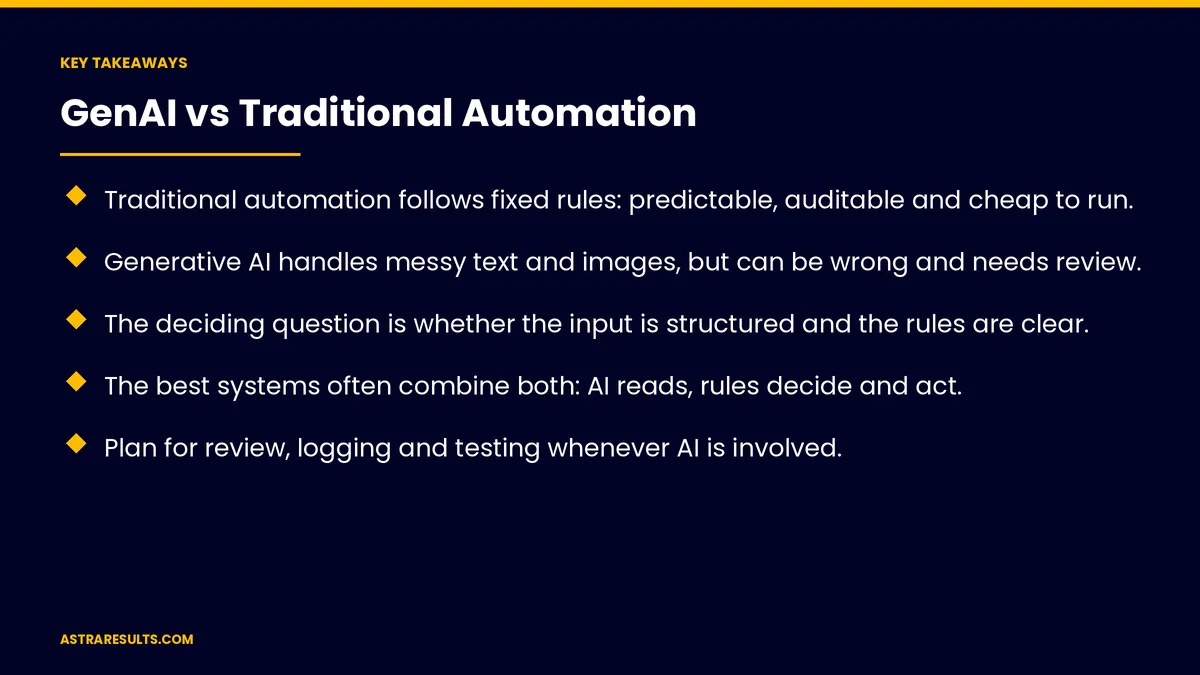
- Traditional automation follows fixed rules: predictable, auditable and cheap to run.
- Generative AI handles messy text and images, but can be wrong and needs review.
- The deciding question is whether the input is structured and the rules are clear.
- The best systems often combine both: AI reads, rules decide and act.
- Plan for review, logging and testing whenever AI is involved.
- Measure accuracy, time saved and cost per task, not just whether it runs.
Published: October 25, 2026 | Reading Time: ~9 minutes | Category: Generative AI Services
This guide compares generative AI with traditional automation: what each does well, the question that decides between them, combining both, accuracy and review, risks and controls, costs, examples by business function and what to measure. Put plainly: use rules for the predictable, AI for the messy, and connect them where the work needs both.
In This Playbook
- What traditional automation does well
- What generative AI does well
- The deciding question
- Combining both
- Accuracy and review
- Risks and controls
- Costs
- Examples by business function
- What to measure
- The first three months
What traditional automation does well
Follows clear rules. "If an invoice is approved, schedule payment."
Predictable and auditable. The same input always gives the same result.
Cheap per run. Once built, rules cost little to execute.
Brittle with mess. Unusual formats and free-form text break it.
Where it fits is covered in AI automation: removing the work that repeats.
What generative AI does well
Reads messy input. Emails, PDFs, notes and photos.
Writes and summarizes. Drafts, replies and summaries in plain language.
Sorts and extracts. Pulls names, dates and amounts from unstructured text.
Can be wrong. Results vary, and mistakes can sound confident.
Beyond chat, as covered in generative AI at work.
The deciding question
Is the input structured, and are the rules clear? Use traditional automation.
Is the input messy, or does the task need judgment about language? Consider generative AI.
Both? Combine them.
The same choice in language tasks is weighed in rules vs NLP classification.
Combining both
AI reads, rules decide. AI turns an email or document into clean data; rules route, approve and act.
Examples. Purchase orders read by AI and entered by rules, as in wholesaler purchase order reading. Invoices extracted by AI and approved by rules, as in accounts payable automation.
Agents. Agents use both, with people approving key steps, as in South Florida logistics agents.
Accuracy and review
Rules are right or broken. Errors show up as clear failures.
AI is usually right. Errors can be subtle, so review matters.
Confidence checks. Low-confidence results go to a person.
Test with real examples. A set of past cases to check accuracy before and after changes.
Risks and controls
Wrong answers. AI can state things that aren't true; keep people on important outputs.
Data privacy. Use business accounts with clear data terms.
Consistency. Fix prompts and settings, and log every result.
Limits on action. Let AI draft and suggest; let rules and people execute, as covered in the action layer.
Separate hype from value. As covered in AI in marketing: what's real and what's hype.
Costs
Traditional automation. Higher build effort, very low cost per run.
Generative AI. Lower build effort for language tasks, with a cost each time it runs.
Review time. Count the people who check AI output.
Compare per task. Total cost per completed task, including review and errors.
Examples by business function
Finance. Rules for approvals and payments; AI for reading invoices and receipts.
Sales. Rules for routing and follow-up timing; AI for drafting replies and summarizing calls.
Operations. Rules for scheduling; AI for reading notes and flagging issues.
Customer service. Rules for ticket priority; AI for drafting answers and summarizing threads.
What to measure
Accuracy. Share of results correct without edits.
Time saved. Hours returned to staff, as covered in automation KPIs.
Error rate. Mistakes that reach customers or records.
Review rate. Share of AI results sent to people.
Cost per task. Including review.
The first three months
Days 1–30: sort the work
List repetitive tasks and mark each as structured with clear rules, messy, or both. Collect real examples for testing.
Days 31–60: build and test
Automate structured tasks with rules. Pilot AI on one messy task with review and confidence checks, and connect it to rules where both are needed.
Days 61–90: measure and expand
Compare accuracy, time saved, error rate and cost per task with the baseline, then expand what works.
How Astra chooses the right automation
Astra Results Marketing helps businesses choose between rules and generative AI, and combine them where needed. We sort tasks by input and rules, build predictable automation for structured work, add AI for messy inputs with review and logging, and measure cost per task.
Engagements begin with an automation review through our generative AI services team.
Related reading
Frequently asked questions
What's the difference between generative AI and traditional automation?
Traditional automation follows fixed rules and gives the same result every time. Generative AI reads and writes language, handling messy input but with results that can vary and need review.
When should we use traditional automation?
When inputs are structured and the rules are clear, such as approvals, scheduling and routing.
When should we use generative AI?
When inputs are messy, such as emails, documents and notes, or when the task involves writing or summarizing.
Can we use both together?
Yes, and often should. AI reads messy input and turns it into clean data; rules and people decide and act.
Is generative AI more expensive?
It usually costs less to build for language tasks but costs something every time it runs, plus review time. Compare total cost per task.
How do we keep AI results reliable?
Test with real examples, send low-confidence results to people, log every result and keep AI to drafting and suggesting rather than acting alone.
Ready to put the right automation on the right work? Astra Results Marketing sorts your tasks, uses rules for the predictable and AI for the messy, connects both with review and logging, and measures cost per task. ▸ CALL (786) 321-2866 · ▸ REQUEST YOUR CONSULTATION





