 Rated 5 star on


Multi-Currency and Tax Settings for Online Stores
Quick answer
Get currency and tax settings right by deciding whether to show local prices only or also charge in them, and by pricing per market. Since the 2018 Wayfair decision, states can require out-of-state sellers to collect sales tax. Marketplaces usually collect on their sales. Refund in the original currency and keep records ready.
Selling online across states and countries brings two settings that are easy to get wrong: currency and tax. Shoppers want prices in their own currency without surprises at checkout. Governments want the right tax collected, and the rules differ by state and country. Mistakes show up as abandoned carts, unhappy customers or tax bills that arrive months later.
Key Takeaways
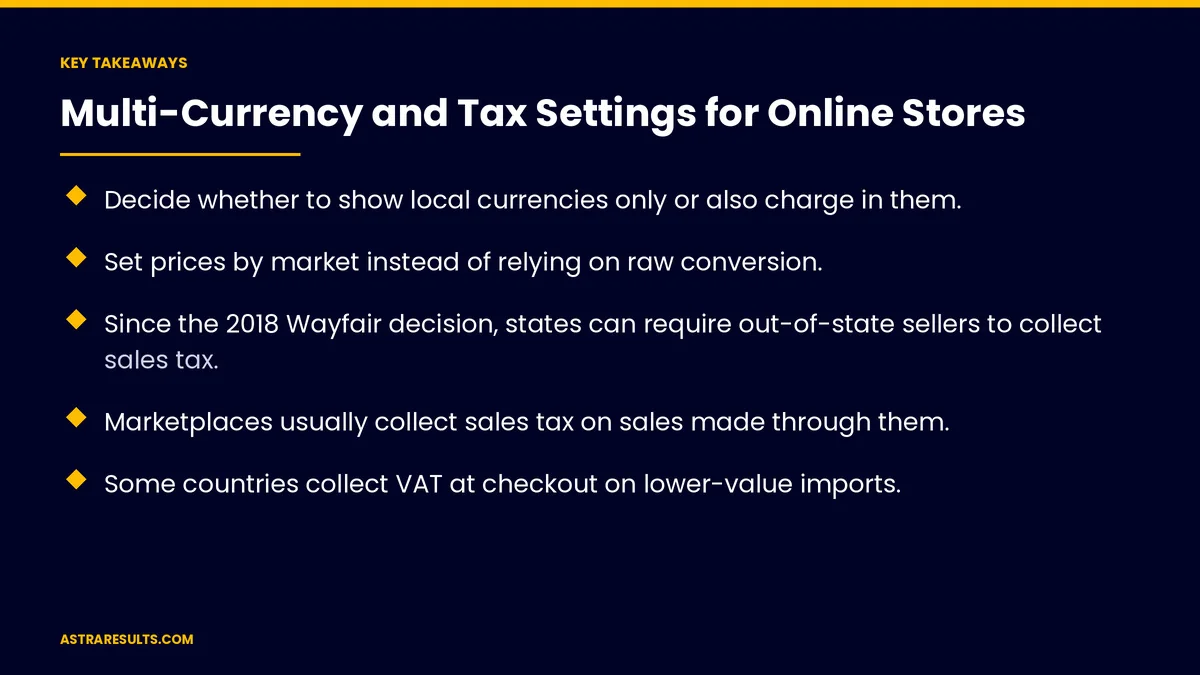
- Decide whether to show local currencies only or also charge in them.
- Set prices by market instead of relying on raw conversion.
- Since the 2018 Wayfair decision, states can require out-of-state sellers to collect sales tax.
- Marketplaces usually collect sales tax on sales made through them.
- Some countries collect VAT at checkout on lower-value imports.
- Refund in the original currency, and keep records ready for filing.
Published: October 5, 2026 | Reading Time: ~9 minutes | Category: E-Commerce Stores
This guide covers currency and tax settings for online stores: showing and charging currencies, pricing by market, US sales tax, marketplace sales, what's taxable, business buyers, overseas taxes, refunds, records and what to measure. Put plainly: show clear prices in each currency, collect tax where you're required to and keep records that make filing simple.
This is general information, not tax advice. Confirm your obligations with a CPA or tax advisor.
In This Playbook
- Should a store show local prices but charge in dollars?
- Pricing by market
- US sales tax
- Marketplace sales
- What's taxable
- Business buyers
- Overseas taxes
- In which currency should refunds be issued?
- Records
- What to measure
- The first three months
Should a store show local prices but charge in dollars?
Display only. Prices shown in local currency, charged in dollars.
Charge in local currency. Shoppers pay in their own currency.
Say which one. Make the charge currency clear before payment.
Conversion fees. Know who pays them: you or the shopper's bank.
Pricing by market
Round prices. Set clean local prices, not long decimals.
Review regularly. Exchange rates move.
Include shipping and duties. Show the full cost, as covered in selling to Latin America.
US sales tax
Economic nexus. Since the 2018 South Dakota v. Wayfair decision, states can require out-of-state sellers to collect sales tax once sales pass a threshold.
Thresholds vary. Florida's is $100,000 in sales a year; other states set their own.
Track sales by state. Know when you cross a threshold.
Register before collecting. Each state has its own process.
Marketplace sales
Marketplaces usually collect. Most states require large marketplaces to collect sales tax on sales made through them.
Your own store is separate. You remain responsible for direct sales.
Selling in both places is weighed in marketplace presence.
What's taxable
Products differ. Clothing, food and digital goods are treated differently by state.
Shipping charges. Taxable in some states, not others.
Use tax tools. Automated rate calculation by address.
Choose tools carefully. As covered in Shopify apps.
Business buyers
Resale and exempt buyers. Collect and store exemption certificates.
Apply exemptions correctly. At checkout or by account.
Overseas taxes
VAT and GST. Many countries charge these on imported goods.
Collected at checkout in some places. The EU on many imports up to €150 and the UK on goods up to £135.
Duties. Charged by destination countries; show them before payment.
Shipping abroad is covered in international shipping.
In which currency should refunds be issued?
Same currency. Refund in the currency the customer paid.
Tax refunded too. Reverse collected tax on returns.
Exchange differences. Know how your payment provider handles them.
Records
Every order's tax and currency. Saved automatically.
Sync to accounting. As covered in QuickBooks integrations.
Ready for filing. Reports by state and country.
Before peak season. Check settings well ahead, as in Black Friday planning.
What to measure
Checkout drop-off by country. Signs of currency or cost surprises.
Sales by state. Against nexus thresholds.
Tax collected and filed. By state and country.
Refund accuracy. Correct currency and tax.
Conversion fees. As a share of sales.
The first three months
Days 1–30: review
Confirm tax obligations with a CPA, check sales by state against thresholds and decide display or charge currencies by market.
Days 31–60: set up
Set local prices, turn on automated tax calculation, store exemption certificates and show duties and taxes before payment.
Days 61–90: test and track
Test checkout and refunds in each currency, sync records to accounting and track drop-off and sales by state.
How Astra sets up currencies and taxes
Astra Results Marketing sets up online stores to sell across states and countries. We configure currencies and local prices, connect automated tax tools, show full costs before payment and sync records to accounting, working alongside your tax advisor.
Engagements begin with a store review through our e-commerce stores team.
Related reading
Frequently asked questions
Should we charge in local currencies?
It depends. Showing local prices helps shoppers; charging in local currency removes surprises but adds conversion and refund steps.
When do we have to collect sales tax in other states?
When your sales into a state pass its threshold. Since the 2018 Wayfair decision, states can require this. Florida's threshold is $100,000 a year.
Do we collect tax on marketplace sales?
Usually the marketplace collects on sales made through it. Your own store's direct sales remain your responsibility.
Are all products taxed the same way?
No. Clothing, food, digital goods and shipping are treated differently by state. Automated tax tools help.
What about selling overseas?
Many countries charge VAT or GST and duties. The EU and UK collect VAT at checkout on many lower-value imports.
How should refunds work?
In the currency the customer paid, with collected tax reversed.
Ready to sell across states and borders with confidence? Astra Results Marketing sets up currencies, local prices and automated tax tools, shows full costs before payment and keeps records ready for your tax advisor. ▸ CALL (786) 321-2866 · ▸ REQUEST YOUR CONSULTATION





