Rated 5 star on


Franchise Intake: One System, Every Location
Quick answer
A franchise brand should run one intake system that answers every inquiry in the brand's voice, using each location's facts. Routing rules decide which unit owns the lead and what happens if it does not respond. Each franchisee keeps its calendar and customer. Reporting by location turns speed to lead into a network standard.
A brand with forty locations has forty ways of answering the phone. Twelve answer well. Fifteen answer eventually. Thirteen have a voicemail that fills up. The national campaign sent leads to all forty at the same cost per click. The brand's single conversion rate hides that a third of the network never picked up.
Key Takeaways
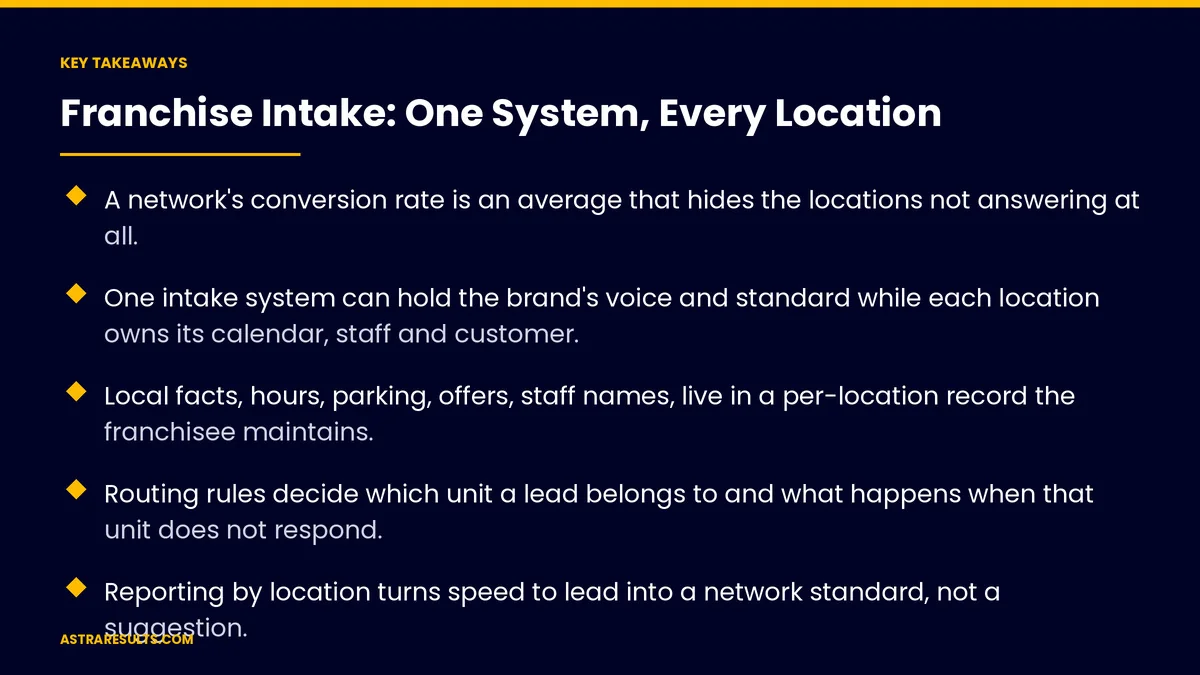
- A network's conversion rate is an average that hides the locations not answering at all.
- One intake system can hold the brand's voice and standard while each location owns its calendar, staff and customer.
- Local facts, hours, parking, offers, staff names, live in a per-location record the franchisee maintains.
- Routing rules decide which unit a lead belongs to and what happens when that unit does not respond.
- Reporting by location turns speed to lead into a network standard, not a suggestion.
- The franchise agreement, not the software, decides who owns the customer record; settle it first.
Published: October 13, 2026 | Reading Time: ~12 minutes | Category: Inbound Intake
Franchise intake means giving every location the best location's response without taking the location out of the conversation. The franchisor owns the brand, the campaign and the standard. The franchisee owns the customer, the calendar and the staff.
This piece covers the one system that serves both: brand voice with local facts, central routing with local ownership, and reporting by unit. Put plainly: one standard of response, forty local conversations, one report the brand can read.
Guidance for franchisors, area developers and multi-unit operators. Nothing here is legal advice. Franchise agreements, data ownership between franchisor and franchisee, joint-employer considerations and text consent are governed by the agreement and by law that varies by state, and must be confirmed with counsel.
In This Playbook
- The average that hides the network
- Brand voice, local facts
- How should franchise leads be routed to each location?
- What every unit gets
- What the brand gets
- Getting franchisees to want it
- Where it fails
- The numbers that move
- The first three months
The average that hides the network
One number for forty markets. Brand reporting rolls up leads and conversions across the system. A 12% network conversion rate is the mean of some units at 25% and some at zero. The campaign cost the same in both.
Where the zeros are. Locations without a front desk. Locations where the owner runs the floor. Locations where the number on the listing rings a phone nobody carries. These are invisible in the roll-up and obvious the moment anyone reports by unit.
Why franchisees cannot fix it alone. Each is a small business with the small-business intake problem described in every lead answered in seconds, buying a solution alone at small-business prices, if at all. The brand can solve it once for everyone.
The tension. Franchisees resist anything that feels like the brand taking their customers. The design has to give them a better response to their own leads, not a central call center that owns the relationship. The balance is the one drawn in centralized versus location-level marketing, applied to the minutes after the click.
Brand voice, local facts
What is the brand's. The voice. Greeting, tone, how the brand says no, how it apologizes, what it never says. The standard: response within minutes, every channel, every hour. The offers that run system-wide. The compliance lines the brand's counsel has drawn. The voice guide is built once, following replies in your voice, and every unit speaks with it.
What is the location's. Hours, including the holiday exceptions. Address, parking, the entrance that is not on the map. Staff names. The calendar and its real availability. Local offers the franchisee is allowed to run. Which services this unit offers and which it does not.
The per-location record. A structured page the franchisee owns and can update in minutes, read by the system every time it answers for that unit. When the record is stale, the answer is wrong. The franchisee sees the staleness in their own report.
The result. A customer in Doral and a customer in Fort Lauderdale hear the same brand and get their own location's facts. Neither is told to "check the website."
How should franchise leads be routed to each location?
By geography. The lead's location, from the form, the number's area, the listing they contacted or their stated address, mapped to the unit's territory as the franchise agreement defines it. Boundaries are the agreement's, loaded as rules, not guessed.
By service. A unit that does not offer the service routes the lead to the nearest that does, under rules the brand and the franchisees have agreed, with the referral recorded.
By capacity. Where the agreement allows, a lead that a unit cannot serve within a set window can be offered the next nearest unit, with the customer's consent and the originating unit credited.
When a unit does not respond. The system holds the conversation: answers, qualifies, books into the unit's calendar. If a human is required and the unit's staff do not pick up within the standard, escalation goes to the owner, then the area developer, and the miss is recorded. Nothing is silently lost.
Ambiguity. A lead the rules cannot place goes to a person at the brand or the area level, with the conversation attached, within the same standard.
What every unit gets
The same response. Every inquiry, every channel, every hour, answered in the brand's voice with the unit's facts within minutes. The evening and weekend hole described in the metric nobody tracks is closed for the whole network at once.
Booking into their own calendar. Appointments, trials, quotes and visits scheduled against the unit's real availability, with confirmations and reminders in the brand's voice and the unit's name.
Their own leads, their own customers. The conversation, the booking and the record belong to the unit as the agreement says. The brand sees the metrics. The franchisee sees the customer.
Spanish, where the market needs it. A unit in Hialeah and a unit in Naples serve different populations. The system handles both languages natively for every unit. The tone follows the customer, as described in what changes when Spanish is a channel.
What the brand gets
Speed to lead by unit. Median and 90th percentile, by channel and hour, for every location, every month. The network standard becomes measurable and enforceable.
Contacts with no reply by unit. The zeros, named. Usually the most persuasive page in the first report.
Campaign performance by unit. The national campaign's leads traced to each location's response and conversion, so the brand can see that the campaign worked and the response did not, or the reverse. This joins to attribution across every channel at the network level.
Compliance visibility. Sampled transcripts across the network, checked against the brand's lines, with the franchisee's own conversations excluded where the agreement requires.
Onboarding. A new unit opens with the brand's intake on day one, its record filled in during pre-opening, and its first month's speed to lead reported like everyone else's.
Getting franchisees to want it
Show them their own number. The self-audit from the speed-to-lead piece, run for their unit, with the contacts they missed counted. Most owners have never seen it and act on it immediately.
Give them the fix before the standard. The system answering their leads in their name from week one, before the brand reports on them. Franchisees who have felt the benefit accept the measurement.
Make the record theirs. The per-location facts are edited by the franchisee, not submitted to the brand for approval. Ownership of the facts is ownership of the answers.
Settle the data question in the open. Who owns the customer record, who can market to it, what happens on transfer or exit. The agreement decides. The system enforces it. Everybody knows what it says.
Report to them first. Each franchisee sees their own report before the brand sees the roll-up. Nobody learns about their zeros from head office.
Where it fails
A call center in disguise. Central staff answering as the brand and booking into a shared queue. Franchisees see their customers taken. The design fails politically before it fails operationally.
Stale local records. Wrong hours, departed staff names, an offer that ended. The answer is wrong in the brand's voice, which is worse than no answer.
Territory rules that do not match the agreement. Leads routed across a boundary the agreement protects. A legal problem created by a configuration file.
Reporting without the fix. A brand that measures speed to lead by unit without giving units the means to hit the standard has produced a scorecard, not a system.
The numbers that move
Network speed to lead. Median and 90th, with the spread between best and worst unit, which should narrow every month.
Zeros. Contacts with no reply, by unit, falling to none.
Booked per lead by unit. The conversion the campaign was paying for, made visible where it was lost.
Campaign return by unit. The same spend, now with a response that does not vary by market.
Time to onboard a unit. Days from signing to the brand's intake live for the new location.
Franchisee satisfaction. Asked, because a system that franchisees resent will be worked around, and one they value will be defended.
The first three months
Days 1–30: the network baseline
Speed to lead and no-reply counts measured for every unit from existing timestamps and phone logs. The data-ownership and territory questions confirmed against the agreement with counsel. Brand voice guide drafted. Per-location record template built and filled by five pilot franchisees. Routing rules written from the agreement's territories.
Days 31–60: the pilot units
Intake live for the pilot units in the brand's voice with each unit's facts, booking into each unit's calendar, in English and Spanish. Escalation rules tested with real non-responses. Pilot franchisees see their own report weekly. Voice guide and record template revised from their feedback.
Days 61–90: the network
Rollout to remaining units in waves, each franchisee filling their record before go-live. Network report live: speed to lead, zeros, booked per lead and campaign return by unit, delivered to each franchisee before the roll-up reaches the brand. Onboarding playbook written for the next new unit.
How Astra handles it
Astra Results Marketing begins with the network baseline by unit, because a brand that has only seen its average has never seen its problem. The data-ownership and territory questions are settled against the franchise agreement with counsel before any rule is configured. The voice guide is the brand's while the facts belong to each location.
The pilot goes live with franchisees who have seen their own numbers and asked for the fix, in both languages, booking into each unit's calendar. Rollout follows in waves, every franchisee editing their own record and reading their own report before head office sees the roll-up.
Reporting runs on speed to lead, zeros, booked per lead and campaign return, by unit, monthly. Engagements begin with a network baseline through our AI inbound sales team.
Related reading
Frequently asked questions
Why does a network's conversion rate mislead?
Because it averages units that answer every lead with units that answer none. The national campaign costs the same in every market, so the roll-up hides where the spend was wasted. Reporting by unit shows it immediately.
Is this a central call center?
No. Central staff answering as the brand and owning the relationship is the design franchisees reject, for good reason. One system answers in the brand's voice with each unit's facts, books into each unit's calendar, and leaves the customer with the franchisee.
What does each location control?
Its hours, address, parking, staff names, calendar and availability, the services it offers and the local offers it is allowed to run, held in a per-location record the franchisee edits directly. The brand controls the voice, the standard and the compliance lines.
How are leads routed between units?
By the territories in the franchise agreement, loaded as rules rather than guessed, with service-based and capacity-based referrals only where the agreement allows and the originating unit is credited. Leads the rules cannot place go to a person at the area or brand level.
Who owns the customer data?
The franchise agreement decides, and the system enforces whatever it says: who holds the record, who may market to it. What happens on transfer or exit. This is confirmed with counsel before any rule is configured, and every franchisee knows the answer.
How do franchisees come to accept it?
By seeing their own speed to lead and missed contacts first, getting the fix before the standard is enforced, owning the facts the system answers with, and reading their own report before head office sees the roll-up.
Ready to give every location your best location's response? Astra Results Marketing measures speed to lead for every unit in your network, settles the data and territory rules against your agreement, and takes intake live in the brand's voice with each location's facts, reported by unit every month. ▸ CALL (786) 321-2866 · ▸ REQUEST YOUR CONSULTATION