Rated 5 star on


Logistics Intake: Quote Requests Answered in Minutes
Quick answer
A freight forwarder, 3PL or courier wins the shipment by returning a usable quote first. Intake should collect every required field in one exchange. Routine lanes are priced from the rate sheet in minutes. Complex ones go to a person with the complete file. Screening happens at intake, and follow-up continues until booked or lost.
A shipper emails four forwarders at 4:50 pm. Two pallets, Miami to Bogotá, ready Monday, need a rate. Three reply the next morning asking for dimensions, weight and Incoterms, one question at a time. The fourth asked everything in one message, had answers by 5:30 and quoted by 6. The shipment moved with the fourth. So did the next twelve.
Key Takeaways
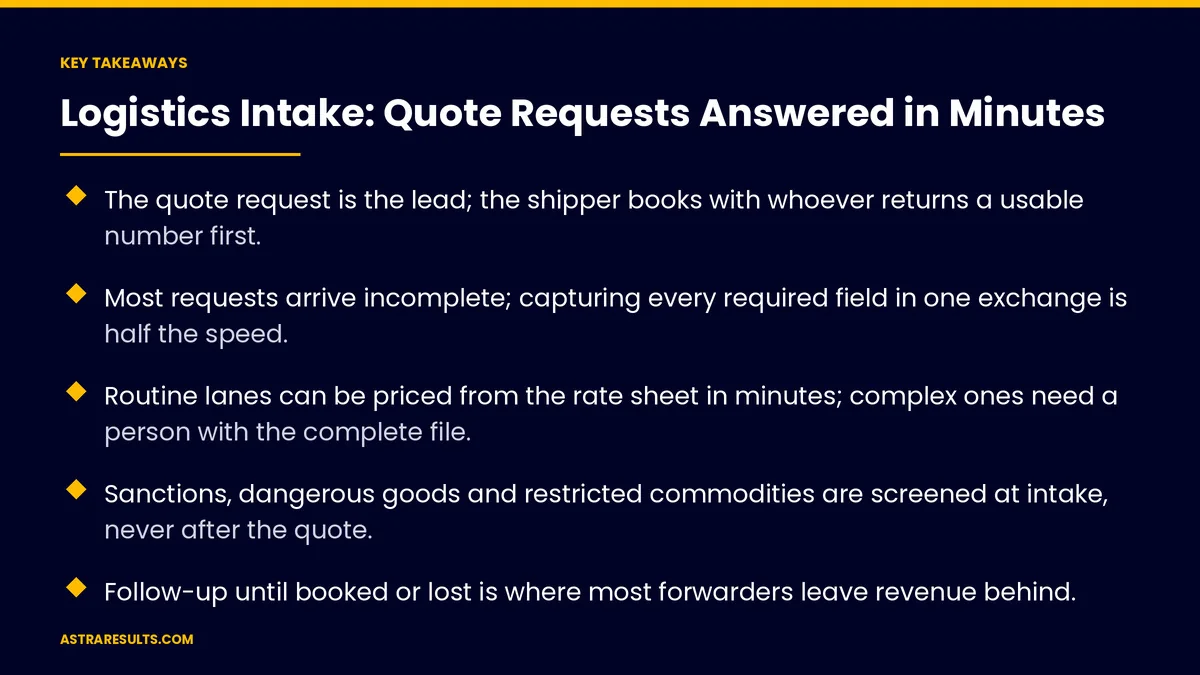
- The quote request is the lead; the shipper books with whoever returns a usable number first.
- Most requests arrive incomplete; capturing every required field in one exchange is half the speed.
- Routine lanes can be priced from the rate sheet in minutes; complex ones need a person with the complete file.
- Sanctions, dangerous goods and restricted commodities are screened at intake, never after the quote.
- Follow-up until booked or lost is where most forwarders leave revenue behind.
- Measure by time to complete request, time to quote, quote-to-booking rate and margin on booked quotes.
Published: October 19, 2026 | Reading Time: ~12 minutes | Category: Inbound Intake
In logistics the quote request is the lead, the quote is the pitch, and the shipper with a usable number first usually books. This piece covers how forwarders, 3PLs, couriers and customs brokers capture a complete request in one exchange, price routine lanes in minutes, route complex ones to a person, and follow up until booked or lost.
Put plainly: the forwarder who asks every question at once and answers with a number wins the lane.
Guidance for owners and operators of freight, logistics and customs businesses. Nothing here is legal advice. Customs, dangerous goods, sanctions screening, licensing and carrier liability are governed by rules that vary by jurisdiction and mode and must be confirmed with counsel and the business's compliance function.
In This Playbook
- The quote request is the lead
- Capturing a complete request in one exchange
- Screening at intake, not after
- Pricing the routine, routing the complex
- Follow-up until booked or lost
- Documents and tracking after the booking
- Channels and language
- The numbers that move
- The first three months
- How this is done at Astra
The quote request is the lead
The shape of the sale. A shipper with freight to move sends the same request to several providers and books with the one that comes back fastest with a credible number. Loyalty exists, but it is earned on the first shipment, and the first shipment goes to whoever quoted first.
What "first" means. Minutes for routine lanes, the same business day for complex ones, and a reply within minutes either way that confirms receipt and asks for what is missing. A shipper who hears nothing for four hours has moved on.
Why most forwarders are slow. Requests arrive by email, WhatsApp, web form and phone, incomplete, to an operations person who is also booking today's shipments. The request waits behind the work. The intake principle in every lead answered in seconds applies, with a longer and more technical conversation.
Capturing a complete request in one exchange
The missing fields. Origin and destination with postcodes or ports. Mode preference. Pieces, dimensions and weight. Commodity and HS code where known. Incoterms. Ready date and required delivery. Hazardous, temperature-controlled, oversize. Insurance. Whether customs clearance is needed at either end.
The failure. Asking for them one at a time, over a day. Every round trip is an hour the shipper spends reading a competitor's quote.
What the system does. Reads the incoming request in whatever form it arrived, identifies what is present and what is missing, and asks for everything missing in one message, in the shipper's language. Accepts a photo of a packing list or a forwarded purchase order and extracts the fields. Confirms the complete request back in a structured summary.
Repeat shippers. Known accounts have known commodities, addresses and terms on file. The system fills those in and asks only what changes: quantity and dates. Identity is confirmed before any account detail is used, the same rule that governs account questions in wholesale.
Screening at intake, not after
What is screened. Parties against sanctions and denied-party lists. Commodities against dangerous goods, dual-use and restricted categories. Destinations against embargoes and route restrictions. The screening rules are the compliance function's. The system applies them consistently at the moment the request is complete.
Why at intake. A quote issued and then withdrawn because a party failed screening is a reputational cost and, in some cases, a regulatory one. Screening first means the quote that goes out can be honored.
What happens on a hit. The request routes to compliance with the screening result attached. The shipper receives a neutral message that the request is under review. Nothing is quoted, and the system does not explain why.
Miami's lanes. A large share of South Florida freight moves to and from Latin America and the Caribbean, where destination-specific rules change often. The permitted-lane list is maintained by compliance and read by the system, never guessed.
Pricing the routine, routing the complex
Routine. Known lane, standard commodity, standard equipment, dates within the rate sheet's validity. The system prices from the current rate sheet and surcharges, applies the account's margin rule, and issues a quote with validity date and terms. Minutes, at any hour.
Complex. Project cargo, out-of-gauge, dangerous goods, new lanes, spot-market ocean, anything where the rate sheet does not apply or the margin decision needs judgment. The system prepares the complete file, attaches the nearest comparable quotes and the current carrier rates it can see, and hands it to a pricing person. The person prices; the system sends.
The line between them. Set by the business and adjusted as the system proves reliable. It starts conservative. Every routine quote issued without a person is reviewed in samples until the error rate justifies widening the list.
Rate validity and surcharges. Fuel, security, peak season, currency. Stated on the quote, pulled from the current tables, expiring on a date the system tracks so the follow-up can say "your rate is valid until Friday."
Follow-up until booked or lost
The leak. Most forwarders send the quote and wait. The shipper is comparing four. Silence is a decision. A follow-up on the day the rate expires and again two days later recovers bookings that would have gone to a competitor who called.
The sequence. Confirmation of the quote sent. A check-in the next business day: any questions, anything to adjust. A note before validity expires. A final message asking whether the shipment moved and with whom, which is the most valuable intelligence a forwarder can collect and almost never does.
Booking. When the shipper says yes, the system converts the quote to a booking request with the complete file, confirms the pickup window and hands to operations. Nothing is retyped.
Lost. Recorded with the reason where the shipper gives one: price, transit time, relationship, timing. Reported monthly by lane so pricing and sales know where the business is losing and why. This closes the loop with the outbound side described in pipeline without a sales floor.
Documents and tracking after the booking
Documents. Commercial invoice, packing list, bill of lading or air waybill, certificates of origin. Collected from the shipper by message, checked for completeness, and filed against the shipment. Missing documents chased before they delay the cargo, not after.
Tracking. Where is my shipment, at every stage, answered from the carrier's data in one sentence with the next milestone. Proactive updates at departure, arrival, customs release and delivery, so the shipper stops asking. The same prevention logic described for consumer orders in e-commerce engagement applies to a container.
Exceptions. Customs holds, rolled cargo, damage, missed pickups. Routed to a person immediately, with the file, and the shipper told what is happening before they find out from the consignee.
Invoicing. Rate, surcharges and pass-through charges reconciled against the quote before the invoice goes out, which is the point where forwarders lose margin to unbilled charges. The automation kinship with accounts payable is direct.
Channels and language
Email and WhatsApp. The two channels that carry most requests, often with attachments. The system reads both, extracts fields from attachments, and replies on the channel the shipper used.
Web forms. Redesigned to capture the complete request the first time, with the same field logic the system applies to email.
Phone. Still used for urgent and complex shipments. Answered, the request captured in structure, and a person called in for anything the system cannot price.
Spanish and Portuguese. For a Miami forwarder, requests in Spanish are the norm and Portuguese is common. Requests captured, confirmed and quoted in the shipper's language and tone, following what changes when Spanish is a channel, with compliance screening identical in every language.
The numbers that move
Time to complete request. From first contact to all fields captured, before and after. The largest change for most forwarders.
Time to quote. Routine and complex separately. Routine in minutes; complex within the business day.
Quote-to-booking rate. By lane, by account, by whether the follow-up sequence ran.
Margin on booked quotes. Including pass-through charges reconciled, so the number is real.
Lost-quote reasons by lane. The intelligence that reprices the rate sheet.
Operations hours returned. Time moved from quoting and chasing documents to moving freight, counted against a baseline in the manner of attribution across every channel. Every booking traced to its request and its source.
The first three months
Days 1–30: requests logged, rules written
Thirty days of quote requests logged by channel, completeness, time to complete and time to quote. Required-field list per mode agreed. Screening rules and permitted-lane list confirmed with compliance. Rate sheets, surcharges and margin rules loaded. The routine-versus-complex line drawn conservatively.
Days 31–60: capture and price
Every request acknowledged within minutes in the shipper's language with all missing fields asked at once. Attachments read. Screening applied at completion. Routine lanes quoted from the rate sheet; complex files prepared and handed to pricing. Follow-up sequence live on every quote.
Days 61–90: documents, tracking, review
Document collection and proactive tracking live on booked shipments. Lost-quote reasons collected and reported by lane. Routine list widened where sample review supports it. Time to quote, quote-to-booking rate and margin compared to Day 1, with compliance reviewing a sample of screened requests.
How this is done at Astra
Astra Results Marketing starts with the request log, because most forwarders know they are slow to quote and none have measured how much of that time is spent asking for fields one at a time. The required-field list and the screening rules are agreed with operations and compliance before the system sends a message.
Capture goes live first, in three languages, with every missing field asked in one exchange and screening applied when a request is complete. Routine lanes are priced from the rate sheet within a list that widens as review supports it. Complex files reach pricing complete. Follow-up runs on every quote until booked or lost, with reasons reported by lane.
Reporting covers time to quote, booking rate and margin. Engagements begin with a request log through our AI inbound sales team.
Related reading
Frequently asked questions
Why does quoting speed matter so much in logistics?
Because shippers send the same request to several providers and book with the first credible number. Loyalty is earned on the first shipment. The first shipment goes to whoever quoted first with a complete, honorable rate.
What makes a quote request complete?
Origin and destination, mode, pieces, dimensions and weight, commodity and HS code, Incoterms, ready and required dates, special handling, insurance and customs needs. The system asks for everything missing in one message and reads attachments such as packing lists to fill fields.
Why screen before quoting?
A quote withdrawn because a party or commodity failed screening is a reputational and sometimes regulatory cost. Screening at the moment the request is complete means every quote issued can be honored. Hits route to compliance. The shipper is told the request is under review, without explanation.
Which quotes does the system price on its own?
Routine ones: known lane, standard commodity and equipment, dates within rate-sheet validity, priced with the account's margin rule. The list starts conservative and widens as sampled quotes prove accurate. Everything else goes to a pricing person with the complete file attached.
What happens after the quote is sent?
A confirmation, a next-day check-in, a note before the rate expires, and a final message asking whether the shipment moved and with whom. Booked quotes convert to booking requests without retyping. Lost ones are recorded with reasons and reported by lane.
How is the return measured?
Time to complete request, time to quote for routine and complex separately, quote-to-booking rate by lane and account, margin on booked quotes with pass-through charges reconciled, lost-quote reasons. Operations hours returned, each against a thirty-day baseline.
Ready to quote before the competitor asks their first question? Astra Results Marketing logs your requests, writes the required-field and screening rules with your operations and compliance teams, prices routine lanes in minutes and follows up every quote until it is booked or lost, measured in bookings and margin. ▸ CALL (786) 321-2866 · ▸ REQUEST YOUR CONSULTATION