Rated 5 star on

Engagement + GenAI: Replies in Your Voice
Quick answer
AI-drafted replies sound like a business when they follow a working voice guide with real examples. The guide sets register, such as tú or usted, by situation. Replies state only facts from the customer record and maintained knowledge. A person sends every draft. Astra reviews real replies weekly to keep the voice from drifting.
Everyone has received the reply. "Thank you so much for reaching out! We truly apologize for any inconvenience this may have caused. Your satisfaction is our top priority." Nobody at the business talks like that. The customer knows a machine wrote it. The business has told them in its first sentence that they were not worth a person.
Key Takeaways
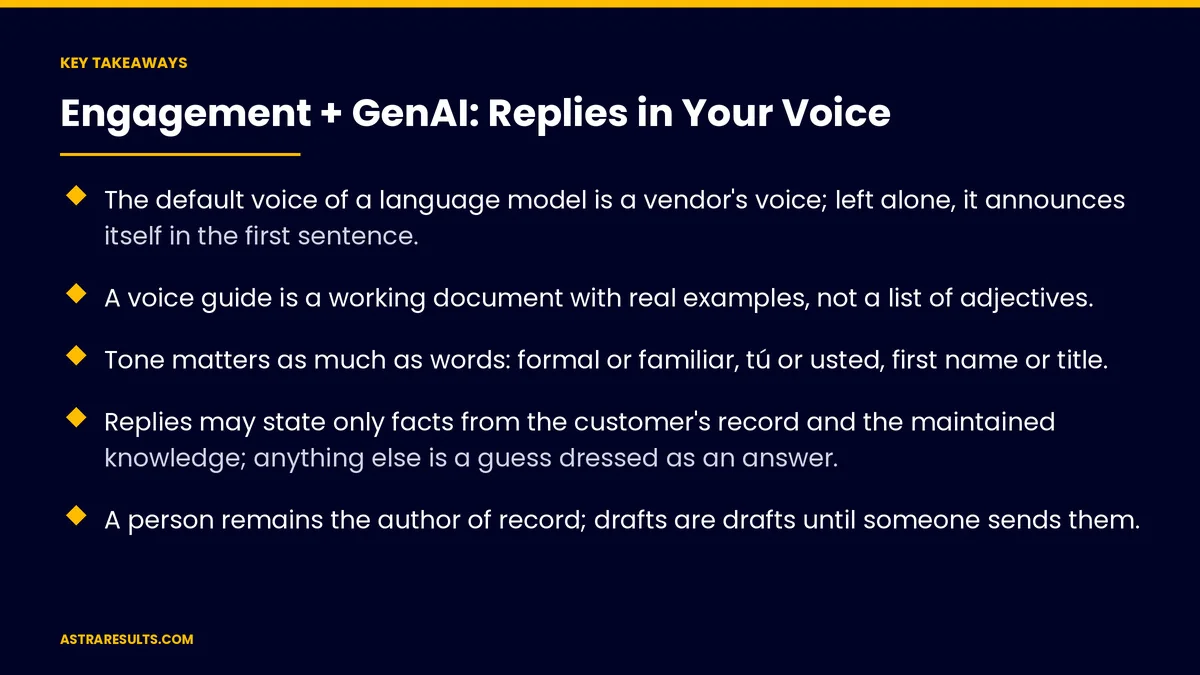
- The default voice of a language model is a vendor's voice; left alone, it announces itself in the first sentence.
- A voice guide is a working document with real examples, not a list of adjectives.
- Tone matters as much as words: formal or familiar, tú or usted, first name or title.
- Replies may state only facts from the customer's record and the maintained knowledge; anything else is a guess dressed as an answer.
- A person remains the author of record; drafts are drafts until someone sends them.
- The voice drifts; a weekly review of real replies is what keeps it.
Published: October 9, 2026 | Reading Time: ~12 minutes | Category: Customer Engagement
Generative models can draft customer replies faster than any team, and most deployments waste that by shipping the default voice. This piece is about the other outcome: replies that sound like the owner, the front desk, the account manager, in the register the customer used, saying only what the business knows to be true.
Put plainly: the model supplies the speed; the business has to supply the voice, and it has to write it down.
Guidance for owners and the people who run customer communication. Nothing here is legal advice. Disclosure of automated communication, recorded consent and what regulated industries may say to customers are governed by rules that vary by jurisdiction and sector and should be confirmed with counsel.
In This Playbook
- Why does an AI model's default reply voice fail customers?
- The voice guide: a working document
- Register: the part most guides miss
- Facts only: the guardrail that matters most
- Tone by situation
- The person remains the author
- Keeping the voice: the review loop
- What it returns
- The first three months
Why does an AI model's default reply voice fail customers?
It over-apologizes. Three sorries before the answer. Customers read it as insincerity because it is. Nobody at the business is that sorry about a delivery window.
It hedges and pads. "May," "might," "I understand that," "please feel free to." Every phrase adds length and removes commitment.
It is uniformly warm. The same brightness for a thank-you, a complaint and a cancellation. Real people modulate. A flat voice reads as absence.
It never says no. Models are tuned to be agreeable. A business has to be able to say "we do not do that" plainly. The reply has to be able to say it too.
It sounds like every other business. Which is the point. The default voice is the mean of the internet. The drafting capability itself is covered in generative AI at work. This piece is about making it sound like one business in particular.
The voice guide: a working document
Not adjectives. "Friendly, professional, approachable" describes every business in the country and constrains nothing. A voice guide that a model can follow is made of rules and examples.
What goes in it. How the business greets, by channel. How it signs off. What it calls the customer: first name, title, nothing. Words it uses and words it never uses. How long a reply should be, by situation. How it says no. How it apologizes when something was its fault, and how it responds when it was not.
Real examples. Twenty to forty replies the owner or the best front-desk person wrote, chosen because they sound right. Paired where possible with the generic version they replaced. The model learns more from these than from any instruction.
Situation by situation. A thank-you, a complaint, a delay, a refund refused, a price question, an out-of-scope request, a customer who is distressed. Each gets its own example set and its own length and tone rule.
Who writes it. The person whose voice it is, with someone to structure it. It is not delegated to the vendor, because the vendor does not know how the business talks.
Register: the part most guides miss
Formal or familiar. A law firm and a taco shop should not draft in the same tone. Neither should a law firm's reply to a corporate client and its reply to an individual. The guide sets the default and the exceptions.
Match the customer. A customer who writes "hey, quick question" gets a shorter, lighter reply than one who writes "Dear Sir or Madam." The system reads the tone of the incoming message and drafts to it, within the business's range.
Spanish: tú or usted. This is not a translation question. Usted to a customer who used tú is cold; tú to one who used usted is presumptuous. The default depends on the business and the market. The exceptions depend on the customer.
Tone rules for Spanish are written into the guide alongside the English ones, following the principles in what changes when Spanish is a channel.
Names and titles. First name, señor and apellido, Dr. or nothing at all. Getting this wrong is the fastest way to sound like a stranger.
Facts only: the guardrail that matters most
The failure. A model asked to reply helpfully will, when it does not know something, produce a plausible sentence. A delivery date it invented. A policy that does not exist. A price from another business. Fluent, confident and wrong.
The rule. A reply may state only what is in the customer's record, the maintained knowledge base or the conversation itself. Anything else is either "I will find out" or a handoff. The reply is constrained to sources, and the sources are named in the draft so the reviewer can check.
What this looks like in practice. The system retrieves the order, the policy and the previous tickets, drafts from them, and marks any claim it could not source. The reviewer sees a draft with the facts highlighted and the unsourced sentence flagged or removed.
Why it is a voice issue too. Made-up specifics are the second-fastest way to lose trust after the vendor voice. A business that says "I will check and come back to you within the hour" sounds like a business; one that guesses sounds like a machine that guessed.
Tone by situation
Thank-you. Short, specific, warm at the level the business is warm. Names the thing the customer did.
Complaint the business caused. One clear apology, the fix, the timeline, a person's name. No hedging about whether it was a problem.
Complaint the business did not cause. Acknowledgment without apology, the facts, what can be done. Sympathy is not admission.
Delay. The new date, the reason in one sentence if there is one worth giving, what the customer can do meanwhile.
Refusal. Plainly, with the reason, and with an alternative if one exists. "We do not offer that. What we can do is."
Distress. Slower, fewer words, a person's name and a direct route to them. Often the right draft is a handoff, not a reply. The tiering logic in intelligent support decides which situations get a draft at all.
The person remains the author
Drafts, not sends. Above a risk threshold the business sets, a person reads, edits and sends. The draft saves them the writing. The sending stays theirs. The skill of editing a draft rather than writing from scratch is the one described in AI for customer support teams.
Below the threshold. Order confirmations, appointment reminders, receipts, routine status. Sent automatically, in the voice, from sources, with the person's name where the business signs its messages.
Disclosure. Whether and how the business tells customers a message was drafted or sent by software is partly a legal question and partly a brand one. The guide records the decision and the reply follows it.
Who signs. A message signed "Maria" should be one Maria would send. If she would not, the draft is wrong, and the guide needs a rule it is missing.
Keeping the voice: the review loop
Drift is the norm. Models change, knowledge is updated, new situations appear. A voice that was right in March sounds off by June unless someone is reading.
The weekly read. A sample of sent replies, read by the person whose voice it is. Marked as sounds like us, does not, or wrong on a fact. Ten minutes a week.
The fix path. Each "does not" becomes a new example or a new rule in the guide. Each "wrong on a fact" becomes a knowledge correction or a tighter source constraint. The guide is a living document with a version number.
The metric. Edit distance between draft and sent, tracked over time. Falling means the drafts are getting closer to the voice. Rising means something changed and the guide has not caught up.
Same discipline as brand. A business that maintains its visual identity carefully often lets its written voice drift, because nobody owns it. The argument for owning creative made in ideas that earn attention applies to the words a business sends every day.
What it returns
Time per reply. Minutes from receipt to sent, before and after, for replies a person still sends.
Edit distance. How much reviewers change, falling over time.
Customer response. Reply rates and sentiment on generated messages versus the previous template, where the business measures them.
Consistency. The same question answered the same way by every person and every channel, which is measurable by sampling and is the quiet return most businesses value once they have it.
Fewer factual errors sent. Counted from the review, and from the complaints that stopped arriving.
The first three months
Days 1–30: the guide
Twenty to forty real replies collected from the people whose voice it is. Rules drafted for greeting, sign-off, names, tone, length by situation, refusals and apologies, in English and Spanish. Sources the system may draw from defined. Risk threshold for draft versus send set with the owner.
Days 31–60: drafts in front of people
Drafting live for every reply above the threshold, with sources marked and unsourced claims flagged. Reviewers edit and send. Edit distance recorded from the first day. Weekly read begins.
Days 61–90: automation and tuning
Routine messages below the threshold sent automatically in the voice. Guide revised from six weeks of reads and edits. Edit distance, time per reply and factual-error count compared to Day 1. Disclosure approach confirmed with counsel and written into the guide.
How Astra handles it
Astra Results Marketing starts with the people, not the model: the replies they are proud of, the words they would never use, the tone they take with a first-time customer and a twenty-year one. The guide is built from that, in both languages, with rules the system can follow and examples it can learn from.
Drafting is constrained to the customer's record and the maintained knowledge, with unsourced claims flagged before a reviewer sees them. A person remains the author of record above a threshold set with the owner. The weekly read and the edit-distance metric are set up as owned practices so the voice holds after launch.
Reporting runs on time per reply, edit distance and factual errors caught. Engagements begin with a voice-guide workshop through our AI customer engagement team.
Related reading
Frequently asked questions
Why do AI-drafted replies sound generic?
Because the default voice of a language model is the average of everything it read: over-apologetic, hedged, uniformly warm and never able to say no. Without a written voice guide with real examples, that is what ships, and customers recognize it in the first sentence.
What goes into a voice guide?
Rules a system can follow, not adjectives: how the business greets and signs off by channel, what it calls the customer, words it uses and never uses, length and tone by situation, how it refuses and how it apologizes. Plus twenty to forty real replies written by the people whose voice it is.
How is tú versus usted handled?
As a tone rule, not a translation setting. The business sets its default for its market and writes exceptions that follow the customer's own choice. Usted to someone who used tú reads cold; tú to someone who used usted reads presumptuous.
How are made-up facts prevented?
By constraining the draft to named sources: the customer's record, the maintained knowledge base and the conversation. Anything the system cannot source is flagged or replaced with "I will find out," and reviewers see the sources alongside the draft.
Does a person still send the reply?
Above a risk threshold the business sets, yes. The system drafts, a person edits and sends, and remains the author of record. Routine confirmations and reminders below the threshold are sent automatically in the voice from sources.
How is the voice kept over time?
A weekly ten-minute read of sent replies by the person whose voice it is, each "does not sound like us" becoming a new rule or example, and edit distance between drafts and sent messages tracked as the metric. Falling edit distance means the guide is working.
Ready for replies that sound like you? Astra Results Marketing builds your voice guide from the replies you are proud of, in English and Spanish, constrains every draft to what your records say, and sets up the weekly read that keeps the voice yours, measured in edit distance and time per reply. ▸ CALL (786) 321-2866 · ▸ REQUEST YOUR CONSULTATION