 Rated 5 star on


A 90-Day GenAI Roadmap
Quick answer
A 90-day GenAI roadmap turns scattered experiments into one measured result. Pick a frequent, valuable, low-risk task, such as proposals or support replies. Record a baseline of time, errors and cost first. Prepare approved content and safety rules. Run the pilot with people reviewing every output, then expand, adjust or stop at day 90.
Many businesses try generative AI the same way: a few people experiment, results are mixed and nothing changes. A short, structured roadmap works better. In 90 days, you can choose one valuable task, set a baseline, prepare content and safeguards, run a fair pilot with people reviewing every output and decide with real numbers.
Key Takeaways
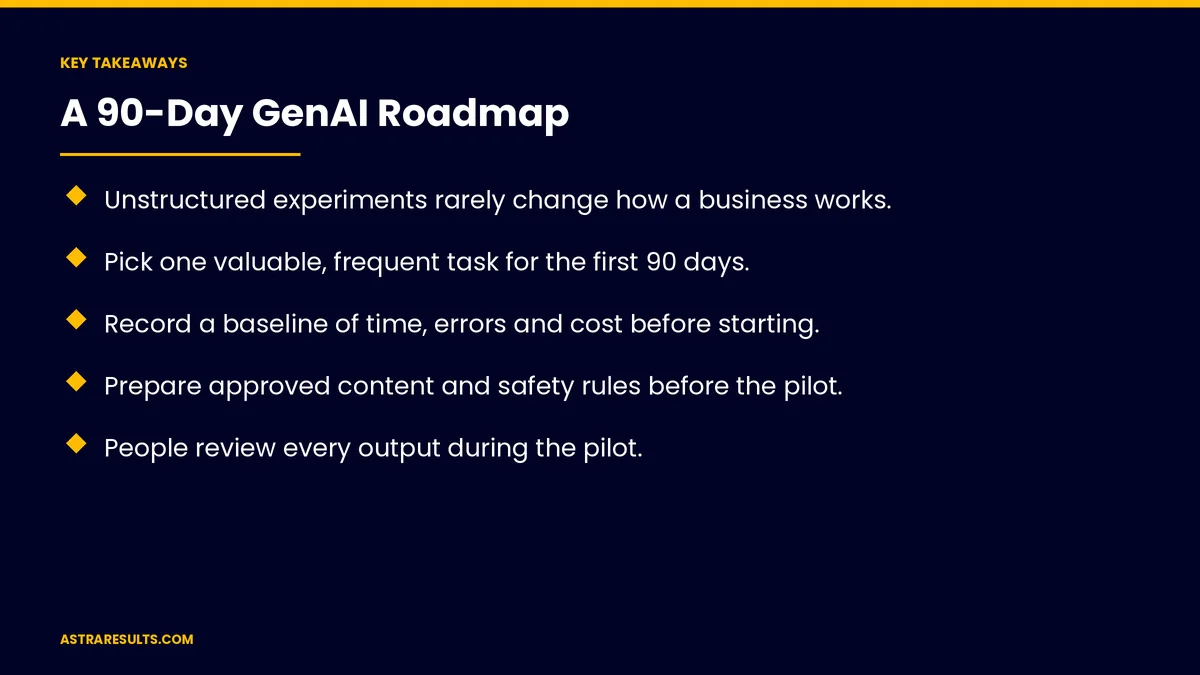
- Unstructured experiments rarely change how a business works.
- Pick one valuable, frequent task for the first 90 days.
- Record a baseline of time, errors and cost before starting.
- Prepare approved content and safety rules before the pilot.
- People review every output during the pilot.
- Decide with numbers at day 90: expand, adjust or stop.
Published: October 3, 2026 | Reading Time: ~8 minutes | Category: Generative AI Services
This guide lays out a 90-day generative AI roadmap: choosing the task, setting the baseline, preparing content, setting safeguards, testing tools, running the pilot, reviewing outputs, measuring and deciding what comes next. Put plainly: one task, a fair pilot and clear numbers before anything scales.
For whether generative AI pays off at all, see the business case for GenAI.
In This Playbook
- Weeks 1–2: choose the task
- Weeks 2–3: set the baseline
- What content does a GenAI pilot need before it starts?
- Weeks 3–4: set safeguards
- Weeks 4–5: test tools
- Weeks 5–11: run the pilot
- Who should review GenAI output during the pilot?
- Weeks 11–12: measure
- Week 13: decide
- What to measure
- The roadmap at a glance
Weeks 1–2: choose the task
Frequent and valuable. Proposals, support replies or product descriptions.
Clear success. Time saved, quality kept or improved.
Low risk first. Drafts people review, not decisions sent alone.
Examples are in generative AI at work.
Weeks 2–3: set the baseline
Time per task. Today, by hand.
Errors and rework. How often work is redone.
Cost. People's time plus tools.
Don't skip it. As covered in building before measuring.
What content does a GenAI pilot need before it starts?
Approved sources. Policies, past work and product details.
Your voice. Examples of good writing, as in replies in your voice.
Map the process. As covered in discovery.
Weeks 3–4: set safeguards
Data rules. What can and can't go into AI tools, as covered in GenAI security.
Accuracy checks. As covered in hallucinations.
Approved tools. No personal accounts for company data.
Weeks 4–5: test tools
Ready-made tools first. Tested fairly, as covered in off-the-shelf first.
Same tasks for each. Compare fairly.
Weeks 5–11: run the pilot
One team. Real work, real volume.
Fixed scope. As covered in AI pilots that fail safely.
Weekly check-ins. Problems and fixes.
Who should review GenAI output during the pilot?
People review before anything goes out. Every draft, every reply.
Track edits. How much people change.
Log errors. What went wrong and why.
Weeks 11–12: measure
Time per task. Including review.
Edit rate and errors. Compared with the baseline.
Team feedback. What helped and what didn't.
Week 13: decide
Expand. To more tasks or teams if results are strong.
Adjust. Better content, prompts or tools if results are close.
Stop. If it doesn't beat the baseline.
What to measure
Hours saved per week. After review.
Edit rate. Share of drafts changed significantly.
Errors caught. Before work goes out.
Team adoption. Daily use during the pilot.
Net value. Savings after costs.
The roadmap at a glance
Days 1–30: choose and prepare
Pick one task, record the baseline, gather approved content and set data and accuracy rules.
Days 31–75: pilot
Test tools fairly, then run a pilot with one team on real work, reviewing every output.
Days 76–90: measure and decide
Compare time, edits and errors with the baseline and decide to expand, adjust or stop.
How Astra runs 90-day GenAI roadmaps
Astra Results Marketing runs 90-day generative AI roadmaps. We help choose the right first task, set the baseline, prepare content and safeguards, run a fair pilot and decide with real numbers.
Engagements begin with a GenAI review through our generative AI services team.
Related reading
Frequently asked questions
Why use a 90-day roadmap?
Because unstructured experiments rarely change how work gets done, while a short, structured plan produces clear results.
Which task should come first?
A frequent, valuable, low-risk task where people review drafts, like proposals or support replies.
Why set a baseline?
Without it, you can't tell whether generative AI saved time or improved quality.
What safeguards are needed?
Data rules, approved tools, accuracy checks and people reviewing every output.
What happens at day 90?
Compare results with the baseline and decide to expand, adjust or stop.
What should we measure?
Hours saved, edit rate, errors caught, team adoption and net value.
Ready for a 90-day plan instead of scattered experiments? Astra Results Marketing runs generative AI roadmaps that pick the right task, pilot fairly and decide with real numbers. ▸ CALL (786) 321-2866 · ▸ REQUEST YOUR CONSULTATION





