 Rated 5 star on

Integration Platforms vs Custom API Work
Quick answer
Use an integration platform for simple, low-volume flows and custom API work for high-volume, complex or sensitive connections. Platforms are fast to set up, but costs often grow with every task run. Custom code costs more upfront and usually handles errors better. Most businesses use both. Switch when bills climb or failures become hard to trace.
Connecting two systems used to mean hiring a developer. Today, integration platforms let a non-programmer link a form to a CRM in an afternoon. For many businesses, that's the right answer. For others, the platform becomes a tangle of fragile flows and a monthly bill that keeps climbing. The choice depends on what you're connecting.
Key Takeaways
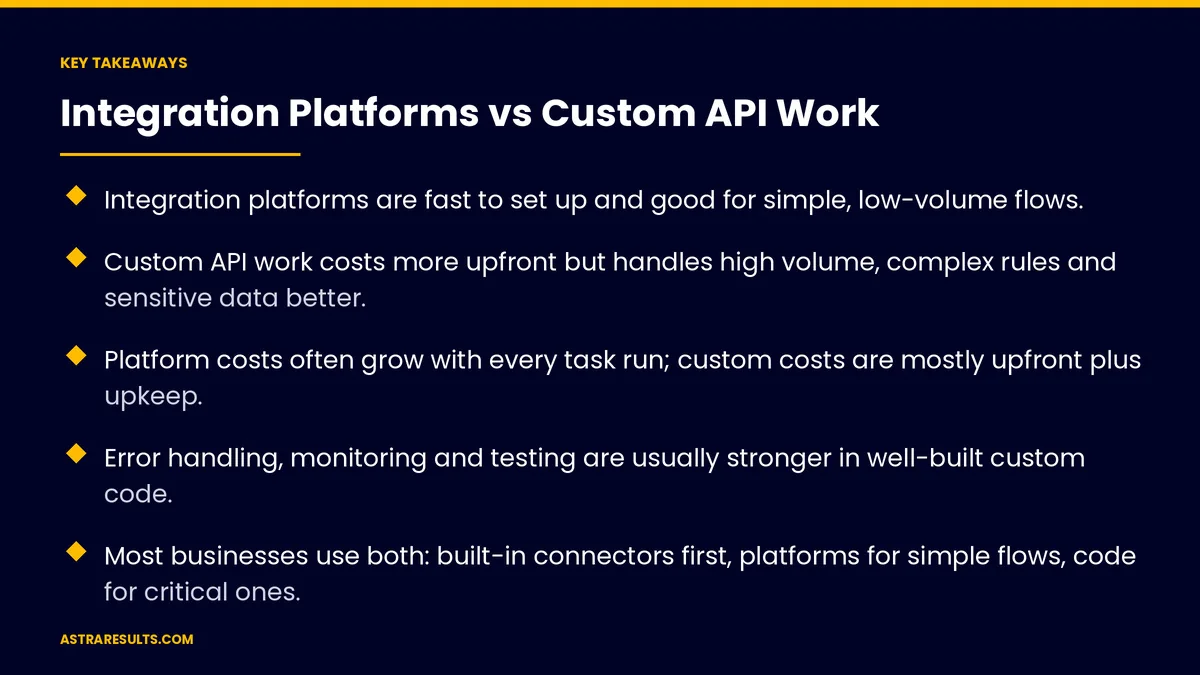
- Integration platforms are fast to set up and good for simple, low-volume flows.
- Custom API work costs more upfront but handles high volume, complex rules and sensitive data better.
- Platform costs often grow with every task run; custom costs are mostly upfront plus upkeep.
- Error handling, monitoring and testing are usually stronger in well-built custom code.
- Most businesses use both: built-in connectors first, platforms for simple flows, code for critical ones.
- Switch when platform bills climb, workarounds pile up or failures become hard to trace.
Published: October 13, 2026 | Reading Time: ~10 minutes | Category: API Integration
This guide compares integration platforms with custom API work across the things that decide it: volume, logic, error handling, security, ownership and total cost. It also covers the usual hybrid and the signs it's time to switch. Put plainly: use a platform for simple, low-volume flows, and write code for the connections your business can't afford to lose.
In This Playbook
- The three options
- Where integration platforms shine
- Where platforms struggle
- Where custom API work shines
- Where custom work struggles
- Compare the total cost
- The hybrid most businesses need
- Signs it's time to switch
- What should we measure for each integration?
- The first three months
- The Astra approach
The three options
Built-in connectors. Many tools include ready-made links to popular systems. Turn them on and configure them. Always check these first.
Integration platforms. Tools that sit between your systems and run "when this happens, do that" flows, set up mostly by clicking rather than coding.
Custom API work. Code written for your systems and rules, running on servers you control.
All three can work. The right one depends on each connection, not on a company-wide rule. The basics of connecting systems are covered in API integration.
Where integration platforms shine
Speed. A simple flow can run the same day.
No developer needed. Operations or marketing staff can build and adjust simple flows.
Lots of ready connections. Most popular business tools are already supported.
Good for experiments. Test whether an automation is useful before investing in code.
Good for low volume. A few hundred runs a month, with simple steps, is the sweet spot.
Where platforms struggle
Cost at volume. Many platforms charge by the number of tasks or runs. As volume grows, so does the bill.
Complex logic. Many branches, loops, data reshaping and exceptions become hard to build and harder to read.
Debugging. When a long chain of steps fails, finding the cause can take hours.
Version control and testing. Changes often go live without the reviews and tests developers use for code.
Limits. Rate limits, timeouts and missing features in a connector can block what you need.
Sprawl. Dozens of flows built by different people, with no list of what exists or who owns it.
Where custom API work shines
High volume. Thousands of records an hour without per-task fees.
Complex rules. Pricing logic, approvals, data matching and exceptions written clearly in code.
Strong error handling. Retries, queues, alerts and daily gap checks built in from the start.
Security and control. Exactly the access each connection needs, sensitive data handled carefully, everything logged. The access principles are the same as in agent security.
Testing and reviews. Changes are reviewed and tested before they go live.
Ownership. The code, hosting and documentation belong to your business, like any custom software.
Where custom work struggles
Upfront cost. Building takes developer time and a budget.
Slower start. Days or weeks instead of hours.
Needs upkeep. APIs change, and someone must keep the code working.
Needs skills. You need a developer or a partner to change it later.
Compare the total cost
Platform cost. Monthly subscription plus per-task fees at your expected volume, over three years, plus staff time to maintain flows.
Custom cost. Build cost, plus hosting, plus yearly upkeep, over the same three years.
Add the cost of failure. Missed orders, duplicate customers or billing errors from a fragile connection. For critical flows, this often decides it.
Grow the volume in your estimate. A platform that's cheap at today's volume may cost far more if orders double.
The hybrid most businesses need
Built-in connectors first. If a tool connects natively and does what you need, use it.
Platforms for simple, low-risk flows. Notifications, form-to-spreadsheet, internal reminders.
Code for critical flows. Orders, payments, accounting, customer records and anything high-volume or sensitive. Bill and invoice flows, as in accounts payable automation, usually belong here.
One list of everything. Every connection, its method, what it moves and who owns it, whatever tool runs it.
Signs it's time to switch
From platform to code. Task bills keep climbing, flows need constant fixes, failures take hours to trace, or the connection now carries money or sensitive data.
From code to platform. A simple flow is costing developer time it doesn't deserve, and a platform can do it reliably.
Move one connection at a time. Run the new version side by side, compare results, then switch. The careful approach is the same as in AI pilots that fail safely.
What should we measure for each integration?
Monthly cost per connection. Platform fees or hosting and upkeep.
Failures and time to fix. How often each connection breaks and how long recovery takes.
Errors in data. Missing, duplicate or wrong records.
Hours returned. Manual work each connection replaced, counted the way automation KPIs are counted.
Volume growth. Runs per month, to spot when a platform will get expensive.
The first three months
Days 1–30: list and sort
List every connection you have or need, with volume, logic, data sensitivity and current cost. Check built-in connectors first. Sort each connection into connector, platform or code.
Days 31–60: build the critical ones
Build or rebuild the critical connections in code, with alerts, retries and logs. Keep simple flows on a platform, documented and owned. Run any switched connection side by side before cutting over.
Days 61–90: measure and tidy
Track cost, failures and data errors per connection. Remove unused flows. Review volume trends and plan the next connections to move, in either direction.
The Astra approach
Astra Results Marketing chooses the integration method connection by connection, not by habit. We check built-in connectors first, use platforms for simple low-risk flows, and write custom code for the connections that carry orders, money and customer data.
Every connection is listed with its owner, cost and failure history, and moved only when the numbers show it's time. Engagements begin with an integration review through our API integration team.
Related reading
Frequently asked questions
When should we use an integration platform?
For simple, low-volume, low-risk flows such as notifications, form submissions to a spreadsheet or internal reminders, and for testing whether an automation is useful before investing in code.
When is custom API work worth it?
For high-volume connections, complex rules, sensitive data, and anything involving orders, payments, accounting or customer records, where failures are costly and strong error handling matters.
Which is cheaper?
It depends on volume and time. Platforms are cheap to start but often charge per task, so costs grow with use. Custom work costs more upfront but less per run. Compare the total over three years, including the cost of failures.
Can we use both?
Yes, and most businesses should. Use built-in connectors first, platforms for simple flows and custom code for critical ones, with one list of every connection and its owner.
How do we know it's time to switch from a platform to code?
When task bills keep climbing, flows need constant fixes, failures take hours to trace, or the connection starts carrying money or sensitive data.
How do we switch without breaking things?
Move one connection at a time, run the new version side by side with the old, compare results, then cut over once they match.
Ready to connect your systems the right way for each job? Astra Results Marketing reviews every connection you have or need, uses built-in connectors and platforms where they fit, and writes reliable custom code for the flows that carry your orders, money and customer data. ▸ CALL (786) 321-2866 · ▸ REQUEST YOUR CONSULTATION





