 Rated 5 star on


Is a New Website the Fix or the Distraction?
Quick answer
A new website is the fix only when the site itself is the problem. Check traffic, conversion rate, lead quality and follow-up first. Low traffic usually points to search or ads. Leads that don't close point to follow-up or sales. Try speed fixes, added proof and landing page tests before you rebuild.
When leads slow down, a new website feels like the obvious answer. It's visible and feels like progress, and sometimes it's right. Often, though, the real problem is somewhere else: too few visitors, a weak offer or leads that nobody follows up on. A rebuild then costs months and money and leaves the real problem untouched.
Key Takeaways
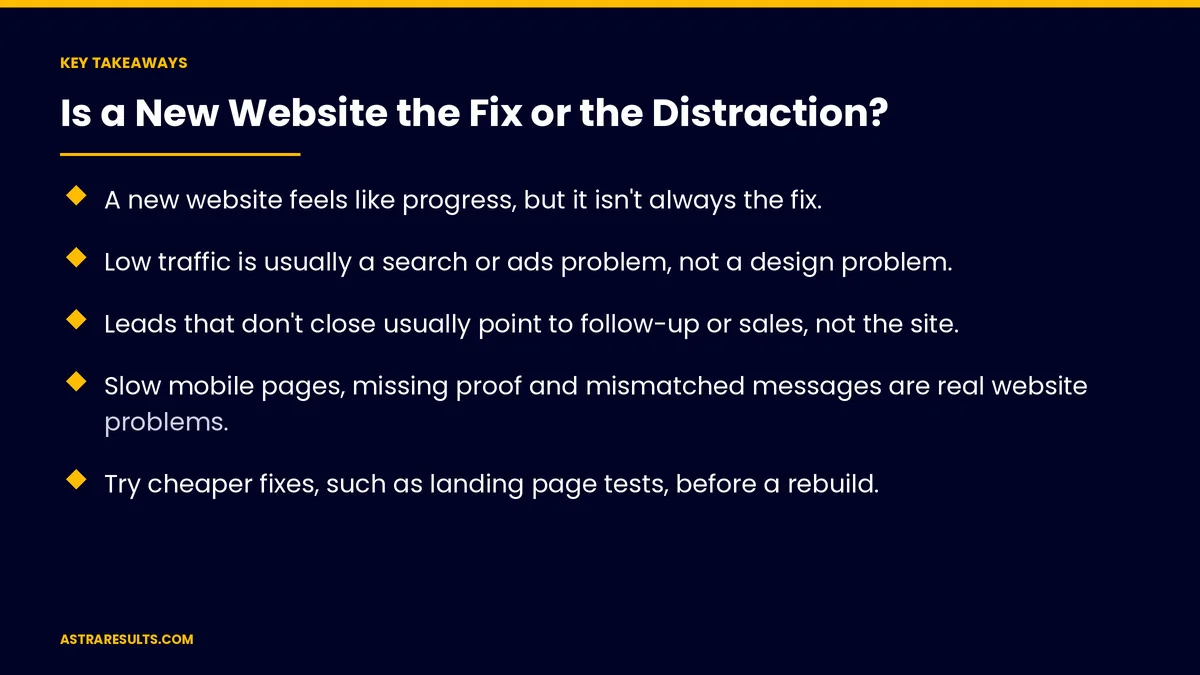
- A new website feels like progress, but it isn't always the fix.
- Low traffic is usually a search or ads problem, not a design problem.
- Leads that don't close usually point to follow-up or sales, not the site.
- Slow mobile pages, missing proof and mismatched messages are real website problems.
- Try cheaper fixes, such as landing page tests, before a rebuild.
- Rebuild when the platform, brand or security truly require it.
Published: October 9, 2026 | Reading Time: ~8 minutes | Category: UI/UX Web Design
This guide covers how to tell whether a new website is the fix: what to check first, reading the numbers, real website problems, when a new site is the answer, when it's a distraction, cheaper fixes to try first, a decision checklist and what to measure. Put plainly: check traffic, conversion and follow-up before you rebuild anything.
For choosing between a redesign and a rebuild, see redesign vs rebuild.
In This Playbook
- What to check first
- Reading the numbers
- Real website problems
- When a new site is the fix
- When it's a distraction
- Cheaper fixes to try first
- A decision checklist
- What to measure
- The first three months
What to check first
Traffic. How many people visit, and from where.
Conversion rate. Share of visitors who call, book or fill in a form.
Lead quality. Share of leads that become customers.
Follow-up. How fast and how well leads are answered.
The numbers that matter are covered in website KPIs.
Reading the numbers
Low traffic, normal conversion. A visibility problem: SEO, ads or local listings.
Good traffic, low conversion. A website problem worth fixing.
Good leads that don't close. A follow-up or sales problem, as covered in the intake gap.
Leads that go missing. A form or routing problem, as covered in website forms that reach the right person.
Real website problems
Slow or broken on phones. Visitors leave before the page loads.
No proof. Missing reviews, credentials or real photos, as covered in trust on a landing page.
Messages that don't match ads. As covered in message match.
Unclear next step. No obvious way to call, book or ask.
Nobody can edit it. As covered in website content management.
When a new site is the fix
Outdated platform. No updates, security gaps or broken features.
Brand change. New name, services or market.
Can't be fixed piece by piece. Problems run through every page.
Built for selling. As covered in websites that sell.
When it's a distraction
The real problem is traffic. A prettier site with no visitors still gets no leads.
The real problem is follow-up. New pages don't answer the phone.
The real problem is the offer. Price, guarantee or service area.
Months lost. While the real issue keeps costing money.
Cheaper fixes to try first
Speed fixes. Compress images and remove heavy tools.
Clear calls to action. On every key page.
Proof added. Reviews and credentials near forms.
Landing page tests. As covered in landing page testing.
A decision checklist
Is traffic high enough to judge the site?
Is conversion below what similar pages achieve?
Are leads answered quickly and followed up?
Can the current platform be fixed and updated?
What will a rebuild cost? As covered in what a business website costs.
What to measure
Traffic by source. Before deciding.
Conversion rate. Before and after fixes.
Lead response time. And close rate.
Page speed on phones. For key pages.
Revenue from the website. The final test.
The first three months
Days 1–30: diagnose
Pull traffic, conversion, lead quality and response times, and decide which problem is real.
Days 31–60: fix the real problem
Improve visibility, follow-up or the website itself, starting with the cheapest fixes.
Days 61–90: decide
If conversion still lags after fixes, or the platform can't be repaired, plan a redesign or rebuild.
How Astra decides on new websites
Astra Results Marketing checks traffic, conversion and follow-up before recommending a new website. We fix the real problem first, try cheaper improvements and recommend a redesign or rebuild only when the site itself is the barrier.
Engagements begin with a website and lead review through our UI/UX web design team.
Related reading
Frequently asked questions
How do we know if our website is the problem?
Check traffic, conversion rate, lead quality and follow-up. If traffic is low or leads aren't followed up, the website probably isn't the main problem.
What are real website problems?
Slow mobile pages, missing proof, messages that don't match ads, unclear next steps and a site nobody can edit.
When is a new website worth it?
When the platform is outdated or insecure, the brand has changed or problems run through every page.
What should we try before rebuilding?
Speed fixes, clear calls to action, added proof and landing page tests.
Why can a new website be a distraction?
Because a rebuild takes months and money while the real problem, such as low traffic or slow follow-up, keeps costing you.
What should we measure?
Traffic by source, conversion rate, lead response time, close rate, mobile page speed and revenue from the website.
Not sure whether you need a new website? Astra Results Marketing checks traffic, conversion and follow-up first, fixes the real problem and recommends a rebuild only when your site is truly in the way. ▸ CALL (786) 321-2866 · ▸ REQUEST YOUR CONSULTATION





