 Rated 5 star on

Making the Business Case for Native iOS
Quick answer
A native iPhone app is worth the extra cost when your data shows a large share of customers or revenue from iPhones. It pays off when key features need deep iOS capabilities. Two native apps usually cost more than one cross-platform app. Middle paths exist, such as iPhone first. Write the business case before deciding.
Cross-platform tools have made it cheaper to reach iPhone and Android with one app. So when someone proposes a native Swift iPhone app, the fair question is: why spend more? Sometimes the answer is that you shouldn't. Sometimes native is the only way to get the features and trust the product needs. The decision should rest on your own data.
Key Takeaways
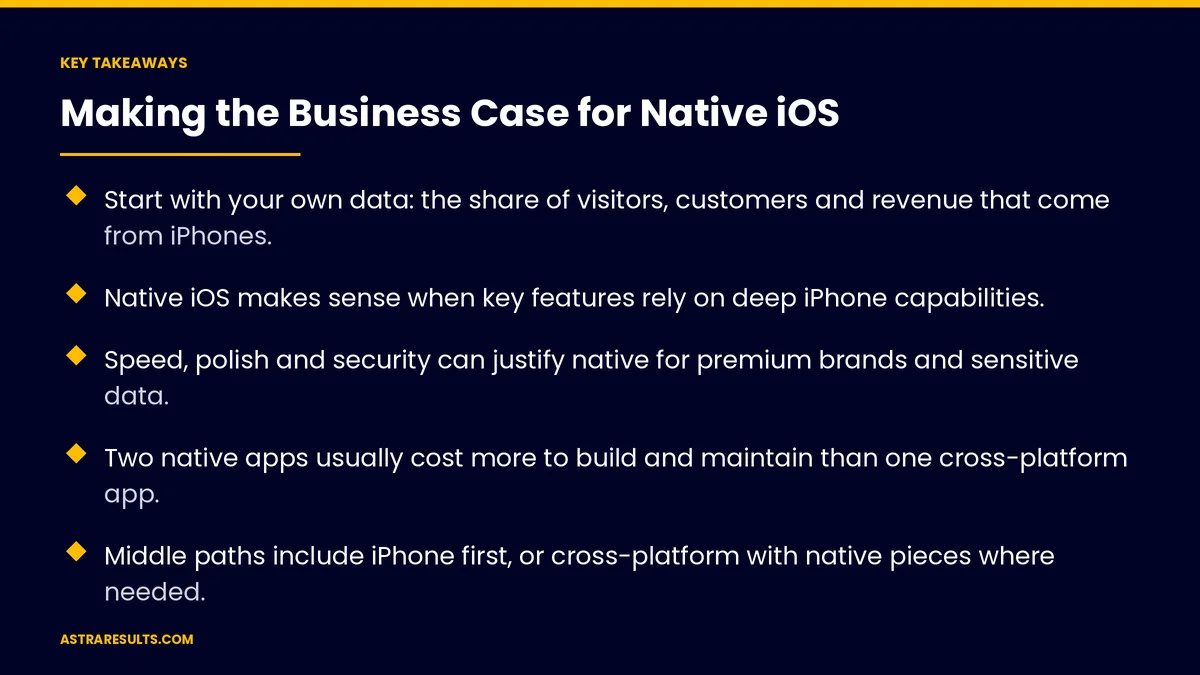
- Start with your own data: the share of visitors, customers and revenue that come from iPhones.
- Native iOS makes sense when key features rely on deep iPhone capabilities.
- Speed, polish and security can justify native for premium brands and sensitive data.
- Two native apps usually cost more to build and maintain than one cross-platform app.
- Middle paths include iPhone first, or cross-platform with native pieces where needed.
- Write the case down: goals, audience, features, cost, risks and how success will be measured.
Published: October 17, 2026 | Reading Time: ~9 minutes | Category: Swift Development
This guide sets out how to build the business case for native iOS: what your audience data says, which features need deep iPhone access, where polish and security matter, what it costs and the options in between. Put plainly: go native when your customers, features or brand truly need it, and prove it with your own numbers.
In This Playbook
- Start with your own audience data
- Features that need deep iPhone access
- Polish, speed and trust
- When cross-platform is the better case
- Counting the cost
- The options in between
- Writing the business case
- Numbers that test the case
- The first three months
Start with your own audience data
Device share. What share of website visitors and existing customers use iPhones?
Revenue share. Do iPhone users account for more or less of your sales than their numbers suggest?
Your market. Device mix differs by country, age and industry. Use your own analytics, not general claims.
Who the app is for. Customers, field staff or both. Company-issued devices may decide the platform for you.
Features that need deep iPhone access
Lock Screen and widgets. Live updates for orders, deliveries or appointments, as in restaurant iPhone apps.
App Clips. Instant experiences from a QR code without a full download.
Health, watch and car. Apple Health, Apple Watch and in-car features.
Camera and augmented reality. Advanced capture, scanning and measuring.
On-device intelligence. Features that run privately on the phone.
Day-one support. New iOS features are usually easiest to adopt quickly in native code.
Polish, speed and trust
Feel matches the platform. Gestures, navigation and animations that iPhone users expect.
Speed. Fast launch and smooth scrolling for apps used many times a day.
Security. Face ID, secure storage and strong data protection, as described for insurance apps with secure document access.
Accessibility. Full support for screen readers, larger text and other iOS settings.
Premium brands. When the app itself represents the brand, quality differences show.
When cross-platform is the better case
Both platforms matter equally. And budget allows only one codebase.
Standard features. Booking, accounts, content and payments, like fitness apps in React Native.
Shared web code. A team that already builds the website in React, as covered in React Native strategy.
Speed to market. Reaching both stores at once with one team.
Counting the cost
Two native apps. Separate iPhone and Android code means more build time and more upkeep.
Specialist skills. Swift and Kotlin developers, or a partner with both.
Ongoing costs. Yearly platform updates for each app, as covered in what custom software costs over five years.
The cost of compromise. A cross-platform app that can't deliver a key feature has its own cost in lost customers.
The options in between
iPhone first. Launch native iOS where most of your customers are, then add Android once the product is proven.
Cross-platform with native pieces. Shared code for most screens, native modules for features that need them.
Web plus native. A web app for occasional users and a native app for frequent ones.
The full comparison is covered in native, cross-platform or web.
Writing the business case
The goal. What the app must achieve: sales, retention, efficiency or service.
The audience. Device share and revenue share from your own data.
The features. Which ones need native access, and why they matter.
The cost. Build and five-year upkeep for each option.
The risks. What happens if a key feature can't be delivered well.
The measures. How you'll judge success after launch. Swift practices are covered in Swift native iOS done properly.
Numbers that test the case
Conversion in the app. Bookings, orders or sign-ups per active user.
App store ratings. Especially comments on speed and ease.
Crash-free sessions. A sign of quality.
Feature use. How often native-only features are used.
Revenue per user by platform. To check the case after launch.
The first three months
Days 1–30: gather the evidence
Pull device and revenue share from your analytics. List the features the app needs and mark which require native access. Estimate build and upkeep costs for each option.
Days 31–60: decide and write it down
Compare native, cross-platform and middle paths against your goals. Write a one-page business case with audience, features, cost, risks and measures.
Days 61–90: start and track
Begin with discovery for the chosen approach. Set up measurement so you can check the case after launch.
How Astra advises on native iOS
Astra Results Marketing helps you decide whether native iOS is worth it, based on your own data. We review device and revenue share, map the features that need deep iPhone access, and compare the cost of native, cross-platform and middle paths over five years.
When native is right, we build in Swift with the polish, speed and security your customers expect. Engagements begin with a platform decision review through our Swift app development team.
Related reading
Frequently asked questions
When is a native iPhone app worth the extra cost?
When a large share of your customers or revenue comes from iPhones, when key features need deep iOS capabilities, or when speed, polish and security are central to your brand.
Which features usually need native iOS?
Lock Screen updates and widgets, App Clips, Apple Health and Apple Watch features, advanced camera and augmented reality, on-device intelligence and quick adoption of new iOS features.
Is native iOS more expensive than cross-platform?
Usually, if you also need Android, because you build and maintain two codebases. Compare five-year costs, not just the first build.
Can we start with iPhone only?
Yes. Launching native iOS first, where most of your customers are, then adding Android once the product is proven, is a common middle path.
What data should the business case use?
Your own: device share and revenue share from analytics, the features customers need, five-year cost estimates for each option, and the measures you'll use after launch.
Can cross-platform apps use native features?
Often, through small native modules. If most of the app ends up needing native code, a fully native build may be the better choice.
Ready to decide whether native iOS is worth it for you? Astra Results Marketing reviews your device and revenue data, maps the features that need deep iPhone access, compares five-year costs across options and builds in Swift when native is the right call. ▸ CALL (786) 321-2866 · ▸ REQUEST YOUR CONSULTATION





