Rated 5 star on


Miami Tourism-Season Aesthetic & Dental Marketing
Quick answer
Miami aesthetic and dental practices should run two plans, one for high season and one for summer. High season fills the calendar, so capacity planning beats demand capture. Summer is the real treatment window for residents. Visitors need an aftercare plan before any procedure. Astra measures patient composition and annual value by season.
Miami's tourism calendar hands aesthetic and dental practices two different businesses inside one year. Most practices run the same playbook through both. High season, roughly November through April, brings population, visitors, event weeks, and a demand curve that makes practices feel successful while quietly filling their schedules with the least valuable patients they'll see all year.
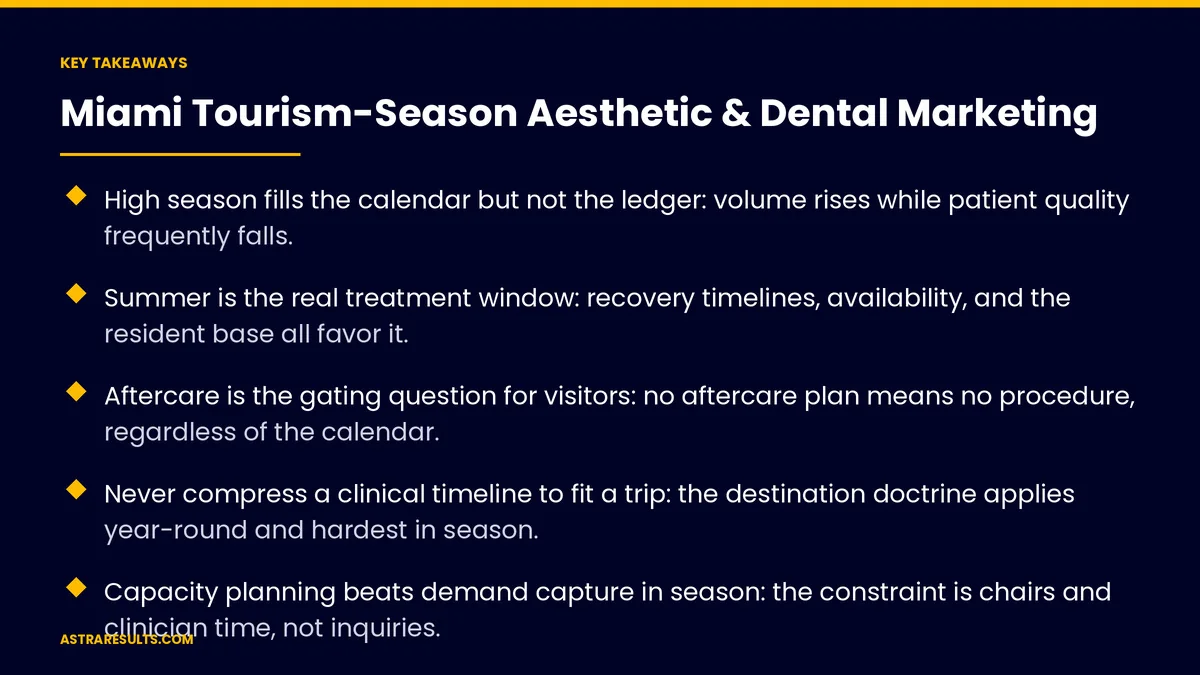
Key Takeaways
- High season fills the calendar but not the ledger: volume rises while patient quality frequently falls.
- Summer is the real treatment window: recovery timelines, availability, and the resident base all favor it.
- Aftercare is the gating question for visitors: no aftercare plan means no procedure, regardless of the calendar.
- Never compress a clinical timeline to fit a trip: the destination doctrine applies year-round and hardest in season.
- Capacity planning beats demand capture in season: the constraint is chairs and clinician time, not inquiries.
- Measure composition, not volume: kept-consult quality, resident share, and annual value by season of acquisition.
Published: October 18, 2026 | Reading Time: ~11 minutes | Category: Strategy · Miami
Summer, which most practices treat as the dead months, is the region's real treatment window: better availability, lower competitive noise, recovery timelines that can run their course, and the resident base that compounds. The kicker states the correction: two seasons, two strategies.
The strategic error the calendar produces is subtle. High season's inbound volume rewards passivity: the phone rings, the calendar fills, and nobody examines the composition of what filled it. Then May arrives, volume drops, and the practice runs a promotion to cover the gap, which trains exactly the deal-shopping cohort the anti-deal posture exists to avoid.
The corrected version inverts both halves: use high season to select rather than to accumulate, and use summer to build. Marketing guidance for licensed practices only. Nothing here is medical or dental advice. Candidacy, treatment planning, and every clinical statement belong to your providers. Compliance review precedes publication of every asset.
In This Playbook
- What High Season Actually Changes
- Summer Is the Treatment Window
- Visitors: The Honest Economics
- Aftercare Is the Gating Question
- Capacity Planning Beats Demand Capture
- The Resident Base, Protected
- Channels
- Measurement
- An Annual Build
What High Season Actually Changes
The mechanics, separated from the feeling of a busy waiting room.
Demand composition shifts. More visitors, more event-adjacent appearance requests, more short-timeline inquiries, and more price-comparison shopping from people who will not be here in six weeks, while the resident base's behavior barely changes.
Capacity becomes the constraint. The practice's limit in season is chairs, clinician hours, and post-treatment follow-up capacity, not inquiry volume: which means spending on demand capture during the months when the schedule is already full is the most common misallocation in this category. The capture-before-attention sequencing applies in reverse: when capture is saturated, attention spend is waste.
Price sensitivity drops in one cohort and rises in another. Affluent seasonal residents and visitors are frequently less price-driven, while the deal-seeking traveler cohort is more so, and the practice's positioning determines which one it attracts, per the anti-deal economics.
The scheduling reality. Seasonal residents leave in April. That means treatment plans requiring months of continuity need to start early in season or wait, a conversation most practices have too late.
Summer Is the Treatment Window
The inversion that produces the year's best patients.
The clinical case. Recovery timelines can run their course when a patient isn't traveling, attending events, or leaving the region in six weeks: which makes summer the right window for anything with meaningful downtime, series-based treatment, or a temporaries phase.
Sun exposure remains a year-round consideration in this region that the provider governs, and the energy-treatment timing honesty belongs in the conversation either way.
The operational case. Availability is real, the schedule can accommodate the multi-visit journey properly. The practice can give each case the attention that produces the gallery-quality outcomes high-season compression erodes.
The commercial case. The summer patient is disproportionately a resident. That means she completes her plan, returns, refers within her local network, and shows up in the annual-client-value ledger rather than in a single transaction.
The campaign implication. The highest-leverage marketing month in this market is the one where practices traditionally cut spend, spring, marketing summer, which is the same fall-reset logic Astra documented in the inverted-season market, running on Miami's calendar.
Visitors: The Honest Economics
The cohort assessment most practices never make.
What's valuable. The visitor who plans properly: remote consultation first, treatment scheduled with real recovery time in the region, aftercare arranged, and a plan built around the medicine rather than the itinerary. That patient exists, and serving her well is the destination doctrine Astra established, with medical-tourism infrastructure behind it.
What isn't. The walk-in wanting something significant done before a Saturday flight, the price-shopper comparing three practices in an afternoon, and the appearance-deadline inquiry with no runway. All of whom consume consultation capacity in the practice's busiest weeks and convert into either a decline or a bad outcome.
The filter that solves it. Publish the requirements before the inquiry: what a visitor consultation involves, how much lead time each service needs, what recovery in the region requires. What the practice will not do on a compressed timeline. The self-selection effect does the screening that front-desk staff otherwise absorb in season.
The no-downtime menu. Legitimately available and plainly bounded, the no-promises framing Astra requires, since "no downtime" is a range rather than a guarantee.
Aftercare Is the Gating Question
The clinical discipline that governs the whole visitor conversation.
The rule. A procedure whose aftercare cannot be arranged is a procedure that doesn't happen, regardless of what the calendar or the patient's enthusiasm suggests.
What must be settled before booking. Who sees the patient for follow-up and when, what happens if a complication occurs after she leaves the region, how records and instructions travel, which local provider is available where continuity is required, and how the practice remains reachable, the aftercare-published-before-booking standard Astra holds without exception.
The instruction layer. Post-treatment guidance must travel home readable in the patient's own language per the chain rule, which for this market's international visitors is a clinical requirement rather than a service touch.
The decline as a marketing asset. Publishing that the practice declines compressed-timeline requests reads as credibility to exactly the patient worth having, and the advise-against economics Astra keeps documenting apply. The visitor told no in March frequently books properly in September.
Capacity Planning Beats Demand Capture
The in-season operational discipline.
The reframe. In the months when the schedule fills itself, marketing's job is allocation rather than acquisition: protecting consultation slots for the cohorts worth converting, reserving surgical or high-value chair time, and making sure the resident base isn't squeezed out by transient volume, which is how practices quietly damage the relationships that carry them through summer.
The waitlist as an in-season instrument. Cancellations spike during event weeks and travel disruptions, and a functioning waitlist converts predictable gaps into the year's easiest revenue.
The triage layer. Consultation formats matched to inquiry type (remote pre-screening for visitors, full consults for real candidates, and correct routing for the rest) which preserves the scarce resource in the weeks it's scarcest.
The staffing and burnout reality. High season compresses clinicians and front-desk teams, and the quality erosion that follows shows up in outcomes, reviews, and gallery cases for the rest of the year. That makes staffing planning a marketing decision.
The price-integrity moment. High season is the wrong time to discount and the right time to hold, since discounting into peak demand is pure margin donation.
The Resident Base, Protected
The asset both seasons depend on.
Why it matters. Residents complete plans, return annually, refer inside local networks, and produce the household and annual-value economics that make a practice durable. They are the cohort most easily neglected in a busy season.
The in-season protection. Existing-patient scheduling priority, recall that continues running rather than pausing, and communication that acknowledges the season's logistics per the event-week logistics standard.
The summer cultivation. The plan conversations, the series treatments, the membership and plan model enrollment, and the deeper consultations that in-season compression makes impossible. Plus the referral asks that land better when the practice isn't visibly overwhelmed.
The seasonal-resident nuance. The November-to-April household is neither visitor nor year-round resident, and serving her well means candid continuity planning, what happens to her plan when she leaves. How the practice coordinates with providers where she spends the rest of the year.
Channels
Search and profile do the heavy lifting for the visitor cohort. Accurate profiles, the lead-time and aftercare requirements published where they screen, and the AI answers that increasingly handle "how far in advance," "how long is recovery," and "can I fly after" through the entity work our AI SEO service builds.
Owned channels carry the resident base: the recall system, the seasonal logistics note, and the spring campaign marketing summer, the year's highest-leverage send. Paid runs counter-seasonally, which is the single most contrarian recommendation in this playbook.
Reduce spend when the schedule fills itself and increase it in spring for the summer window, behind the negatives fortress with travel-package, deal-site, and vacation-planning intent excluded wholesale. Social runs restraint with the seasonal counsel as the content. The plain timeline post outperforms the beach-adjacent aspiration post with the patient worth having.
Spanish and Portuguese run native per the chain rule, which for this market's international inbound is table stakes rather than differentiation.
Measurement
The dashboard, per the case-level standard, built to defeat the season's flattery:
- Composition rather than volume — kept-consult quality, decline and down-scope rates, and treatment-started rate by cohort, since in-season volume with poor conversion is a capacity problem disguised as success
- Resident versus visitor versus seasonal-resident share from source-of-truth intake with an out-of-area flag
- Annual client value by season of acquisition, the number that settles this playbook's entire argument by showing that summer-acquired patients outperform
- Series and plan completion by acquisition season
- The compressed-timeline decline count logged as the trust investment it is
- Aftercare-plan completion for every out-of-area case as a clinical-governance metric
- Waitlist backfill in season
- Cost per kept consult read separately by season, because blending them hides both stories
An Annual Build
Spring (March–May): market the summer
The counter-seasonal campaign live with the honest-timeline content as its spine; series and plan conversations opened with the resident base; the summer schedule structured for multi-visit journeys. The prior season's composition data read and acted on.
Summer (June–September) — build.
- Treatment series run properly with full attention per case
- Plan and membership enrollment prioritized
- Gallery-quality documentation captured under the full consent doctrine
- Referral asks made while capacity allows warmth
- The visitor infrastructure built rather than improvised, so it's ready before it's needed
Fall (October–November) — prepare, don't discount.
- Capacity allocation planned for the coming season
- Consultation triage formats set
- The lead-time and aftercare requirements published prominently before inquiry volume arrives
- Staffing planned against realistic load
- Price integrity confirmed in writing so the season's pressure doesn't erode it
Winter (December–February): allocate, protect, hold. Paid spend reduced where the schedule is self-filling; resident scheduling protected; waitlist worked; the compressed-timeline decline held. Composition tracked weekly so the season's story is known in March rather than guessed at.
How Astra Plans Seasonal Aesthetic and Dental Marketing
Astra Results Marketing runs Miami's aesthetic and dental calendar as two businesses.
High season managed for allocation and composition rather than acquisition, summer marketed in spring as the region's real treatment window, visitors filtered by published lead-time and aftercare requirements, compressed timelines declined as a matter of clinical policy, and the resident base protected in both halves, measured on annual value by season of acquisition rather than on volume.
Engagements begin with a seasonal-composition and capacity audit through our business consulting team.
Related reading
Frequently asked questions
Should we spend more on marketing during high season?
Usually less. In the months when the schedule fills itself, your constraint is chairs and clinician hours rather than inquiries, so demand-capture spend competes with a queue that already exists. Shift the budget to spring, where it markets the summer window that produces your best patients. This counter-seasonal reallocation is the highest-return change most practices in this market can make.
Isn't summer the dead season?
It's the treatment season, which is different. Recovery timelines can run their course, availability is real, multi-visit journeys can be scheduled properly. The patient is disproportionately a resident who completes her plan, returns, and refers locally. Compare annual client value by season of acquisition and the argument settles itself. Summer-acquired patients typically outperform substantially.
How should we handle visitors who want treatment before they fly home?
By publishing the requirements before they inquire: lead times per service, what recovery in the region requires, and the plain statement that the practice doesn't compress clinical timelines to fit a trip. Aftercare is the gating question. No arrangeable follow-up means no procedure. The visitor told no in March frequently books properly in September, and the decline itself reads as credibility to the patient worth having.
What about the no-downtime menu for short-stay visitors?
Legitimate and useful, bounded plainly. "No downtime" is a range rather than a guarantee, individual response varies, and the provider governs candidacy. Publish it clearly as the short-window option and let it serve the visitor who has a real constraint, while keeping the significant work on the timeline the medicine requires rather than the one the itinerary suggests.
Should we discount to fill the summer schedule?
No, discount into a slow month and you've trained a deal-shopping cohort that returns only for discounts, which is how practices end up permanently promotional. Market summer's real clinical advantages in spring instead, enroll plans and series, and hold price integrity. The cohort comparison on retention and annual value will make the case internally within a year.
What should we measure to know whether the season worked?
Composition rather than volume: kept-consult quality, treatment-started rate, decline and down-scope rates, and resident-versus-visitor share from intake, then annual client value by season of acquisition, which is the number that reframes the whole calendar. A busy season with weak conversion is a capacity problem wearing the costume of success, and only composition data reveals it.
Ready to Run Two Seasons Instead of One? Astra Results Marketing plans Miami's aesthetic and dental calendar for allocation in season and building in summer. With visitor requirements published, compressed timelines declined, and annual value measured by season of acquisition. Start with a seasonal-composition and capacity audit for your practice. ▸ CALL (786) 321-2866 · ▸ REQUEST YOUR CONSULTATION