Rated 5 star on


Miami Physical Therapy & Rehab Practice Marketing
Quick answer
A Miami physical therapy practice should market completed plans of care, not evaluations. Retention comes before acquisition, through full-series scheduling, workable appointment times and reschedule grace. Direct access is explained carefully and framed as extra access. Referring physicians get readable progress reports. Cash-pay costs are stated plainly. Astra measures visits per plan.
Physical therapy has an unusual business shape. The product is not a visit, it is a completed plan of care, typically a series of appointments over weeks, with home exercise between them, where results depend almost entirely on whether the patient shows up and does the work.
Key Takeaways
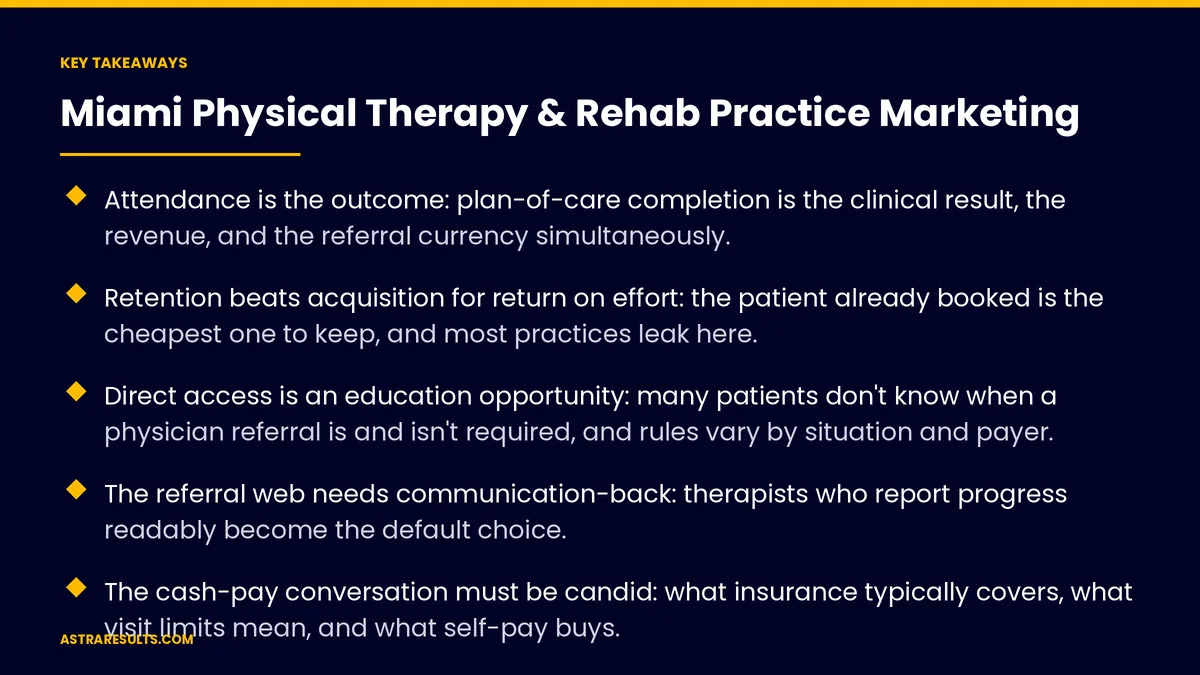
- Attendance is the outcome: plan-of-care completion is the clinical result, the revenue, and the referral currency simultaneously.
- Retention beats acquisition for return on effort: the patient already booked is the cheapest one to keep, and most practices leak here.
- Direct access is an education opportunity: many patients don't know when a physician referral is and isn't required, and rules vary by situation and payer.
- The referral web needs communication-back: therapists who report progress readably become the default choice.
- The cash-pay conversation must be candid: what insurance typically covers, what visit limits mean, and what self-pay buys.
- Measure completions, not evaluations: visits-per-plan, cancellation causes, and home-program adherence signals.
Published: October 25, 2026 | Reading Time: ~11 minutes | Category: Medical · Physical Therapy
That means the marketing question that matters isn't how many new patients arrive. It's how many finish. A practice that books twelve visits and sees the patient five times has produced an unhappy patient, an incomplete outcome, a disappointed referring physician, and a fraction of the revenue, from a patient who was successfully acquired. The kicker states the reframe: attendance is the outcome.
That single fact reorganizes the playbook. Acquisition matters, and this piece covers it: the direct-access opportunity most patients don't know exists, the referral web that carries most volume, the cash-pay conversation, and the corridor logistics of a drive-time metro.
But the highest-return marketing work in this vertical is retention of patients already acquired, because the plan-of-care completion rate is simultaneously the clinical outcome, the revenue driver, and the referral-relationship currency. Marketing guidance for licensed practices only. Nothing here is medical advice. Evaluation, plan of care, treatment selection, and every clinical statement belong to your licensed therapists.
Direct-access rules, referral requirements, and scope of practice are governed by Florida law and payer requirements that only your counsel and clinicians can apply. Compliance review precedes publication of every asset.
In This Playbook
- Attendance Is the Outcome
- The Direct-Access Opportunity
- The Referral Web
- The Money Conversation
- Adherence Content
- Specialization and Corridors
- Channels
- What belongs on a Miami physical therapy practice's dashboard?
- A 90-Day Build
Attendance Is the Outcome
The reframe, and where the money is.
The arithmetic. A plan of care abandoned halfway produces a partial clinical result and roughly half the revenue. It happens routinely: because of scheduling friction, transportation, copays that add up, feeling somewhat better, or simply losing the thread.
What that means for marketing. The practice's most valuable asset isn't a campaign, it's the operational and communication system that keeps a patient in the plan. That makes this the clearest case in the library of the principle that operations are marketing, established in the regional pillar.
The retention levers, in order of impact.
- Scheduling the full series at evaluation rather than visit by visit
- Appointment times that fit a working life (early morning and evening are the difference between finishing and quitting)
- Reschedule grace with waitlist backfill per the funnel disciplines
- Progress made visible to the patient so improvement is felt rather than assumed
- Reminder communication that addresses the barriers rather than repeating the date
The measurement consequence. Visits-per-plan and completion rate become the flagship numbers. Cancellation reasons get captured because they diagnose exactly which lever is missing.
The Direct-Access Opportunity
The education gap most practices leave unclaimed.
What patients don't know. That in many circumstances a patient may seek physical therapy evaluation without first getting a physician referral.
That the details (what a therapist may do, for how long, and what a given insurance plan requires) depend on the situation, the payer, and current Florida rules, all of which the practice must describe accurately per its own counsel's guidance.
Why the content matters. Patients who assume they need a physician appointment first frequently delay for weeks or never come at all. The practice that explains the landscape plainly captures demand nobody else addressed.
The plain framing. Explain that direct evaluation is often possible, that insurance requirements are a separate question from state practice rules. That the practice will help the patient determine what applies to her. With the standing note that some conditions warrant physician evaluation first, and the therapist will say so.
The referral-relationship care. Direct-access marketing must never read as bypassing physicians, because the referral web below is this vertical's largest channel. The framing is additional access, not competition, and practices that get this wrong trade a small acquisition gain for a large referral loss.
The Referral Web
The channel that carries most volume, per the courtesy standard.
The sources. orthopedics and sports medicine above all, plus primary care, pain management, neurology, urology for pelvic-floor referrals, OB-GYN, surgeons for post-operative protocols, and cardiology for cardiac rehab where applicable.
What earns and keeps referrals. Scheduling turnaround (a referred patient seen this week rather than in three), progress reporting that is readable and prompt (the single most underrated differentiator in this vertical, because most referring physicians receive either nothing or a document they won't read) protocol fidelity for post-surgical cases, and candid communication when a patient isn't progressing or isn't attending.
The independence question. Where a referring practice owns therapy services, an independent clinic competes on access, communication, and the patient's right to choose, stated as facts about itself per the steelman rules, never as an accusation.
The forwardable asset. The plain-language "what physical therapy involves and what your first visit looks like" guide a surgeon or physician hands a hesitant patient, per the forwardable economics Astra keeps proving, which also does the dread-reduction work that improves attendance.
The Money Conversation
Where trust is won and plans get abandoned.
The insurance reality, explained plainly. Coverage for therapy varies substantially, visit limits and authorization requirements are common, copays accumulate across a multi-visit plan. Patients are routinely surprised by the total, which is the most preventable cause of abandoned care in the specialty.
The plain content. How coverage generally works, what a visit limit means practically, what to ask a plan, and what the practice does when authorization runs out, with specifics routed to the patient's plan and the practice's billing team, per the navigation standard.
The cash-pay and hybrid models. Self-pay and out-of-network practices are legitimate and growing.
The plain version publishes what a session costs, what a typical plan involves, what the patient gets that a high-volume insurance model may not (session length, one-on-one time with a licensed therapist rather than an aide, therapist continuity), and states plainly that insurance-based care is the right choice for many patients, which is the steelman that makes the rest credible.
The value articulation per the premium-defense pattern. The price stated beside what it buys clinically, never as a lifestyle claim.
Adherence Content
The clinical work that doubles as retention marketing.
The home-program problem. Outcomes depend heavily on exercises done between visits. Adherence is generally poor: because instructions are unclear, forgotten, or in the wrong language.
What helps. Written and video home programs that are usable, delivered in the patient's own language per the chain rule. This is the clearest case in the library of comprehension determining outcome, as the orthopedic playbook noted about rehab instructions specifically.
The tone. Encouraging and non-judgmental, with the no-shame, no-lecture standard applied to compliance conversations, because a patient who feels scolded about missed exercises stops reporting plainly and then stops attending.
The progress-visibility mechanism. Patients who can see measurable improvement stay in the plan, so the practice's communication makes gains explicit rather than leaving them to be felt.
The discharge-and-return content. What maintenance looks like after discharge, when to come back, and how to prevent recurrence, which both serves the patient and generates the return visits that make this a lifetime relationship rather than an episode.
Specialization and Corridors
Specialization as differentiation. Orthopedic and post-surgical rehab, sports rehab, pelvic-floor therapy (a significantly underserved and high-demand niche), neurologic rehab, vestibular therapy, hand therapy, and geriatric balance and fall prevention, each with its own searching patient and its own referral sources, built as one-intent pages rather than a services list. The niche argument per the specificity-beats-comprehensiveness principle.
A clinic known for pelvic-floor or vestibular work receives referrals a generalist never sees.
The corridor reality. Therapy requires repeated visits. That makes proximity decisive in a drive-time metro, geo pages written with candid drive times per the geo-honesty standard, because a patient will abandon a plan that costs her forty minutes each way twice a week.
The workforce lane. This region's hospitality, construction, and service work generates repetitive-strain and injury rehab, served with the worker-dignity register and candid handling of the workers'-compensation pathway.
The active-retiree lane. Balance, fall prevention, and joint-preservation work addressed with respect rather than decline framing.
Channels
Search carries the condition-and-specialization library under named-therapist authorship (the first-visit walkthrough, the direct-access explainer, the insurance-and-cost content, and the specialization pages) earning the AI answers this market asks ("do I need a referral for physical therapy in Florida," "how many PT visits will I need," "¿cuánto dura la terapia física?") through the entity work our AI SEO service builds.
Video is the format this vertical underuses most: exercise demonstrations, first-visit walkthroughs, and therapist explanations serve patients and reduce dread simultaneously, per the on-camera system. The profile carries hours (early and evening availability is a real differentiator), locations, and languages properly. Reviews run never-gated and matter a great deal here, since therapy choice is frequently made on local reputation.
Paid runs behind the negatives fortress: DIY-exercise and YouTube-program intent excluded, equipment shopping routed out, massage and spa confusion filtered, PT-school and jobs traffic excluded. Spanish runs native throughout, with Kreyòl and Portuguese on the staff-it rule. Home programs and pain-reporting conversations are comprehension-critical.
What belongs on a Miami physical therapy practice's dashboard?
The dashboard, per the case-level standard:
- Visits-per-plan and plan-of-care completion rate as the flagship, because they are simultaneously the clinical, revenue, and referral metric
- Cancellation and no-show causes captured specifically — transportation, scheduling, cost, feeling better — since each names a different fix
- Evaluation-to-plan-start conversion (the first leak)
- The referral ledger by physician relationship with scheduling turnaround and report turnaround measured as service metrics
- The direct-access share as the education content's proof
- Home-program adherence signals where the practice tracks them
- Discharge-to-return rate as the lifetime-relationship read
- Specialization mix against the practice's stated niches
- Language cohorts with completion rates read per language — the sharpest test of whether home programs work
- Cost per completed plan on the ledger standard, rather than cost per new patient
A 90-Day Build
Days 1–30: Retention first
Full-series scheduling at evaluation implemented. Early and evening availability assessed and published. Reschedule grace with waitlist backfill built; cancellation-reason capture added; progress-visibility communication designed. Measurement instrumented for visits-per-plan, completion, and cancellation causes. No new acquisition spend until the leak is measured.
Days 31–60: Education and access
The direct-access explainer published with counsel review and referral-respectful framing. The insurance-and-cost content live; the first-visit walkthrough and specialization pages published under therapist authorship in English and native Spanish; home-program video and written materials rebuilt for usability in both languages.
Days 61–90: Web and reads
- The referral web engaged with report turnaround measured and the forwardable first-visit guide distributed
- Corridor geo pages live with candid drive times
- Paid live behind the fortress
- AI-answer accuracy checked in both languages
- First clear reads — completion rate, cancellation causes, referral ledger, direct-access share, adherence signals — and next quarter's spend allocated from cost per completed plan
How Astra Builds Rehab Practices
Astra Results Marketing builds physical therapy and rehab marketing on the fact that decides everything. Attendance is the outcome. So retention operations come before acquisition spend, direct access is explained without threatening the referral web, progress reporting earns the physician relationships, the money conversation is handled plainly before it abandons a plan.
Home programs are built for comprehension in the patient's own language. Measured on completed plans rather than new patients. Engagements begin with a completion, referral, and access audit through our business consulting team.
Related reading
Frequently asked questions
Why focus on retention before acquisition?
Because the patient already booked is the cheapest one to keep, and this specialty leaks badly. A twelve-visit plan attended five times produces a partial outcome, half the revenue, and a disappointed referring physician, from a patient your marketing already paid to acquire. Fix full-series scheduling, appointment times that fit working lives, reschedule grace, and progress visibility first; then measure completion rate. Most practices find their acquisition was never the problem.
How should we market direct access without upsetting referring physicians?
Frame it as extra access rather than an alternative to physicians. Explain that direct evaluation is often possible, that insurance requirements are a separate question from state practice rules, that the practice will help determine what applies, and that some conditions warrant physician evaluation first, which the therapist will say. Get the wording reviewed by counsel. Practices that frame direct access as bypassing physicians trade a small acquisition gain for a large referral loss.
What single thing most improves referral volume?
Progress reporting that is prompt and readable. Most referring physicians receive either nothing or a document they won't open, so the clinic that reports clearly, including when a patient isn't progressing or isn't attending, becomes the default choice. Pair it with scheduling turnaround (seen this week, not in three), and the referral ledger will show the effect within a quarter.
How do we handle the cost conversation for cash-pay or out-of-network care?
Publish it: session cost, what a typical plan involves, and what the patient gets clinically (session length, one-on-one time with a licensed therapist, therapist continuity) stated beside the price rather than as a lifestyle claim. Then say plainly that insurance-based care is the right choice for many patients. That concession is what makes the rest of the argument credible to someone doing real arithmetic.
What's the biggest preventable cause of abandoned plans?
Cost surprise, followed by scheduling friction. Copays accumulate across a multi-visit plan and visit limits arrive without warning, so explain coverage mechanics, visit limits, and what happens when authorization runs out before the plan starts rather than after. Then capture cancellation reasons specifically. Each reason names a different operational fix, and guessing at them is how practices spend a year solving the wrong one.
Does language capability really affect outcomes here?
More directly than in almost any specialty. Outcomes depend on home exercises done between visits, and a home program a patient can't fully read won't be followed. Run the whole chain natively (scheduling, the visit, the written and video home program, and the pain-reporting conversation) and read completion rates by language, because that comparison tells you whether your instructions work or merely exist.
Ready to Market Completed Plans Instead of New Patients? Astra Results Marketing builds rehab marketing on attendance as the outcome. Retention operations first, direct access explained safely, referral reporting that earns physicians, and home programs built for comprehension. Start with a completion, referral, and access audit for your practice. ▸ CALL (786) 321-2866 · ▸ REQUEST YOUR CONSULTATION