Rated 5 star on


Miami Urology & Men's Health Clinic Marketing
Quick answer
A Miami urology and men's health practice wins by being the credible alternative to the hype. It takes men's questions seriously and explains screening without shame. It builds privacy into scheduling and billing. Cancer and fertility care get candid, unhurried content. Astra measures completed evaluations and follow-through, not lead volume.
No corner of medicine is more saturated with marketing hype than men's health. Testosterone storefronts, performance clinics, telehealth subscription models, supplement funnels, and gyms selling hormone panels have trained an entire market to expect confident promises about vitality, virility, and "optimization". Most of it unencumbered by the evidence standards a physician-led urology practice operates under.
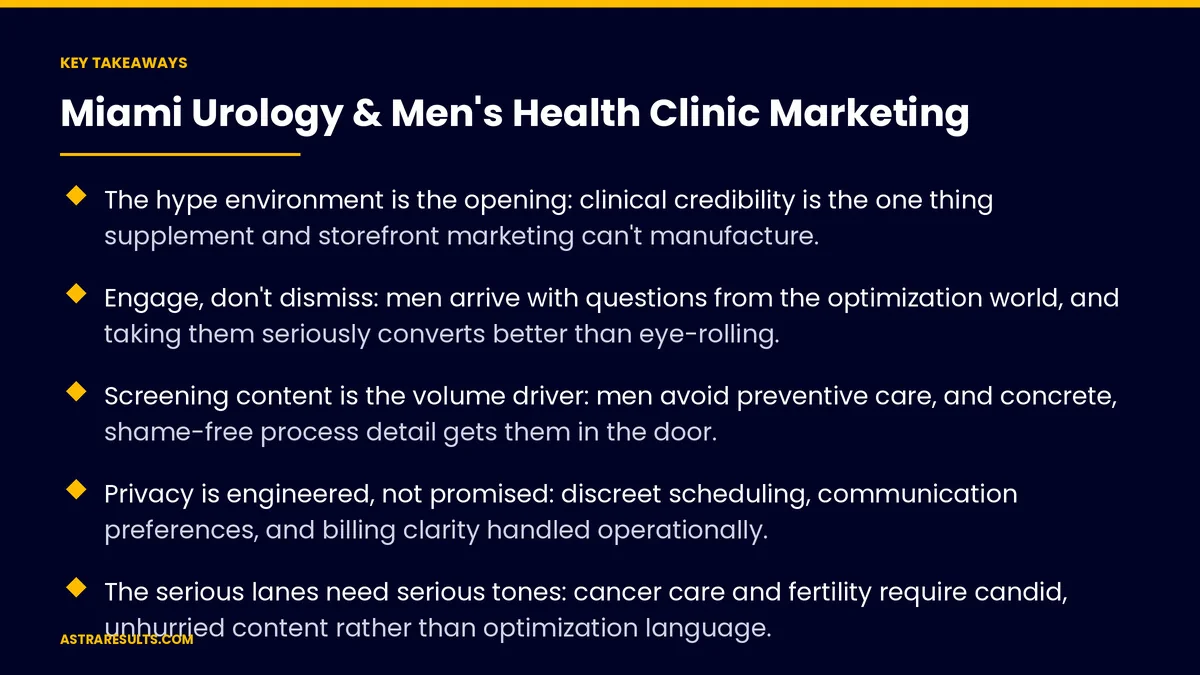
Key Takeaways
- The hype environment is the opening: clinical credibility is the one thing supplement and storefront marketing can't manufacture.
- Engage, don't dismiss: men arrive with questions from the optimization world, and taking them seriously converts better than eye-rolling.
- Screening content is the volume driver: men avoid preventive care, and concrete, shame-free process detail gets them in the door.
- Privacy is engineered, not promised: discreet scheduling, communication preferences, and billing clarity handled operationally.
- The serious lanes need serious tones: cancer care and fertility require candid, unhurried content rather than optimization language.
- Measure completions and follow-through: the evaluation attended, the plan continued, and retention — not lead volume.
Published: October 26, 2026 | Reading Time: ~11 minutes | Category: Medical · Urology
That environment is usually described as a competitive threat. For a real clinical practice it is the single clearest opening available, because the one thing the hype machine cannot manufacture is medical credibility. The kicker states the position: medicine, not masculinity ads.
Two disciplines follow.
The evidence tone. Engage the questions men bring in from that world seriously, say plainly what's supported and what isn't, explain what proper evaluation involves, and never sell into the gap, the evidence-honesty standard Astra built for the wellness-adjacent market, applied where the noise is loudest.
The dignity tone. Like gastroenterology, this specialty's real barrier is embarrassment (men delay screening, minimize symptoms, and arrive late) so shame-free clinical directness does more for the funnel than any campaign. Marketing guidance for licensed practices only. Nothing here is medical advice; diagnosis, testing, treatment selection, prescribing, and every clinical statement belong to your physicians and must follow current guidelines.
Hormone and prescription-related marketing carries specific regulatory sensitivities your counsel must address. Compliance review precedes publication of every asset.
In This Playbook
- The Evidence Register
- Getting Men Through the Door
- Privacy, Engineered
- The Serious Lanes
- Pricing, Subscriptions, and the Honest Model
- The Referral Web
- Channels
- What belongs on a Miami urology clinic's marketing dashboard?
- A 90-Day Build
The Evidence Register
The position that differentiates a physician-led practice from everything else in the category.
What the market has been taught. That low energy, weight gain, poor sleep, and reduced libido have one explanation and one purchasable solution, a framing that ignores the many conditions that produce those symptoms and the evaluation that distinguishes them.
What the practice publishes instead. What proper evaluation involves, what symptoms can indicate across a range of causes, what treatment decisions depend on, and what monitoring responsible care requires, with every clinical specific belonging to the physician and every claim inside current guidelines.
The engagement rule, not the dismissal rule. Men arriving with questions from the optimization world are not to be condescended to. They've been marketed at, not educated, and the practice that answers the question seriously ("here's what a proper workup looks like and what the results would and wouldn't mean") wins the patient the eye-roll loses.
The both-directions candor per the wellness-bridge standard: saying where conventional treatment helps and where the market's claims outrun the evidence reads as credibility to a skeptical audience that can detect a script in either direction.
What's banned. Performance and virility language, "optimization" framing, before-and-after vitality claims, and any content that treats normal aging as a deficiency to be corrected, the no-insecurity absolute in its men's-health form.
Getting Men Through the Door
The behavioral problem this specialty exists on the wrong side of.
The pattern. Men present later, skip preventive visits, and minimize symptoms. That means the practice's content job is less about persuasion than about removing friction and dread.
The shame-free clinical directness. Name symptoms plainly, state that these are ordinary medical matters, describe what the visit involves so nobody arrives braced, and never make the topic a punchline, the no-shame register Astra established, with the specific note that jokes in this specialty confirm every hesitation a patient overcame.
The screening layer, handled correctly. Prostate-cancer screening involves real shared-decision-making (guidance evolves, individual risk factors matter, and benefits and harms are discussed rather than assumed) so content should explain that the conversation exists and why it's individualized, cite current guidance, and defer to the physician rather than publishing a fixed recommendation.
The partner-and-family channel. Partners frequently initiate care. Content addressed to them (what to raise, how to raise it, why waiting costs more) reaches men that content addressed to men doesn't, per the household-influence pattern Astra documents in avoidant populations.
Privacy, Engineered
The operational layer that decides whether men book.
Why it matters here. The topics are private, the workplace is often adjacent (this is a corridor of towers and offices). The fear of being seen or overheard is a real scheduling barrier.
What engineered privacy looks like. Discreet scheduling and check-in where the facility allows, communication-preference capture at intake (how may we contact you, may we leave messages, which number), billing and statement clarity so nothing arrives at a shared address unexplained, and telehealth options where clinically appropriate for follow-ups. The described-not-performed rule per the discretion register.
State the privacy structure calmly as a service feature, because the patient is explicitly shopping for it.
Reviews handled with unusual care. never-gated but never pressured, since a public review here is a health disclosure many patients won't want: asked once, gratefully, and never chased.
The Serious Lanes
Where tone discipline matters most.
Cancer care. Prostate, bladder, kidney, and testicular cancers are core urologic practice. Content must run in the calm, non-alarmist register Astra requires: what diagnosis involves, what the treatment landscape generally includes, what surveillance means for appropriate patients. How second opinions work, with no outcome promises and no urgency levers.
The survivorship layer. Post-treatment function and quality-of-life concerns are real, frequently unaddressed, and require the dignity framing Astra holds for post-treatment populations, never as an upsell to an elective service.
Fertility and family building. Male-factor infertility is underdiagnosed and under-discussed, the emotional stakes are high. The content must avoid both blame framing and false hope. With the couple as the unit and the coordination with reproductive specialists explained plainly.
Kidney stones and acute urology. Real access-sensitive presentations where a published fast path per the availability-is-trust standard wins patients and referrals.
Chronic conditions. Incontinence, pelvic pain, and BPH-related symptoms managed over years. That makes this specialty a retention business as much as a procedural one.
Pricing, Subscriptions, and the Honest Model
The commercial layer where this category's abuses concentrate.
The subscription reality. Much of the men's-health market runs on recurring billing with automatic prescription renewal. Patients arrive either enrolled in one or wary of them.
The practice's plain version. If the practice offers programs or bundled services, publish what's included, what's clinical versus administrative, the actual duration and cancellation terms. What happens to monitoring if a patient stops, the scope-honesty-drives-retention principle Astra proved in membership medicine, applied where the category's default is opacity.
The insurance-versus-cash clarity. Much of urology is insurance-covered while some men's-health services aren't. Confusion here produces the specialty's most common complaint, explained plainly, with specifics routed to the patient's plan.
The lab-and-monitoring candor. Responsible treatment involves ongoing monitoring, which has cost and time implications a patient deserves to know before starting rather than after.
The anti-hype pricing posture. No introductory-offer urgency, no bundled-package pressure, no "optimization program" framing. Price integrity plus clinical transparency is the durable position in a category built on the opposite.
The Referral Web
The channel that carries the clinical side.
The sources. Primary care above all, plus internal medicine and cardiology (cardiometabolic and urologic conditions overlap substantially), endocrinology, oncology, nephrology, reproductive medicine, physical therapy for pelvic-floor care, and concierge practices whose members expect coordinated access. What earns the referral per the courtesy standard.
Prompt readable consultation notes, the plan communicated so the primary physician can coordinate, patients returned rather than absorbed, and zero steering economics, which matters especially where a practice has interests in labs, imaging, pathology, surgical facilities, or dispensing.
The credibility dividend. In a specialty adjacent to a hype-saturated market, referring physicians are actively screening for practices that won't embarrass them. The evidence tone is what makes a practice referable.
The forwardable asset. The plain-language "what a urology evaluation involves" guide a primary-care physician hands a reluctant patient, per the forwardable economics Astra keeps proving.
Channels
Search carries the library under named-physician authorship with YMYL disciplines at full strength (the evaluation explainers, the shame-free symptom content, the screening-conversation page, the cancer and fertility lanes, and the pricing-and-monitoring candor) earning the AI answers this market asks ("do I need a urologist or my primary doctor," "what does a testosterone evaluation involve," "¿es normal a mi edad?") through the entity work our AI SEO service builds.
Physician video is the specialty's strongest format. A urologist discussing these topics calmly, without hype and without humor, is itself the differentiator. Paid runs behind the negatives fortress with this vertical's largest waste categories excluded wholesale, supplement, enhancement-product, and gray-market pharmaceutical intent, plus telehealth-subscription comparison shoppers and gym hormone-panel traffic, and never with performance or urgency creative.
Spanish runs native per the chain rule, with Kreyòl and Portuguese on the staff-it rule. These are conversations men will only have in their first language. That makes native capability a real access issue rather than a marketing feature. Community education runs the participation rules, with awareness-month programs delivered as service.
What belongs on a Miami urology clinic's marketing dashboard?
The dashboard, per the case-level standard:
- Evaluation completion and plan follow-through, since the booked-but-abandoned appointment is this specialty's signature loss
- Retention and continuity years for the chronic lanes
- Time-to-appointment for acute presentations against published availability
- The referral ledger by physician relationship with note-turnaround measured
- The partner-and-family-initiated share, which diagnoses whether that content is working
- The register audit — content reviewed on calendar for hype drift, optimization language, humor, and any framing that pathologizes normal aging
- Monitoring adherence where the practice tracks it clinically, as the responsible-care signal
- Program cancellation reasons captured specifically where programs exist
- Language cohorts read separately
- Cost per completed evaluation and per retained patient on the ledger standard
A 90-Day Build
Days 1–30: Register and rules
- The evidence tone documented with the banned-language list (performance, virility, optimization, aging-as-deficiency)
- The shame-free clinical standards written and staff trained
- The screening-conversation content drafted to cite current guidance and shared decision-making
- Privacy operations designed (scheduling, communication preferences, billing clarity)
- Measurement instrumented for completion, follow-through, and the tone audit
Days 31–60: The library live
Evaluation, symptom, screening, cancer, and fertility content published under physician authorship in English and native Spanish. The pricing, insurance, and monitoring candor pages live; physician video begun in the calm no-hype tone. The partner-facing content published; acute access path published and staffed.
Days 61–90: Web and reads
- The referral web engaged with note-turnaround measured and the forwardable evaluation guide distributed to primary care
- Paid live behind the fortress with supplement and subscription exclusions verified
- AI-answer accuracy checked in both languages
- The first tone audit completed
- First clear reads — completion rate, follow-through, referral ledger, partner-initiated share — and next quarter set on completions and continuity years
How Astra Builds Urology and Men's Health Practices
Astra Results Marketing builds urology and men's health marketing on clinical credibility in a hype-saturated category: the evidence tone that engages rather than dismisses, shame-free directness that gets men through the door, privacy engineered rather than promised, the cancer and fertility lanes served with proper gravity, and pricing candor where the category defaults to opacity, measured on completions, follow-through, and continuity years.
Engagements begin with a tone, privacy, and referral audit through our business consulting team.
Related reading
Frequently asked questions
How do we compete with testosterone clinics and supplement marketing?
By being the credible alternative rather than the annoyed one: engage the questions men bring from that world seriously, explain what a proper evaluation involves and what results would and wouldn't mean, say plainly where treatment helps and where the market's claims outrun the evidence. Men in this category have been marketed at, not educated. The practice that finally educates them wins the patient, and the referring physicians who are screening for exactly that.
What content actually gets men to book?
Concrete process detail delivered without shame or humor: what the visit involves, what will be asked and examined, how long it takes. What happens next, plus symptom content that names things plainly and states that these are ordinary medical matters. Then add the partner-facing layer. Partners frequently initiate care, and content telling them what to raise reaches men that content aimed at men doesn't.
How should we handle prostate screening content?
As the shared decision it is: explain that screening involves an individualized conversation about benefits and harms, that risk factors change the calculus. That guidance evolves, citing current recommendations and deferring to your physicians rather than publishing a fixed rule. The content's job is to get the conversation started, not to settle it, which also keeps the page from aging into misinformation.
What privacy measures actually matter to these patients?
Operational ones: communication preferences captured at intake, discreet scheduling and check-in where possible, billing and statements that don't arrive unexplained at a shared address, and telehealth for appropriate follow-ups. Then describe that structure plainly, because patients are explicitly shopping for it. And handle reviews carefully. A public review here is a health disclosure, so ask once and never chase.
Should we offer subscription or program-based men's health services?
If you do, publish the whole structure. What's included, what's clinical versus administrative, real duration and cancellation terms, what happens to monitoring if someone stops, and the ongoing lab-and-monitoring costs a responsible plan involves. The category's default is opacity, and scope surprises produce cancellations plus word-of-mouth damage, the same expectation-accuracy math that governs every membership model.
Does Spanish-language capability matter in this specialty?
More than in most. These are conversations many men will only have in their first language. That makes native capability an access issue rather than a marketing feature. Run the full chain (content, scheduling, the visit, and the instructions) and add Kreyòl and Portuguese where the chain is staffed. A man who was going to delay care anyway will delay indefinitely if he also has to have the conversation in his second language.
Ready to Be the Clinical Voice in a Hype-Saturated Category? Astra Results Marketing builds urology and men's health marketing on the evidence tone, shame-free directness, engineered privacy, and pricing candor. Measured on completions, follow-through, and continuity years. Start with a tone, privacy, and referral audit for your practice. ▸ CALL (786) 321-2866 · ▸ REQUEST YOUR CONSULTATION