Rated 5 star on

Miami Event-Season Marketing: Plan the Week, Not the Hashtag
Quick answer
Miami practices should treat major event weeks as operational events, not hashtag moments. Planning starts with traffic, staffing, parking and reschedule grace. Campaigns start weeks ahead, timed to real treatment timelines. Ads describe the week and never use event names or marks. Astra measures lift against a real high-season baseline.
Miami's major events (the December art week, the spring Formula 1 race, the Miami Open, the March electronic music festival, the boat shows, food and wine weekends, and fashion weeks) do something no other American metro's calendar does at this scale.
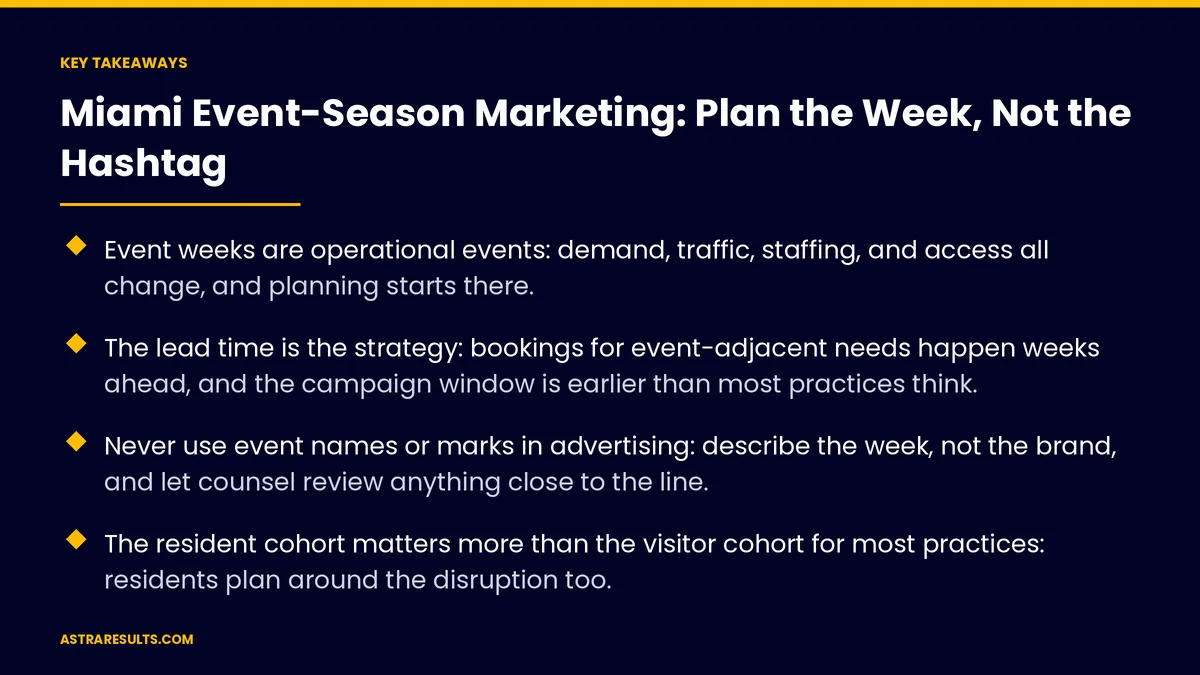
Key Takeaways
- Event weeks are operational events: demand, traffic, staffing, and access all change, and planning starts there.
- The lead time is the strategy: bookings for event-adjacent needs happen weeks ahead, and the campaign window is earlier than most practices think.
- Never use event names or marks in advertising: describe the week, not the brand, and let counsel review anything close to the line.
- The resident cohort matters more than the visitor cohort for most practices: residents plan around the disruption too.
- Logistics are the deliverable: parking, traffic, staffing, and reschedule grace are what patients notice.
- Measure lift against a real baseline: event weeks sit inside high season, so uncontrolled comparisons produce false conclusions.
Published: October 13, 2026 | Reading Time: ~13 minutes | Category: Strategy · Miami
They reshape the city's demand, traffic, hotel pricing, and staffing reality for weeks at a time, multiple times a year. Most practices respond to this either by ignoring it entirely or by posting a themed graphic. Both are mistakes, and the second is worse, because it consumes the only asset the moment offers, attention, on something that produces nothing.
The correct response is operational rather than creative. Event weeks change who is in the city, when they can come in, what they need, how long it takes them to get anywhere, and whether the practice's own staff can reach the office.
A practice that plans around those changes captures real demand and avoids real losses; a practice that plans a hashtag captures neither. The kicker states the discipline: plan the week, not the hashtag.
One legal note before the mechanics. Major event names, logos, and marks are protected intellectual property. Event organizers actively enforce them, so using an event's name or marks in advertising, implying affiliation or sponsorship, or building campaign creative around event branding is a legal question for counsel, not a creative decision.
Everything in this playbook is designed to work without touching a protected mark, because the practices that plan around events don't need to name them.
In This Playbook
- What Actually Drives Event Demand
- The Lead-Time Calendar
- The IP Line
- Residents Versus Visitors
- Logistics Are the Deliverable
- Which Practices Should Actually Engage
- The Ethics of the Moment
- Channels
- Measurement
- A 12-Month Build
What Actually Drives Event Demand
The mechanisms, separated from the mythology.
Mechanism one (the appearance deadline. People attending, hosting, or working these events have a date by which they want to look and feel a particular way, which drives real demand for aesthetic and dental services) but on a lead-time curve rather than an event-week curve, since the treatments that matter require weeks of runway.
The practice that markets during the event has missed the entire window.
Mechanism two: the visitor with a problem. A tourist with a dental emergency, a lost prescription, an injury, or an acute condition needs care now and searches accordingly. This is real, urgent, and best served by access and findability rather than campaigns.
Mechanism three (the resident planning around disruption. Locals reschedule, avoid certain corridors, work from home, and compress errands into different windows) which changes appointment behavior across every practice type in the affected areas. Mechanism four — the business and hospitality workforce, which works punishing hours during these weeks and needs care before and after rather than during.
Mechanism five, plainly stated — most practices see no event effect at all, and identifying that is as valuable as capturing lift, because it prevents a year of misallocated effort.
The Lead-Time Calendar
The planning instrument that replaces the themed post.
The principle. Work backward from each event date through the treatment or service timeline, then start the conversation before the window closes. For aesthetic and dental work, that means the honest-timeline rule Astra holds everywhere governs the calendar. Procedures with weeks of settling or a temporaries phase cannot be compressed into a date.
The counsel that says so is the counsel that converts, "we won't compress your smile into your event calendar."
The build. A documented annual calendar with each major week marked, the lead-time windows for each relevant service mapped backward from it, and the content and outreach scheduled inside those windows rather than during the event.
The honest-decline moment. When someone calls two weeks out wanting something that takes eight, the answer is the no-downtime option now and the real timeline for the rest, the expectation-accuracy discipline that produces the patient who books properly next cycle.
The post-event window. The week or two after a major event is frequently the best booking period of the quarter, because the deadline has passed and the calendar has cleared, an underused opportunity in most practices.
The IP Line
The boundary that keeps this safe, stated plainly because the temptation is strong.
What's protected. Event names, logos, tournament and race marks, festival branding, and in many cases distinctive visual identities, all actively enforced, frequently against small local businesses who assumed nobody would notice.
What that rules out. Using an event's name in ad copy, headlines, hashtags-as-advertising, or landing-page titles; visual creative that borrows event branding; and anything implying affiliation, sponsorship, or official status.
What remains available and works fine. Describing the week generically ("the first week of December," "race weekend," "tournament week"), addressing the need ("looking your best for a big event," "we're open through a busy week," "here's how to reach us when downtown traffic is impossible"), and serving the logistics. None of which require a protected mark.
The rule for practices. If the creative needs the event's name to work, the creative doesn't work. Counsel reviews anything near the line, per the standing IP caution Astra applies to borrowed material.
The official-partnership exception. Real sponsorships exist and carry their own contractual usage rules, which counsel administers.
Residents Versus Visitors
The split that determines where the effort goes.
The visitor cohort. Real but narrower than practices assume, and best served through findability and access rather than campaigns: an accurate profile with correct hours, urgent-care and emergency-visit content that ranks for the searches visitors make, candid same-day availability, and clear payment and insurance information for out-of-area patients. For dental and urgent medical practices this is valuable.
For most others it is a rounding error.
The resident cohort. Larger, more valuable, and mostly ignored in event marketing. Residents are planning around the same disruption and will choose the practice that makes it easy, which means logistics content is resident marketing.
The high-value-visitor question, handled plainly. Event weeks bring affluent international visitors. Some practices serve that market, via the destination doctrine Astra established, with preliminary remote consults, exams deciding, aftercare published before booking, and never a compressed timeline to fit a trip. Marketing to that cohort during an event week without that infrastructure is how practices acquire their worst outcomes.
The discretion layer per the society line: no implied famous or prominent clients, ever, regardless of who is in town.
Logistics Are the Deliverable
The operational content patients notice and remember.
What to publish before each event week.
- Whether the practice is open and on what hours
- How to get there when specific corridors are closed or gridlocked
- Where to park and what changes
- Whether transit is a better option
- How late the practice will hold an appointment for someone stuck in traffic
- How to reschedule without penalty — reschedule grace being the single most appreciated operational courtesy in this metro
The staffing reality, which is the harder half. The practice's own team faces the same traffic, the same transit disruption, and sometimes the same road closures. So schedules should be built with that in mind rather than discovered on the morning of.
The waitlist backfill. Event-week cancellations are predictable, which makes them the easiest cancellations to monetize with a functioning waitlist.
The corridor specificity. Brickell and downtown, Miami Beach, and the Design District and Wynwood experience these weeks very differently, and generic city-wide messaging serves none of them.
Which Practices Should Actually Engage
The plain filter, because most event-marketing advice assumes universal relevance.
Genuinely event-sensitive.
- Aesthetic and cosmetic practices on the lead-time curve
- Cosmetic dentistry on the same curve
- Med spas with no-downtime menus for the near-term window
- Urgent dental and walk-in medical for the visitor cohort
- Practices physically inside the affected corridors, for whom logistics planning is mandatory regardless of demand
Marginally sensitive. Most specialty medicine, where the effect is scheduling disruption rather than demand. Plan the logistics, skip the campaign.
Essentially insensitive. Chronic-care specialties, most legal practice, and advisory work, where the correct event-season strategy is nothing beyond operational planning. Where any campaign is a distraction from the channels that actually produce.
The corollary worth stating. A practice that concludes events don't affect its demand has produced a useful finding, not a failure, and should redirect that attention to its ledger.
The Ethics of the Moment
The standing absolutes, restated because event marketing invites drift.
No manufactured urgency. "book before Basel" framing that implies a real deadline where none exists fails the honest-urgency line Astra holds everywhere.
No insecurity leverage. Event-adjacent appearance marketing is exactly where the no-insecurity absolute gets tested, and "don't be the one who looks tired at the party" is the version to never write. No compressed clinical timelines for a date, ever, the clearest application of the safety-over-schedule rule. No event-adjacent discounting, which trains the deal-shopping cohort the anti-deal posture exists to avoid.
No opportunism if something goes wrong during an event week. The no-tragedy-marketing absolute applies to crowded events exactly as it applies everywhere else.
Channels
Search and profile carry the visitor cohort: urgent-need content that ranks, accurate hours including event-week changes, and the plain access information out-of-area patients need. Plus the AI answers that increasingly handle "dentist open near me now" through the entity work our AI SEO service builds.
Owned channels carry the resident cohort: the logistics posts, the email or text to the existing patient base ahead of the week (the highest-return event-season asset most practices never send), and the lead-time content published in its window.
Paid, if used at all, runs narrow and mark-free behind the negatives fortress (ticket, hospitality, and event-logistics searches excluded wholesale, since they are the largest waste category during these weeks) and never with urgency creative. Social runs restraint: logistics and useful information, no themed graphics, no borrowed branding.
Intake staffing matched to the week's actual pattern, with the never-voicemail standard held and after-hours coverage extended where the visitor cohort is real.
Measurement
The dashboard, because event lift is the most over-claimed effect in local marketing.
The baseline problem, stated first. Most of these events fall inside the region's high season, so comparing event week to a summer week measures the season rather than the event. The comparison has to be against adjacent in-season weeks and against the same week in prior years.
The metrics.
- Bookings and kept appointments by service line for the event week and the surrounding weeks
- Lead-time-window conversion, which is where the real effect lives if it exists
- The post-event booking window's performance
- Visitor-versus-resident split from source-of-truth intake with an out-of-area flag
- Cancellation and no-show rates against normal, since disruption cuts both ways
- Waitlist backfill rate during the week
- The logistics content's engagement as the resident-marketing read
- Staffing cost against realized demand, which is the number that most often reveals event-week enthusiasm to have been expensive
The plain annual conclusion. Some practices will find no effect, and documenting that is the point.
A 12-Month Build
Q1 — Calendar and rules.
- The annual event calendar documented with lead-time windows mapped backward per service line
- The IP rules written with counsel and the mark-free creative standards set
- The logistics-content template built once for reuse
- The ethics absolutes restated in the campaign checklist
- Measurement instrumented with the in-season baseline defined before any campaign runs
Q2 — First candid cycle.
- Logistics communication sent to the patient base ahead of one event week
- Lead-time content published in its correct window rather than during the event
- Staffing planned around team-access reality
- Waitlist backfill activated
- Results read against adjacent in-season weeks rather than against a flattering comparison
Q3: Refine and prune
Service lines showing real lead-time lift identified and prioritized; service lines showing none dropped from event planning entirely; the visitor-cohort infrastructure built only where the intake data shows it's real. The post-event booking window worked deliberately.
Q4 — The December week and the annual read.
- The year's largest event week run on the documented plan
- The full-year comparison completed with the baseline discipline held
- Next year's calendar built from what the data showed rather than from what the city's energy suggested
How Astra Plans Event Seasons
Astra Results Marketing treats Miami's event weeks as operational events rather than creative ones.
The lead-time calendar built backward from each date, the IP line respected absolutely so no campaign needs a protected mark, logistics published as the resident marketing it is, the visitor cohort served through access and findability, the plain filter applied to which practices should engage at all, and lift measured against a real in-season baseline.
Engagements begin with an event-calendar, logistics, and baseline audit through our business consulting team.
Related reading
Frequently asked questions
Can we use the event's name in our ads?
Take that to counsel first. Event names, logos, and marks are protected and actively enforced, including against small local businesses, and implying affiliation or sponsorship carries its own exposure. The practical answer is that you don't need them. Describe the week generically, address the need, and serve the logistics. If your creative only works with the event's name in it, the creative doesn't work.
When should we start marketing for a big event week?
Earlier than feels natural, and not during the event. Work backward from the date through your actual treatment timelines. Anything requiring weeks of settling or a temporaries phase has a window that closes well before the week itself. Then hold the honest-timeline line when someone calls too late: the no-downtime option now, the real timeline for the rest. That patient books properly next cycle.
Do these events actually bring us patients?
For some practices yes, for most only marginally, and for many not at all. Finding out which you are is the valuable part. Aesthetic and cosmetic practices on the lead-time curve, urgent dental and walk-in medical for visitors, and any practice inside an affected corridor should plan seriously. Chronic-care specialties, most legal work, and advisory practices should plan logistics and skip the campaign entirely.
What's the highest-return thing we can do for an event week?
Send your existing patient base clear logistics information a week ahead. Hours, access, parking, traffic, transit, how late you'll hold an appointment, and how to reschedule without penalty. It's the asset most practices never send, it serves residents who are planning around the same disruption. It converts, because logistics content is resident marketing.
How do we serve visitors who need urgent care?
Through findability and access rather than campaigns: accurate hours including event-week changes, urgent-need content that ranks for what visitors search, candid same-day availability, and clear payment and insurance information for out-of-area patients. Extend after-hours coverage if your intake data shows the visitor cohort is real for you. Check that data before assuming it is.
How do we know whether an event week actually worked?
By comparing against adjacent in-season weeks and the same week in prior years, never against a slow summer week, most of these events fall inside high season, so a naive comparison measures the season and calls it the event. Then look at lead-time-window conversion, the visitor-resident split from intake, cancellation rates, and staffing cost against realized demand. That last number is where event-week enthusiasm most often turns out to have been expensive.
Ready to Plan the Week Instead of the Hashtag? Astra Results Marketing plans Miami event seasons operationally. Lead-time calendars, mark-free creative, logistics as resident marketing, and lift measured against a real in-season baseline. Start with an event-calendar, logistics, and baseline audit for your practice. ▸ CALL (786) 321-2866 · ▸ REQUEST YOUR CONSULTATION