Rated 5 star on


Seasonal Campaign Planning for Service Businesses
Quick answer
A service business plans seasonal campaigns from its own demand data, not inherited assumptions. It separates when demand arrives from when work is delivered. It spends before the peak, not during it. In season, marketing allocates capacity. The trough is not discounted. Results are compared year over year, never peak against trough.
Almost every service business is seasonal, and almost none of them know their actual season. What they have instead is a set of inherited assumptions (summer is slow, January is strong, the holidays are dead, back-to-school is a moment) most of which came from a different industry, a different market, or a single memorable year.
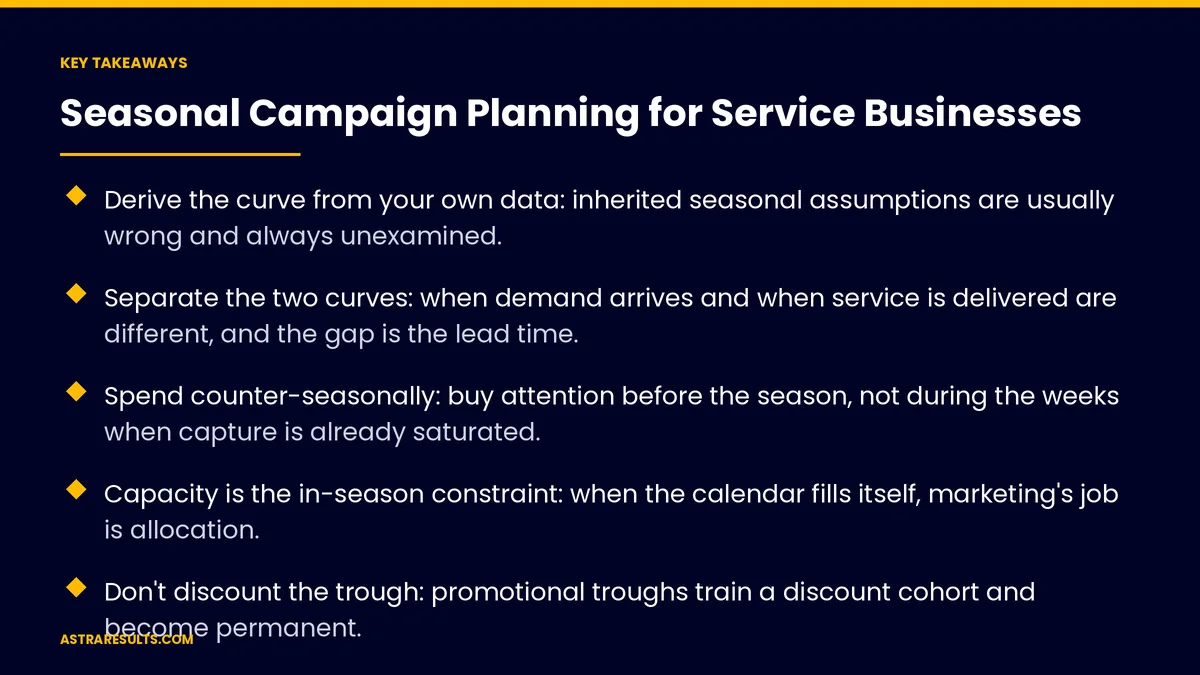
Key Takeaways
- Derive the curve from your own data: inherited seasonal assumptions are usually wrong and always unexamined.
- Separate the two curves: when demand arrives and when service is delivered are different, and the gap is the lead time.
- Spend counter-seasonally: buy attention before the season, not during the weeks when capture is already saturated.
- Capacity is the in-season constraint: when the calendar fills itself, marketing's job is allocation.
- Don't discount the trough: promotional troughs train a discount cohort and become permanent.
- Measure against a real baseline: year-over-year and same-period comparisons, never peak-versus-trough.
Published: October 21, 2026 | Reading Time: ~13 minutes | Category: Strategy · National
Marketing plans built on those assumptions produce a predictable pattern: spend concentrated where demand already exists, promotional discounting in the trough, and a real annual opportunity that nobody found because nobody looked.
This playbook is the generalized version of the seasonal work Astra has done market by market (Miami's tourism calendar, Houston's inverted summer, Chicago's two-season split, and the seasonal-resident cycle) reduced to a method that works anywhere. Its first instruction is the kicker, and it's the step nearly everyone skips: find your real curve first.
In This Playbook
- Find Your Real Curve
- The Two Curves and the Lead Time
- Spend Counter-Seasonally
- Capacity Is the In-Season Constraint
- Don't Discount the Trough
- The Trough's Real Opportunity
- What should a seasonal service business publish, and when?
- Measurement Against a Real Baseline
- A 12-Month Implementation
Find Your Real Curve
The analysis that precedes every decision below.
The method. Pull two or three years of your own data (inquiries, booked appointments, kept appointments, and revenue by week or month) and plot each separately, because they peak at different times and the differences are the whole insight. Then segment: by service line, by acquisition source, by new-versus-returning, and by customer cohort where relevant.
What practices consistently discover.
- The season they believed in doesn't match the data
- Different service lines have opposite curves
- The "slow" period has better conversion than the peak
- The peak's volume masks a composition problem — more inquiries, worse fit — which is exactly what the seasonal-composition analysis surfaced in the Miami calendar
The external overlay, second not first. Local school calendars, weather patterns, regional employment cycles, tax and fiscal dates, insurance and benefit-year timing, and industry-specific rhythms, used to explain the curve you found rather than to predict one you haven't measured.
The plain caveat. Two years of data in a small business is a noisy signal, so the curve is a hypothesis to test rather than a law. The measurement discipline below exists to test it.
The Two Curves and the Lead Time
The distinction that determines when campaigns run.
Curve one: demand arrival. When people inquire, research, and decide.
Curve two, service delivery. When the work happens. The gap between them is your lead time, and it is the single most actionable number in seasonal planning, because campaigns must run against the arrival curve while capacity plans run against the delivery curve.
Why this trips businesses up. A business whose delivery peak is June and whose decision cycle is eight weeks needs its campaign live in March. If it runs the campaign in June, it markets to people who are already booked elsewhere. This is the same logic the event lead-time calendar applies to a single week, generalized to a year.
The multi-stage version. For high-consideration services, arrival splits further into research, inquiry, consultation, and commitment, each with its own lag. That is why the four-stage funnel is the instrument that makes seasonal planning possible at all.
The practical build. Work backward from each delivery peak through your measured lead time, and mark the campaign window on a calendar.
Spend Counter-Seasonally
The recommendation that feels wrong and usually is right.
The logic. In the weeks when demand arrives on its own, capture is saturated: the phone rings, the calendar fills, and incremental spend competes with a queue that already exists. In the weeks before, the same spend reaches people whose decision is still open.
The reallocation. Reduce or hold spend at the arrival peak, concentrate it in the pre-peak window, and treat the trough as a build period rather than a discount period.
The evidence to check before believing this. Cost per kept appointment or signed engagement by week, which typically rises at the peak because competition and click costs rise while conversion doesn't improve proportionally.
The exception worth naming. Businesses whose demand is urgent and unplanned (emergency services, urgent care, acute repair) should maintain in-season presence, because for them the peak is the decision moment and lead time is measured in minutes. The infrastructure caveat Astra holds everywhere: capture before attention, if intake, booking, or follow-up is broken, counter-seasonal spend just wastes money earlier.
Capacity Is the In-Season Constraint
The reframe for peak weeks.
The shift. When the calendar fills itself, marketing's job becomes allocation rather than acquisition: protecting slots for the highest-value cohorts, reserving capacity for the work with the best economics, and preventing transient demand from displacing the relationships that carry the trough.
The instruments. Consultation and inquiry triage matched to type. A functioning waitlist, which converts predictable peak cancellations into the easiest revenue of the year; and returning-customer scheduling priority, since the peak is when established relationships are most easily neglected.
The staffing consequence. Peak compression degrades service quality. The resulting reviews, outcomes, and word of mouth affect the following twelve months. That makes staffing planning a marketing decision rather than an operations one.
The pricing moment. Peak demand is the wrong time to discount and the right time to hold, because discounting into a full calendar is margin donation.
Don't Discount the Trough
The trap that turns a seasonal dip into a structural problem.
The pattern. Volume falls, a promotion covers the gap, it works. It runs again next year: until the trough is defined by discounting, the customers acquired in it return only for discounts. The business has trained a cohort it now depends on.
The cohort evidence. Compare retention and multi-year value for promotion-acquired customers against full-price and plan-enrolled ones, per the failure-analysis method. The gap is usually decisive and settles the internal argument arithmetically rather than philosophically.
What to do with the trough instead. Use it for the work the peak makes impossible: deeper service delivery, the multi-visit or multi-phase engagements that need runway, plan and membership enrollment per the subscription-economics logic, referral cultivation while there's time for warmth, content and infrastructure building, and staff development.
The reframe that makes it work. The trough frequently has real advantages for the customer (availability, attention, and timelines that can run their course) and marketing those advantages plainly beats discounting them. The counter-seasonal campaign is the trough's answer, not a sale.
The Trough's Real Opportunity
Where the annual upside usually hides.
The pattern Astra keeps finding. The period businesses treat as dead is frequently the period with the best customer economics: the Miami summer that produces resident patients who complete plans, the Houston winter that becomes the series engine, the Chicago fall reset that builds the winter book.
The common structure. In the trough, the customer who shows up is disproportionately local, deliberate, and relationship-oriented rather than transient and deadline-driven: which produces completion, retention, and referral rather than a single transaction.
The test. Compute annual or lifetime value by period of acquisition, which almost nobody does and which typically reveals the trough cohort outperforming.
The strategic conclusion. The highest-leverage marketing month in most seasonal businesses is the month before the period they've been ignoring.
What should a seasonal service business publish, and when?
Content on the arrival curve. The questions people ask while deciding, published before the window opens rather than during it, under the authorship standards the business's vertical requires.
The AI-answer layer. Seasonal questions (when to schedule, how far ahead to book, what the timing trade-offs are) are increasingly answered by assistants. The business whose candid timing content exists gets cited, per the answer-layer economics.
Owned channels first. The existing-customer communication ahead of a season is the highest-return seasonal asset most businesses never send, and it costs nothing. Paid on the counter-seasonal schedule behind a maintained negatives fortress, with seasonal waste categories excluded explicitly, because seasonal search brings seasonal noise.
The annual calendar as a document. Delivery peaks marked, lead times measured, campaign windows scheduled, capacity plans attached, staffing planned, and the trough's build agenda written down, a single page that replaces the improvisation most businesses run on. The honest-urgency line held throughout: real deadlines taught plainly, manufactured seasonal countdowns never, per the standing rule.
Measurement Against a Real Baseline
The discipline that keeps seasonal conclusions candid.
The baseline trap. Comparing a peak week to a trough week measures the season, not the campaign, which is how seasonal marketing generates confident wrong conclusions in every business that doesn't control for it.
The correct comparisons. Same period year-over-year, adjacent in-season periods, and cohort-matched groups where possible.
The metrics.
- Cost per kept appointment or signed engagement by period, not blended annually, since blending hides both stories
- Conversion at each funnel stage by period, which is where composition problems surface
- Value by period of acquisition, the number that settles the trough argument
- Capacity use against demand at the peak
- Waitlist backfill
- The lead-time measurement itself, refreshed annually because decision cycles shift
The falsifiability habit. Each seasonal decision paired with the metric that would show it was wrong, reviewed at a stated interval, because the alternative is defending last year's calendar on instinct, which is how the inherited assumptions this playbook opened with got inherited in the first place.
A 12-Month Implementation
Months 1–2: Derive the curve
- Two to three years of inquiry, booking, kept-appointment, and revenue data plotted separately and segmented by service line and source
- The external overlay applied to explain rather than predict
- Lead time measured from the funnel data
- The annual calendar drafted with delivery peaks, lead times, and campaign windows marked
Months 3–5: Fix capture, then reallocate
Intake, booking, and follow-up verified before any spend change, since counter-seasonal spend into a broken funnel just wastes money earlier. The pre-peak campaign window funded by reducing peak spend; the existing-customer pre-season communication built and scheduled.
Months 6–8: Work the trough properly
The trough's build agenda executed (multi-phase service delivery, plan enrollment, referral cultivation, content and infrastructure) with the trough's real customer advantages marketed plainly and no promotional discounting. Capacity and staffing plans set for the coming peak.
Months 9–12: Run the peak on allocation and read honestly
- Triage, waitlist, and returning-customer priority active through the peak
- Price integrity held
- Then the annual read with baseline discipline. Cost per outcome by period, value by period of acquisition, lead time refreshed — and next year's calendar rebuilt from the data rather than from the assumptions
How Astra Plans Seasonal Marketing
Astra Results Marketing plans seasonality from the business's own curve rather than the calendar everyone else uses: demand and delivery curves separated, lead time measured, spend reallocated counter-seasonally, peak weeks managed for allocation, the trough built rather than discounted, and every conclusion tested against a real baseline.
Engagements begin with a demand-curve, lead-time, and baseline audit through our business consulting team.
Related reading
Frequently asked questions
How do we find our actual season?
Plot two to three years of your own data (inquiries, bookings, kept appointments, and revenue, each separately) then segment by service line, source, and new-versus-returning. They peak at different times, and the differences are the insight. Apply school calendars, weather, employment cycles, and industry rhythms afterward to explain the curve you found rather than to predict one you never measured.
Why spend before the season instead of during it?
Because during the peak your capture is saturated. The calendar is filling itself, so incremental spend competes with a queue that already exists while click costs and competition rise. In the pre-peak window, the same money reaches people whose decision is still open. Check cost per kept appointment by week before believing it, that number typically deteriorates at the peak, which is the whole argument in one metric.
Isn't a slow-season promotion the obvious move?
It's the move that turns a seasonal dip into a structural problem. Promotion-acquired customers return only for promotions, the trough becomes defined by discounting. The business ends up dependent on a cohort it trained. Compare retention and multi-year value by acquisition period and the case closes arithmetically. Market the trough's real advantages instead: availability, attention, timelines that can run their course.
What should we actually do during the trough?
The work the peak makes impossible: multi-phase service delivery that needs runway, plan or membership enrollment, referral cultivation while there's time to be warm, content and infrastructure building, and staff development, plus the counter-seasonal campaign for the next peak. Then compute value by period of acquisition. Most businesses discover the trough cohort outperforms the peak cohort substantially.
How should marketing change during our busiest weeks?
Shift from acquisition to allocation. Triage inquiries by type, run a real waitlist to convert predictable cancellations, give returning customers scheduling priority so established relationships aren't displaced by transient demand, hold price integrity, and staff to protect service quality, because peak compression produces the reviews and word of mouth that shape the following twelve months.
What's the most common seasonal measurement mistake?
Comparing the peak to the trough and calling the difference performance. That comparison measures the season, not the campaign. Use same-period year-over-year and adjacent in-season comparisons, report cost per outcome by period rather than blended annually, and pair every seasonal decision with the metric that would prove it wrong. Otherwise you'll defend this year's calendar on instinct next year, which is how the assumptions you started with became assumptions.
Ready to Plan From Your Own Curve? Astra Results Marketing plans seasonality on measured demand and delivery curves, real lead times, counter-seasonal spend, allocation at the peak, and a trough that gets built rather than discounted. Start with a demand-curve, lead-time, and baseline audit for your business. ▸ CALL (786) 321-2866 · ▸ REQUEST YOUR CONSULTATION