 Rated 5 star on

Making the Business Case for Predictive Analytics
Quick answer
A strong predictive analytics business case starts with one specific, frequent decision, not the technology. Measure how that decision performs today. Estimate value as decisions improved times the value of each improvement, using low, middle and high ranges. Count data, build, running and staff costs. Name who acts on predictions, then prove results with a pilot.
"We should use AI to predict things" is not a business case. Leaders approve projects that improve a specific decision by a believable amount, at a known cost, with a way to prove it worked. Most proposals fail because they start with the technology, not the decision. Start with the decision, and the case almost writes itself.
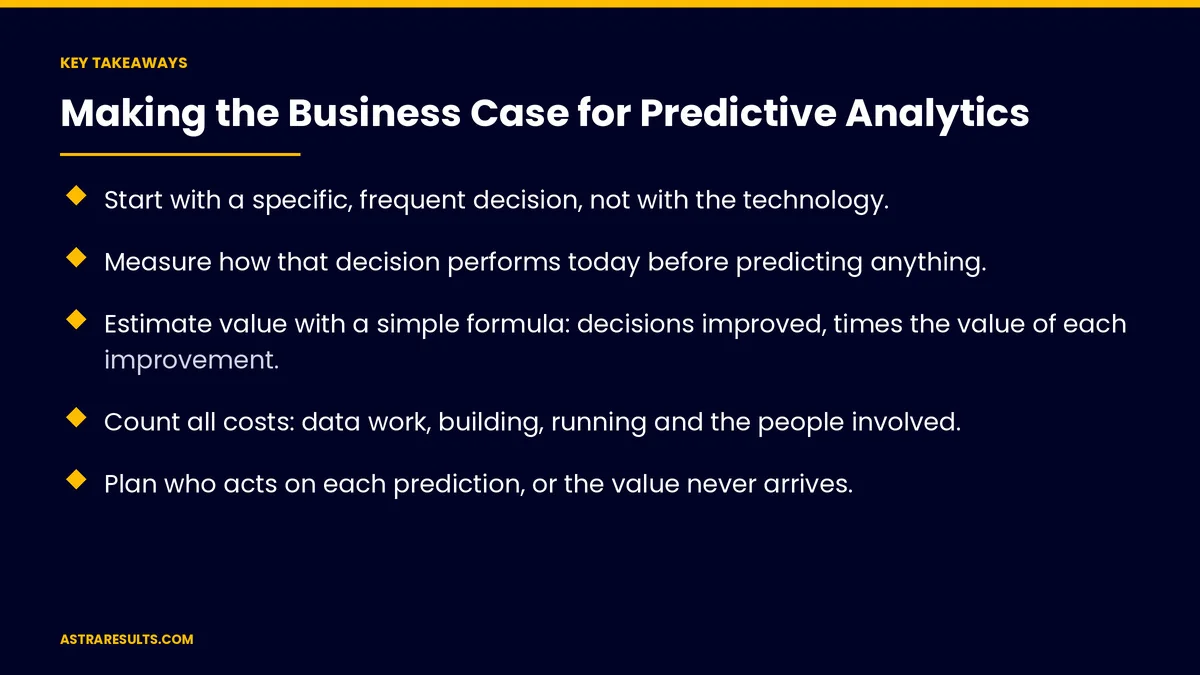
Key Takeaways
- Start with a specific, frequent decision, not with the technology.
- Measure how that decision performs today before predicting anything.
- Estimate value with a simple formula: decisions improved, times the value of each improvement.
- Count all costs: data work, building, running and the people involved.
- Plan who acts on each prediction, or the value never arrives.
- Prove results with a pilot that compares against a group without predictions.
Published: October 20, 2026 | Reading Time: ~9 minutes | Category: Machine Learning & Analytics
This guide covers how to build a business case for predictive analytics: choosing the decision, measuring the baseline, estimating value and costs, planning who acts on predictions, designing a pilot that proves results, handling risks and knowing when not to proceed. Put plainly: one decision, one baseline, one measured improvement.
In This Playbook
- Start with a decision
- Measure the baseline
- Estimate the value
- Count all the costs
- Plan the action
- Prove it with a pilot
- What risks does a predictive analytics project face?
- When not to proceed
- Presenting the case
- What to measure
- The first three months
Start with a decision
Pick a frequent decision. Which customers to call, how much to order, which leads to prioritize, which machines to service.
Make it specific. "Which members are likely to cancel next month" beats "understand our customers."
Check it can change. If nobody can act differently on a prediction, it has no value.
The basics of how models help decisions are covered in machine learning for operators.
Measure the baseline
How is the decision made today? By rule, by habit or by gut feel.
How well does it work? Current cancellation rate, stockouts, wasted calls or breakdowns.
What does it cost? Lost revenue, waste, staff time or downtime.
Write it down. Without a baseline, nobody can prove improvement later.
Estimate the value
A simple formula. How many decisions per year, times how many could improve, times the value of each improvement.
Example in words. If you could keep a small share of members who would have canceled, multiply that number by what a member is worth over a year.
Use ranges. A low, middle and high estimate is more believable than one precise number.
Include soft benefits. Staff time saved and fewer emergencies, without overstating them.
Count all the costs
Data work. Collecting, cleaning and connecting data, often the largest part, as covered in what data infrastructure costs.
Building the model. Development and testing.
Running it. Hosting, monitoring and retraining over time.
People. The team members who act on predictions, and their training.
The full stack. What each piece does is covered in the ML stack explained.
Plan the action
Who acts on each prediction? A named role, not "the team."
What do they do? A clear step, such as a call, an offer or a service visit.
How do predictions reach them? In the tools they already use, or through an agent that drafts the next step, as covered in the action layer.
How often? Daily, weekly or in real time, matched to the decision.
Prove it with a pilot
Compare two groups. One gets predictions and actions; a similar group continues as before.
Run long enough. Enough decisions to see a real difference.
Measure the same numbers as the baseline. Cancellations, stockouts, conversions or breakdowns.
Fail safely. Limit scope and know how to stop, as covered in AI pilots that fail safely.
What risks does a predictive analytics project face?
Data quality. Gaps and errors in history weaken predictions.
Fairness. Make sure predictions work as well for different customer or location groups, as in franchise location models.
Adoption. Staff may ignore predictions they don't trust, so show the reasons behind them.
Drift. Models lose accuracy as conditions change, so plan regular checks.
When not to proceed
No usable data. Too little history, or data that can't be trusted.
No way to act. Predictions nobody can use.
Low stakes. The decision is rare or cheap to get wrong.
A simple rule works. Sometimes a clear rule beats a model at a fraction of the cost.
Presenting the case
One page. Decision, baseline, estimated value range, costs, pilot plan and risks.
Payback in plain terms. How long until value covers costs, under the middle estimate.
Clear go or no-go points. What the pilot must show to continue.
The same approach works elsewhere. As in making the business case for native iOS.
What to measure
The baseline number. Before and after.
Lift over the comparison group. The real improvement.
Action rate. How often predictions lead to action.
Costs to date. Against the estimate.
Payback progress. Value delivered against costs.
The first three months
Days 1–30: decision and baseline
Choose one frequent decision and measure how it performs today. Check that data exists and that someone can act on predictions. Estimate value and costs as ranges.
Days 31–60: build and pilot
Build a first model, connect predictions to the people or agents who act, and start a pilot with a comparison group.
Days 61–90: prove and decide
Compare results against the baseline and comparison group. Present payback under the measured results and decide whether to expand, adjust or stop.
How does Astra build a predictive analytics case?
Astra Results Marketing helps businesses build and prove the case for predictive analytics. We start with one decision, measure the baseline, estimate value and costs as ranges and plan who acts on each prediction.
Then we run a pilot with a comparison group and report the measured lift and payback. Engagements begin with a decision and data review through our machine learning and advanced analytics team.
Related reading
Frequently asked questions
Where should a predictive analytics business case start?
With one specific, frequent decision that could change based on a prediction, such as which customers to contact or how much stock to order.
How do we estimate the value?
Multiply how many decisions happen per year, how many could improve and the value of each improvement. Use low, middle and high ranges rather than one number.
What costs should we include?
Data collection and cleaning, model building, hosting, monitoring and retraining, plus the time of the people who act on predictions.
How do we prove predictive analytics works?
Run a pilot that compares a group receiving predictions and actions with a similar group continuing as before, measuring the same numbers as the baseline.
When is predictive analytics not worth it?
When there's no usable data, no way to act on predictions, the decision is rare or low-stakes, or a simple rule works well enough.
How should we present the case to leadership?
On one page: the decision, baseline, value range, costs, pilot plan, risks, payback under the middle estimate and clear go or no-go points.
Ready to build a business case leaders will approve? Astra Results Marketing builds predictive analytics cases around one decision, a measured baseline, realistic value and cost ranges and a pilot that proves the gain. ▸ CALL (786) 321-2866 · ▸ REQUEST YOUR CONSULTATION





