 Rated 5 star on

Demand Forecasting Without a Data Science Team
Quick answer
Smaller businesses can improve demand forecasts without a data science team. Start with at least a year of clean sales history by product, location and week. Use a simple baseline, like the same period last year adjusted for growth. Add seasons, promotions, holidays, weather and events. Compare forecasts with actual sales every week.
Most businesses already forecast demand, even if it's gut feeling or last year's numbers. The question is whether it's good enough to plan stock, staff and cash. You don't need a data science team to improve it. Clean history, a simple method, the factors that move demand and regular checks against reality get most businesses a long way.
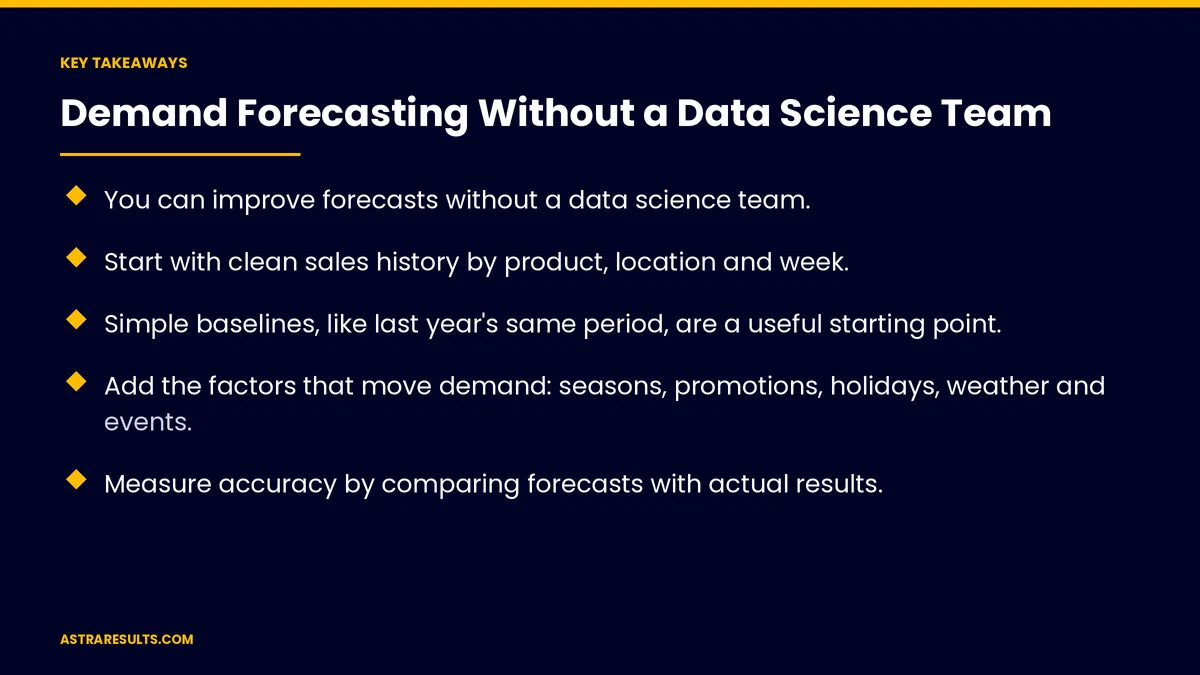
Key Takeaways
- You can improve forecasts without a data science team.
- Start with clean sales history by product, location and week.
- Simple baselines, like last year's same period, are a useful starting point.
- Add the factors that move demand: seasons, promotions, holidays, weather and events.
- Measure accuracy by comparing forecasts with actual results.
- Let people add what they know, then use forecasts for ordering, staffing and cash.
Published: October 2, 2026 | Reading Time: ~9 minutes | Category: Machine Learning & Analytics
This guide covers practical demand forecasting for smaller businesses: getting sales history ready, starting with simple baselines, adding seasons, promotions and events, choosing tools, forecasting at the right level, measuring accuracy, combining forecasts with people's knowledge and putting forecasts to work. Put plainly: start simple, add what really moves demand and check every forecast against what happened.
In This Playbook
- Why does demand forecasting matter for a business?
- Get the history ready
- Start with simple baselines
- Add what moves demand
- Choosing tools
- Forecast at the right level
- Measure accuracy
- Combine forecasts with people's knowledge
- Put forecasts to work
- When should a business bring in forecasting help?
- What to measure
- The first three months
Why does demand forecasting matter for a business?
Ordering. Too much stock ties up cash; too little loses sales.
Staffing. Schedules matched to expected demand.
Cash planning. Know what's coming in and going out.
Better decisions. Forecasts help everywhere, as covered in machine learning for operators.
Get the history ready
Sales by product, location and week. At least a year, ideally more.
Clean the data. Fix duplicates, missing weeks and returns, as covered in data KPIs.
Note unusual periods. Stockouts, closures and one-time events that distort the numbers.
Record promotions. What was on sale, when and how deeply.
Start with simple baselines
Same period last year. Adjusted for overall growth.
Recent averages. The last few weeks, for steady products.
Compare methods. See which baseline would have predicted recent weeks best.
Simple often wins. For many products, a sensible baseline performs well.
Add what moves demand
Seasons. Summer, holidays and back to school.
Promotions. Sales lift during discounts, and the dip after.
Holidays and events. Local festivals, games and school calendars.
Weather. Heat, rain and storm warnings, especially in South Florida.
New products. Use similar products' history as a guide.
Choosing tools
Spreadsheets. Built-in forecast functions handle simple cases.
Reporting and inventory tools. Many include forecasting features.
Partner-built models. For many products, locations or complex patterns, as explained in the ML stack.
Match the tool to the need. Start with what you have, then upgrade if accuracy falls short.
Forecast at the right level
Category and week. Often more accurate than item and day.
Item level where it matters. Fast sellers and expensive items.
Location level. Stores and neighborhoods differ, as in franchise location models.
Daily for operations. Restaurants often need item-by-daypart forecasts, as in restaurant group AI.
Measure accuracy
Compare forecast with actual. Every week, for key products.
Average percentage error. A simple way to show how far off forecasts are.
Watch for bias. Forecasts that are always too high or too low.
Track by product group. Some items are harder to forecast than others.
Combine forecasts with people's knowledge
Managers know things data doesn't. A new competitor, a road closure or a big local event.
Record adjustments. Note what was changed and why.
Check whether adjustments help. Over time, see if overrides improved accuracy.
Put forecasts to work
Ordering. Suggested orders based on forecast and stock.
Moving stock between stores. Forecasts guide transfers, as in retail inventory transfer agents.
Staffing. Schedules matched to expected busy times.
Cash. Expected sales feed cash planning.
When should a business bring in forecasting help?
Many products and locations. More than spreadsheets can handle.
Accuracy isn't improving. Despite cleaner data and better methods.
High stakes. Expensive stock or tight margins.
Make the case first. As covered in the business case for predictive analytics.
What to measure
Forecast accuracy. Average percentage error by product group.
Bias. Consistent over- or under-forecasting.
Stockouts. Before and after.
Excess stock. Items left over or marked down.
Staffing match. Labor hours against actual demand.
The first three months
Days 1–30: prepare the data
Gather at least a year of sales by product, location and week. Clean it, note unusual periods and record past promotions.
Days 31–60: baseline and improve
Test simple baselines against recent weeks, then add seasons, promotions and events. Start measuring accuracy weekly for key products.
Days 61–90: use and review
Use forecasts for ordering and staffing, record manager adjustments and compare stockouts and excess stock with the baseline. Decide whether you need more advanced help.
How Astra helps with forecasting
Astra Results Marketing helps businesses forecast demand without building a data science team. We prepare sales history, test simple baselines, add the factors that move demand and set up weekly accuracy checks.
When needs grow, we build models that connect to ordering, staffing and cash planning. Engagements begin with a forecasting review through our machine learning and advanced analytics team.
Related reading
Frequently asked questions
Do we need data scientists to forecast demand?
Not to start. Clean sales history, simple baselines and the factors that move demand improve most forecasts. Bring in help when products, locations or stakes grow.
What data do we need?
At least a year of sales by product, location and week, plus records of promotions, stockouts, closures and unusual events.
What's a simple forecasting method?
The same period last year adjusted for growth, or recent weekly averages for steady products. Compare which works best for your items.
How do we measure forecast accuracy?
Compare forecasts with actual sales every week, track average percentage error by product group and watch for forecasts that are consistently too high or low.
Should managers adjust forecasts?
Yes, when they know about events the data can't see. Record what they changed and why, and check whether adjustments improve accuracy.
What should forecasts be used for?
Ordering, moving stock between stores, staff scheduling and cash planning.
Ready to forecast demand with more confidence? Astra Results Marketing helps businesses clean sales history, start with simple baselines, add what moves demand and measure accuracy, then builds models when needs grow. ▸ CALL (786) 321-2866 · ▸ REQUEST YOUR CONSULTATION





