 Rated 5 star on

Mobile Apps for Loyalty and Repeat Customers
Quick answer
A loyalty app makes sense for businesses customers visit often, such as cafes, salons, gyms and stores. For less frequent visits, a digital wallet card or text program may cost less. Simple rewards beat complex point schemes. The app must connect to your point-of-sale. Measure extra visits against a comparison group, not member counts.
A customer who comes back is worth far more than one who visits once. So many businesses want a loyalty app. But plenty get downloaded, used twice and deleted. The ones that work make coming back easier and more rewarding, connect to how the business sells, and cost less than the extra business they bring in.
Key Takeaways
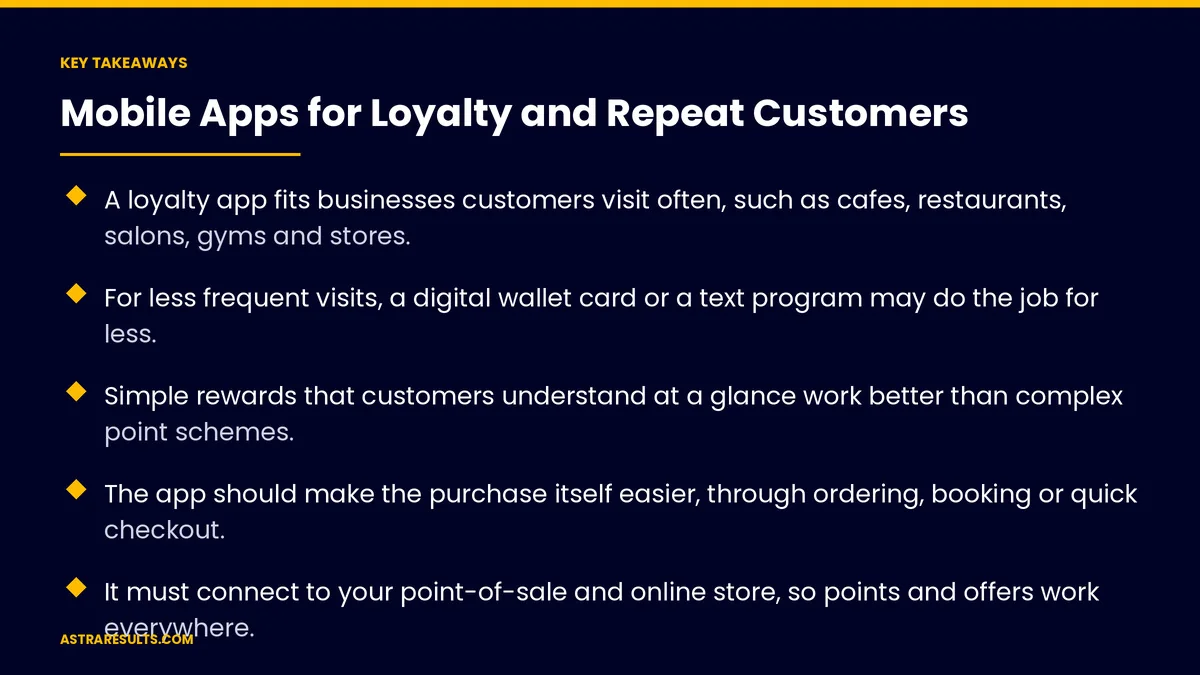
- A loyalty app fits businesses customers visit often, such as cafes, restaurants, salons, gyms and stores.
- For less frequent visits, a digital wallet card or a text program may do the job for less.
- Simple rewards that customers understand at a glance work better than complex point schemes.
- The app should make the purchase itself easier, through ordering, booking or quick checkout.
- It must connect to your point-of-sale and online store, so points and offers work everywhere.
- Measure extra visits against a comparison group, not just how many members you have.
Published: October 31, 2026 | Reading Time: ~10 minutes | Category: Mobile App Development
This guide covers when a loyalty app makes sense, which rewards work, the features that keep people using it, connecting it to your sales systems, and measuring extra visits. Put plainly: a loyalty app earns its place when customers would open it anyway, and the rewards cost less than the visits they create.
In This Playbook
- When a loyalty app makes sense
- Reward models that work
- Features that bring people back
- Connect it to how you sell
- Getting people to download it
- Notifications without annoying people
- Privacy and trust
- Measuring real lift
- The first three months
When a loyalty app makes sense
Frequent visits. Customers who buy weekly or monthly, like coffee, meals, fitness classes or services, will open an app often.
A clear reason to open it. Ordering ahead, booking, checking a balance or getting an offer.
Several locations. An app keeps one account and one reward balance across every location, as covered in franchise apps.
When an app is too much. If customers visit a few times a year, a digital wallet card, an email program or text offers may work better and cost less. The general choice is weighed in native, cross-platform or web.
Reward models that work
Points. Earn points per dollar, redeem for rewards. Flexible, but keep the math simple.
Punch cards. Buy nine, get the tenth free. Easy to understand and good for single products.
Tiers. Better perks as customers spend more. Works when there's a real difference between tiers.
Paid membership. Customers pay for ongoing benefits, like free delivery or member pricing.
Perks over discounts. Early access, a free upgrade or a birthday treat can mean more than a percentage off, and cost less.
Run the math. Every reward has a cost. Check it against your margins, as in price optimization.
Features that bring people back
Fast earning. Scan at the counter or earn automatically when paying in the app.
Order ahead or book. The biggest reason to keep an app is that it makes buying easier.
Clear balance and progress. "Two more visits to your free coffee" motivates more than a points total.
Personal offers. Based on what each customer buys, sent at the right time.
Referrals. Rewards for bringing a friend.
Quick reorder. One tap to repeat a usual order, the same idea behind e-commerce engagement.
Connect it to how you sell
Point-of-sale. Points and rewards must work at the counter as well as in the app.
Online store and ordering. The same account and balance online and in person.
Customer records. Purchases and preferences in one place, so offers are relevant. Connections are covered in API integration.
Staff tools. Staff should be able to see a customer's rewards and apply them quickly.
One balance everywhere. A reward earned in one place should be usable in another.
Getting people to download it
A reason at the counter. A welcome reward for signing up, offered at checkout.
Make sign-up quick. Phone number or email, and they're in.
Show it everywhere. Signs, receipts, emails and your website.
Train staff. A short line at checkout drives more sign-ups than any ad.
Spanish too. In Miami, offer the app and its messages in English and Spanish.
Notifications without annoying people
Ask at the right moment. Request permission after the customer sees value, not on first launch.
Fewer, better messages. A reward ready, an order confirmed, a relevant offer. Not daily promotions.
Personal timing. Send offers when a customer usually buys, not all at once.
Easy opt-out. Respect preferences, or customers turn off all notifications or delete the app.
Privacy and trust
Collect only what you need. Purchase history and contact details, with clear consent.
Explain how data is used. In plain language, at sign-up.
Protect it. Secure accounts and limited staff access.
Keep the app working. Updates, fixes and support after launch, as covered in app maintenance.
Measuring real lift
Members aren't proof. Your best customers join first, so members always look better than non-members.
Use a comparison group. Compare visit frequency and spend for similar customers before and after joining, or hold back offers from a small random group.
Repeat rate. The share of customers who come back within a set time.
Visit frequency and spend. For active members, compared with the comparison group.
Reward cost. Total cost of rewards given, against the extra margin they produced.
App retention. The share of members still opening the app after 30 and 90 days.
The first three months
Days 1–30: decide and design
Check visit frequency to decide between an app, a wallet card or a text program. Choose a reward model and run the margin math. List the point-of-sale, store and customer systems the app must connect to.
Days 31–60: build and connect
Build the core: sign-up, earning, balance, rewards, and ordering or booking if it fits. Connect point-of-sale and online systems. Train staff and prepare signs, receipts and welcome offers.
Days 61–90: launch and measure
Launch with a welcome reward. Track sign-ups, repeat rate, visit frequency, reward cost and app retention against a comparison group. Adjust rewards and messages from the results.
How does Astra build loyalty apps?
Astra Results Marketing builds loyalty apps that make coming back easier and more rewarding. We start by checking whether an app is the right tool, choose rewards that fit your margins, and connect the app to your point-of-sale, store and customer systems.
We launch with staff and in-store support, keep notifications relevant, and measure extra visits against a comparison group so you know the program pays. Engagements begin with a loyalty review through our mobile app development team.
Related reading
Frequently asked questions
Does every business need a loyalty app?
No. Apps work best when customers visit often and have a reason to open the app, like ordering or booking. For less frequent visits, a digital wallet card, email or text program may work better for less.
Which reward model works best?
The simplest one your customers understand at a glance. Punch cards suit single products, points suit varied purchases, and tiers or paid memberships suit high-value customers. Perks often cost less than discounts.
How do we get customers to download the app?
Offer a welcome reward at checkout, make sign-up quick, show the app on signs, receipts and emails, and train staff to mention it at every sale.
Does the app need to connect to our point-of-sale?
Yes. Customers expect to earn and redeem at the counter as well as in the app, with one balance across every location and channel.
How often should we send notifications?
Only when there's something useful: a reward ready, an order update or a relevant offer. Ask for permission after the customer sees value, and make opting out easy.
How do we know the loyalty app works?
Compare visit frequency and spend for members against a comparison group, not against all non-members, because your best customers join first. Weigh reward costs against the extra margin they bring.
Ready for a loyalty program customers use and you can afford? Astra Results Marketing checks whether an app fits, designs rewards around your margins, connects the app to your point-of-sale and store, and measures the extra visits it brings against a comparison group. ▸ CALL (786) 321-2866 · ▸ REQUEST YOUR CONSULTATION





