 Rated 5 star on


Price Optimization: Finding the Price That Maximizes Profit
Quick answer
The profit-maximizing price comes from margin math and real tests, not revenue alone. With a 30% margin, a 10% price rise can lose a quarter of its volume and still earn the same gross profit. The same margin means a 10% discount needs 50% more volume to break even. Use clear tiers and discount rules, and test changes first.
Many prices were set years ago by adding a markup to cost or copying a competitor, and nobody has looked closely since. Yet price is often the most powerful lever a business has. A small change goes straight to profit, in either direction. Price optimization means setting prices on purpose, from margin math, customer demand and real tests.
Key Takeaways
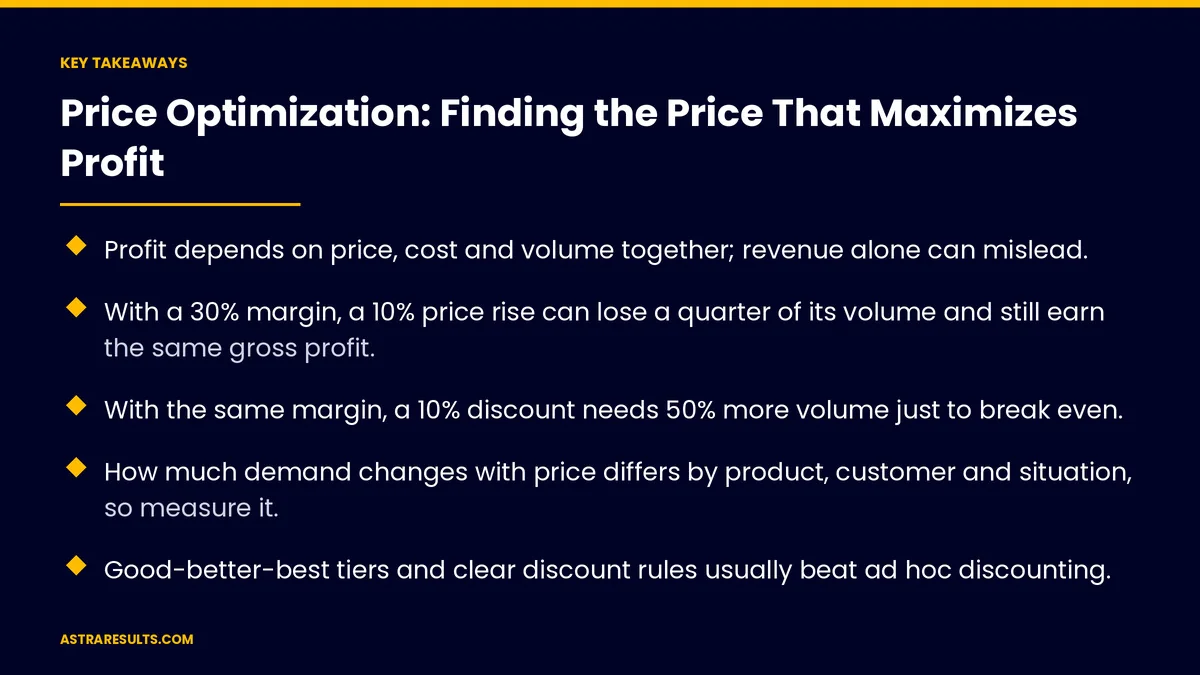
- Profit depends on price, cost and volume together; revenue alone can mislead.
- With a 30% margin, a 10% price rise can lose a quarter of its volume and still earn the same gross profit.
- With the same margin, a 10% discount needs 50% more volume just to break even.
- How much demand changes with price differs by product, customer and situation, so measure it.
- Good-better-best tiers and clear discount rules usually beat ad hoc discounting.
- Test price changes on part of your market before rolling them out everywhere.
Published: October 6, 2026 | Reading Time: ~10 minutes | Category: Price Optimization
This guide explains how to find prices that maximize profit: the margin math behind a price change, how demand responds, tiers and discounts, quote pricing, and testing and announcing changes. Put plainly: know what each price change does to profit before you make it, then test it on real customers.
In This Playbook
- Why price matters so much
- The margin math
- How demand responds to price
- Ways to set prices
- Tiers and bundles
- Discounts with rules
- Pricing quotes for B2B
- Testing and raising prices
- What should we measure when optimizing prices?
- The first three months
Why price matters so much
It goes straight to profit. A higher price on the same sale adds its full amount to the margin. A lower price takes its full amount away.
Most businesses under-manage it. Prices set once and adjusted rarely, discounts given freely, quotes priced by habit.
Small changes add up. A few percent on every sale, across a year, can outweigh a major cost-cutting project.
It's different from dynamic pricing. Price optimization sets your base prices, tiers and discount rules. Automatic, real-time changes are covered in dynamic pricing optimization.
The margin math
Start with unit margin. Price minus variable cost. On a $100 sale that costs $70, the margin is $30.
A 10% price rise. The price becomes $110 and the margin $40. You could lose 25% of your volume and still make the same gross profit.
A 10% discount. The price becomes $90 and the margin $20. You'd need 50% more volume just to break even.
The lesson. Discounts cost more than they look, and price rises are safer than they feel, especially at lower margins.
Use your own numbers. Run this math for each product or service with your real costs and margins before changing anything.
How demand responds to price
Price elasticity. How much the quantity sold changes when the price changes. Some products barely move; others drop sharply.
It depends on the situation. Urgent needs, unique products and loyal customers respond less. Easy-to-compare products and new customers respond more.
It varies by segment. Business buyers, consumers, members and first-time customers often react differently.
Measure it, don't guess. Past price changes, promotions and tests show how your customers respond.
Better tools help. With enough data, machine learning can estimate demand by product and segment, as explained in machine learning for operators. It depends on clean sales data, as covered in data pipelines explained.
Ways to set prices
Cost-plus. Cost plus a markup. Simple, but ignores what customers will pay.
Competitor-based. Matching or undercutting others. Useful as a reference, risky as a strategy.
Value-based. Pricing on what the product is worth to the customer: time saved, risk reduced, results delivered.
The practical blend. Use cost as the floor, competitors as context and customer value as the guide.
Tiers and bundles
Good, better, best. Three options at different prices let customers choose, and many pick the middle.
Clear differences. Each tier should differ in obvious ways: features, speed, support or quantity.
Anchor with the top tier. A premium option makes the middle tier look reasonable.
Bundles. Grouping products or services can raise the average sale, if the bundle is easy to understand.
Subscriptions. Recurring plans need tiers that match how different customers use the product.
Discounts with rules
Every discount has a cost. Run the margin math before offering one.
Set rules, not exceptions. Who can approve which discount, how deep and for what reason.
Discount for a reason. Volume, longer commitments, off-peak timing or clearing stock, not just because someone asked.
Avoid training customers to wait. Frequent sales teach buyers never to pay full price.
Track discount depth. The average discount by salesperson, product and customer often reveals leaks.
Pricing quotes for B2B
Win rate and margin together. Winning every quote usually means pricing too low. Losing most means too high or poor fit.
Price by segment. Large accounts, repeat customers and new buyers may need different rules.
Give sales a range. A target price and a floor, with approval needed below the floor.
Learn from losses. Record why quotes are lost: price, timing, fit or competitor. The same approach is used for account pricing in wholesaler engagement.
Testing and raising prices
Test on part of the market. One product line, one region or new customers only, before rolling out everywhere.
Compare with a control. Keep similar products or regions at the old price to see the real effect.
Measure profit, not just volume. A small drop in volume can still mean more profit.
Announce increases clearly. Give notice, explain what's included, and honor existing commitments.
Protect key relationships. Consider grandfathering loyal customers for a time.
Price clearly. Show the full price, including mandatory fees, especially for lodging and event tickets, where the law requires it, as noted in revenue management.
What should we measure when optimizing prices?
Gross profit. In dollars, by product, service and segment.
Margin percentage. Before and after price changes.
Volume. Units or orders, compared with a control group.
Average discount depth. By product, salesperson and customer.
Quote win rate. By segment and price level.
Customer retention. Whether price changes affect repeat business.
The first three months
Days 1–30: know your numbers
Calculate unit margins for your main products and services. Review discounts given in the past year, by depth and reason. Gather past price changes and promotions to see how demand responded.
Days 31–60: set structure and rules
Define tiers where they fit, set discount rules and approval levels, and give sales target and floor prices for quotes. Choose one product line or region for a price test.
Days 61–90: test and roll out
Run the price test with a control group. Compare gross profit, volume and retention. Roll out what works with clear customer communication, and plan the next test.
How Astra optimizes pricing
Astra Results Marketing helps businesses set prices on purpose. We work out the margin math for your products and services, measure how your customers respond to price, and design tiers, discount rules and quote ranges that protect profit.
Then we test changes on part of your market against a control group and roll out what works with clear communication. Engagements begin with a pricing review through our price optimization team.
Related reading
Frequently asked questions
What is price optimization?
Setting prices on purpose to maximize profit, using margin math, how customers respond to price, and real tests. It covers base prices, tiers, discount rules and quote pricing.
How much volume can we lose after a price increase?
It depends on your margin. With a 30% margin, a 10% price rise can lose 25% of its volume and still earn the same gross profit. Run the math with your own costs and margins.
Why are discounts so expensive?
Because they come straight out of margin. With a 30% margin, a 10% discount needs 50% more volume just to break even. Use discounts for clear reasons, with rules and approval levels.
What is price elasticity?
How much the quantity sold changes when the price changes. It differs by product, customer and situation, so measure it from past changes and tests rather than guessing.
Should we price based on cost or value?
Use cost as the floor, competitor prices as context and customer value as the main guide. Pricing on cost alone often leaves money on the table.
How should we test a price increase?
Apply it to one product line, region or new customers first, keep a similar group at the old price, and compare gross profit, volume and retention before rolling it out.
Ready to find the prices that maximize your profit? Astra Results Marketing works out your margin math, measures how customers respond to price, designs tiers and discount rules, and tests changes against a control group before you roll them out. ▸ CALL (786) 321-2866 · ▸ REQUEST YOUR CONSULTATION





