 Rated 5 star on

Object Detection on the Shop Floor
Quick answer
Object detection lets shop floor cameras recognize vehicles, people, protective gear and parts. It can warn when people and forklifts get too close and flag missing hard hats or vests. It also counts parts to keep records accurate. Detect objects and events, not identities. Start with one area and one use.
Shop floors and warehouses are busy places: forklifts crossing walkways, people working near machines and parts moving through every stage. Object detection lets cameras recognize things like vehicles, people, protective gear and parts, then trigger alerts or counts. Used carefully, it prevents accidents and keeps inventory accurate without anyone watching screens all day.
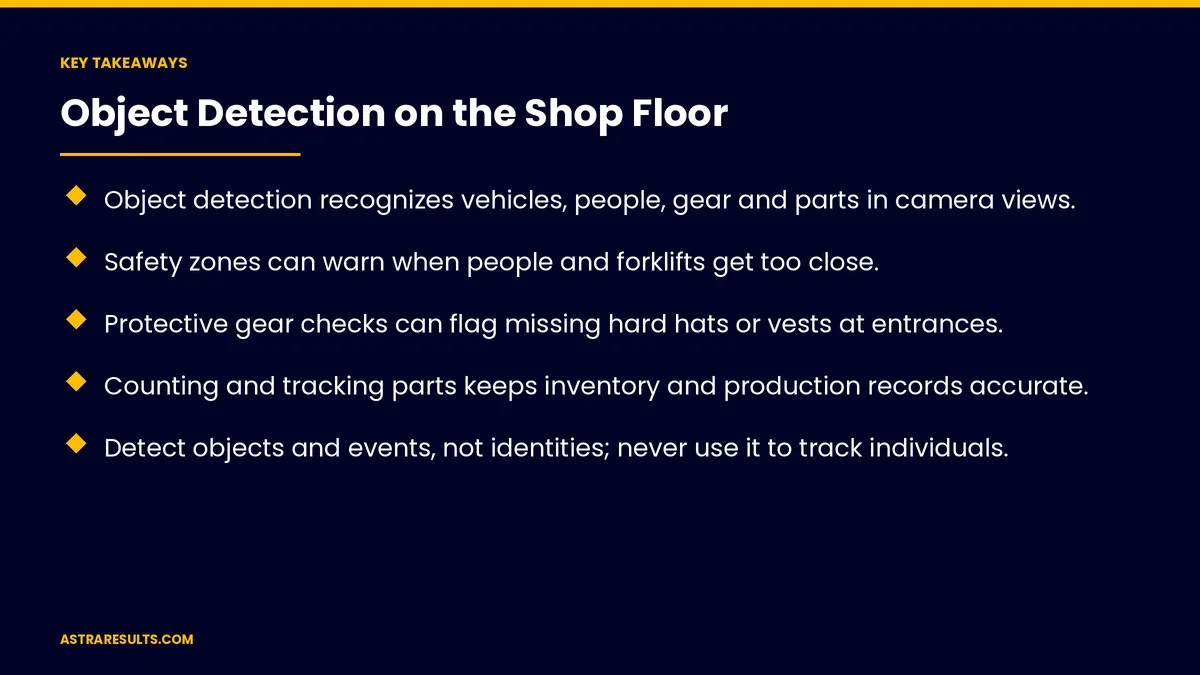
Key Takeaways
- Object detection recognizes vehicles, people, gear and parts in camera views.
- Safety zones can warn when people and forklifts get too close.
- Protective gear checks can flag missing hard hats or vests at entrances.
- Counting and tracking parts keeps inventory and production records accurate.
- Detect objects and events, not identities; never use it to track individuals.
- Start with one area and one use, and measure before expanding.
Published: October 17, 2026 | Reading Time: ~9 minutes | Category: Computer Vision
This guide covers what object detection finds, safety zones, gear checks, counting parts, useful alerts, worker privacy, setup and pilots. Put plainly: detect hazards and parts, alert people at the right moment and never use it to identify or watch individual workers.
This is general information, not legal advice. Review workplace monitoring rules with counsel and involve employees early.
For catching defects on products, see visual inspection.
In This Playbook
- What it detects
- Safety zones
- Where should protective gear checks happen?
- Counting and tracking parts
- Alerts that help
- Does shop floor detection identify workers?
- Setup
- Start with a pilot
- Safety culture
- What to measure
- The first three months
What it detects
Vehicles. Forklifts, carts and trucks.
People. As shapes in a zone, not as identities.
Protective gear. Hard hats, vests and glasses.
Parts and pallets. Items moving through stages.
Safety zones
Around equipment. Areas people shouldn't enter while machines run.
Forklift and walkway crossings. Warnings when people and vehicles get close.
Alerts on the spot. Lights or sounds where it matters.
Where should protective gear checks happen?
At entrances. Missing hard hats or vests flagged.
Reminders, not punishment. A prompt to gear up before entering.
Rules by area. Different zones need different gear.
Counting and tracking parts
Items counted automatically. As they move between stations.
Pallets tracked. Arrivals, staging and shipping.
Records connected. As in manufacturer data.
Alerts that help
Right person, right moment. Not a flood of warnings.
No screen-watching. As covered in intelligent monitoring.
Tuned over time. Fewer false alarms as the system learns.
Does shop floor detection identify workers?
Objects and events, not identities. No face recognition.
No individual tracking. Not used to monitor or rate people.
Clear notice. Workers know what cameras detect and why.
Limited retention. As covered in privacy in computer vision.
Involve employees. Explain the safety purpose early.
Setup
Camera placement. Clear views of zones and crossings.
Lighting. Steady enough for reliable detection.
Sensors may be enough. As weighed in cameras vs sensors.
Start with a pilot
One area, one use. A busy crossing or a staging area.
Baseline first. Near misses, counts and errors today.
Ninety days. As covered in a 90-day computer vision pilot.
Safety culture
Show it on video. As in manufacturer video.
Celebrate improvements. Fewer near misses, shared with teams.
The basics are covered in computer vision.
What to measure
Near misses. Before and after.
Gear compliance. At monitored entrances.
Count accuracy. Compared with manual counts.
False alarms. Fewer over time.
Incidents. Injuries and equipment damage.
The first three months
Days 1–30: plan and involve
Choose one area and use, record the baseline, review monitoring rules with counsel and explain the purpose to employees.
Days 31–60: detect and alert
Install cameras or sensors, turn on detection and local alerts and tune false alarms.
Days 61–90: measure
Track near misses, gear compliance, count accuracy and false alarms, then decide where to expand.
How Astra builds shop floor detection
Astra Results Marketing builds object detection for manufacturers and warehouses. We set up safety zones, gear checks and part counting that alert the right people, without identifying or tracking individual workers.
Engagements begin with a pilot plan through our computer vision team.
Related reading
Frequently asked questions
What can object detection find on a shop floor?
Vehicles, people as shapes in zones, protective gear and parts or pallets moving through stages.
How does it improve safety?
By warning when people and forklifts get too close and flagging missing gear at entrances.
Does it identify workers?
It shouldn't. Detect objects and events, not identities, and never use it to track or rate individuals.
Can it help with inventory?
Yes. It can count parts and track pallets as they move, keeping records accurate.
How should we start?
With one area and one use, a baseline and a 90-day pilot, after explaining the purpose to employees.
What should we measure?
Near misses, gear compliance, count accuracy, false alarms and incidents.
Ready for a safer, better-tracked shop floor? Astra Results Marketing builds object detection for safety zones, gear checks and part counting, with alerts that help and worker privacy protected. ▸ CALL (786) 321-2866 · ▸ REQUEST YOUR CONSULTATION





