 Rated 5 star on


A 90-Day Computer Vision Pilot
Quick answer
A 90-day computer vision pilot tests one use case at one site before you commit to more. First check whether a simple sensor would answer the question. Set success measures and a baseline before installing cameras. Collect images in real lighting and angles. Run live with people confirming every alert, then expand, adjust or stop on day 90.
Computer vision can spot empty shelves, damaged freight, site progress or vehicle dents automatically. But big rollouts across every location are risky when you don't yet know how well the system works in your conditions. A 90-day pilot at one site, on one use case, answers that question with real numbers before you commit to more.
Key Takeaways
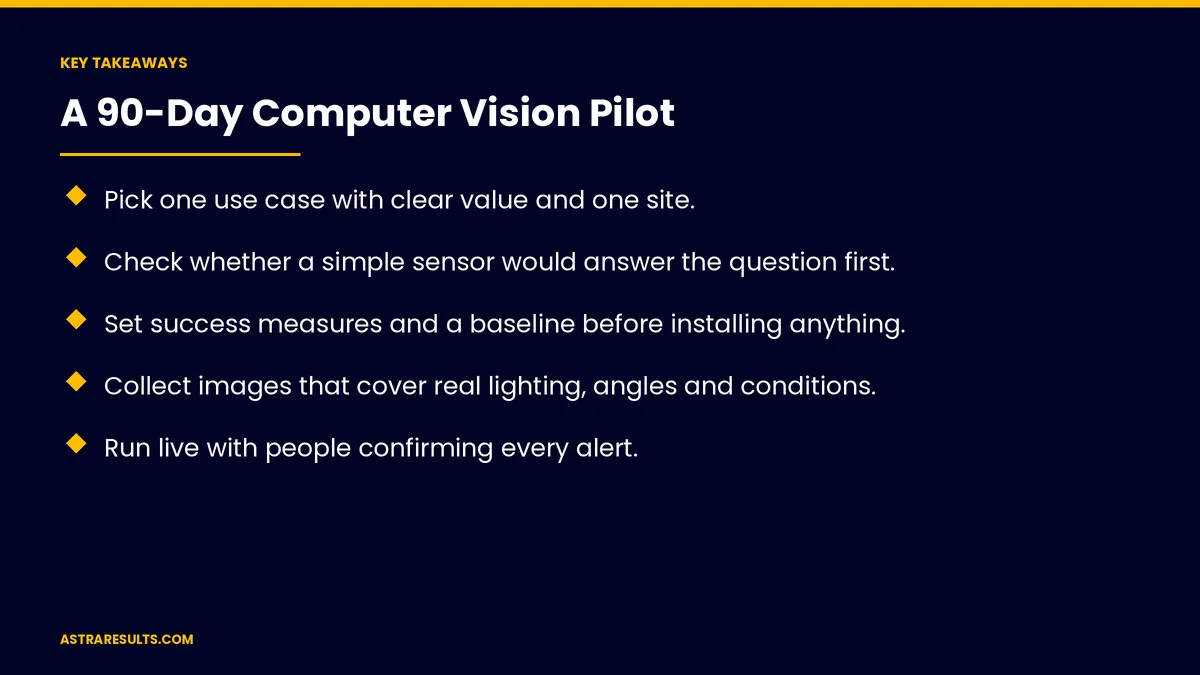
- Pick one use case with clear value and one site.
- Check whether a simple sensor would answer the question first.
- Set success measures and a baseline before installing anything.
- Collect images that cover real lighting, angles and conditions.
- Run live with people confirming every alert.
- Decide on day 90: expand, adjust or stop.
Published: October 1, 2026 | Reading Time: ~9 minutes | Category: Computer Vision
This guide is a 90-day pilot plan: choosing the use case, checking whether cameras are needed, setting measures, privacy, collecting images, testing the model, running live with people confirming, common risks, costs and the decision on day 90. Put plainly: test one use case at one site, measure against a baseline and decide with real numbers.
In This Playbook
- Before day one: choose the use case
- Do you need cameras?
- Set measures and a baseline
- Privacy plan
- Days 1–30: install and collect
- Days 31–60: test the model
- Days 61–90: run live
- What risks can derail a computer vision pilot?
- Costs
- Day 90: decide
- What to measure
- After the pilot
Before day one: choose the use case
Clear value. Time saved, losses prevented or faster response.
Visible problem. Something a person could spot by looking.
Examples. Shelf gaps, as in retail vision; dock damage, as in damage detection at the dock; site progress, as in construction vision.
One site. Representative, with a willing team.
Do you need cameras?
One measurement? A sensor may be simpler, as weighed in cameras vs sensors.
Need to see what's happening? Cameras fit.
Set measures and a baseline
How it's done today. Time spent, problems missed and response time.
Success measures. Detection accuracy, false alarms, response time and business results.
Go criteria. The numbers that would justify expanding.
Privacy plan
Point cameras at the work. Not at faces.
Blur people where possible. And limit retention.
Clear notice. For staff and visitors, as covered in privacy in computer vision.
No audio. Florida requires all-party consent to record conversations.
Days 1–30: install and collect
Install cameras at one site. Fixed angles, stable mounts.
Collect images. Morning, afternoon, night, busy and quiet times.
Label examples. What counts as a problem and what doesn't.
On-device or cloud. Decide where analysis runs, as in iPad + industry AI.
Days 31–60: test the model
Set up the model. Using your labeled images.
Test on unseen images. Not the ones used to set it up.
Set alert thresholds. Balance missed problems against false alarms.
People review alerts. Before anything is automated.
Days 61–90: run live
Real conditions. Alerts go to the team.
People confirm every alert. Right or wrong, recorded.
Measure against the baseline. Accuracy, false alarms and time saved.
Alerts, not screens. As covered in intelligent monitoring.
What risks can derail a computer vision pilot?
Lighting changes. Glare, shadows and night.
Blocked views. People, carts and pallets.
Moved cameras. Mounts bumped out of position.
Network gaps. Lost uploads or delayed alerts.
Costs
Cameras and mounts. Plus installation.
Setup and labeling. Time to prepare images.
Running costs. Processing, storage and support.
Choosing a partner is covered in choosing an ML partner.
Day 90: decide
Expand. Results beat the go criteria.
Adjust. Promising, but thresholds, angles or the use case need work.
Stop. Results fall short; keep the lessons.
Pilot discipline is covered in AI pilots that fail safely.
What to measure
Detection accuracy. Real problems caught.
False alarm rate. Alerts that weren't problems.
Response time. From alert to action.
Business results. Losses prevented or time saved.
Staff feedback. Helpful or noisy.
After the pilot
If you expand
Add sites one at a time, reuse labeled images and keep measuring accuracy and false alarms at each new site.
If you adjust
Change camera angles, thresholds or the use case and run a shorter second pilot.
If you stop
Document what you learned, and consider sensors or other approaches for the same problem.
How Astra runs computer vision pilots
Astra Results Marketing runs 90-day computer vision pilots. We choose one use case and one site, set measures and a baseline, plan privacy, collect real images, test before going live and help you decide with real numbers on day 90.
Engagements begin with a pilot plan through our computer vision team.
Related reading
Frequently asked questions
Why run a 90-day pilot?
To learn how well computer vision works in your real conditions, with real numbers, before committing to more sites.
How do we choose the use case?
Pick a visible problem with clear value, such as shelf gaps, damage or progress tracking, at one representative site.
What should we measure?
Detection accuracy, false alarms, response time and business results, compared with a baseline.
How do we protect privacy?
Point cameras at the work, blur people where possible, limit retention, give clear notice and don't record audio.
What can go wrong?
Lighting changes, blocked views, moved cameras and network gaps. Plan for each.
What happens on day 90?
Expand if results beat the go criteria, adjust if promising, or stop and keep the lessons.
Ready to test computer vision with real numbers? Astra Results Marketing runs 90-day pilots with one use case, one site, clear measures and privacy built in, so you can decide with confidence. ▸ CALL (786) 321-2866 · ▸ REQUEST YOUR CONSULTATION





