 Rated 5 star on


Visual Inspection: Catching Defects Humans Miss
Quick answer
Computer vision checks every part the same way all shift, catching flaws tired eyes miss. Cameras can spot scratches, dents, missing parts and label errors. Steady lighting and fixed camera positions matter as much as the software. Train it on good and defective examples. Let people review borderline cases and save every finding.
Human inspectors are skilled, but no one can stare at thousands of identical parts for hours without missing some flaws. Fatigue, speed and repetition all take their toll. Cameras with computer vision check every part the same way, all shift long. People still decide the borderline cases and handle what the system can't.
Key Takeaways
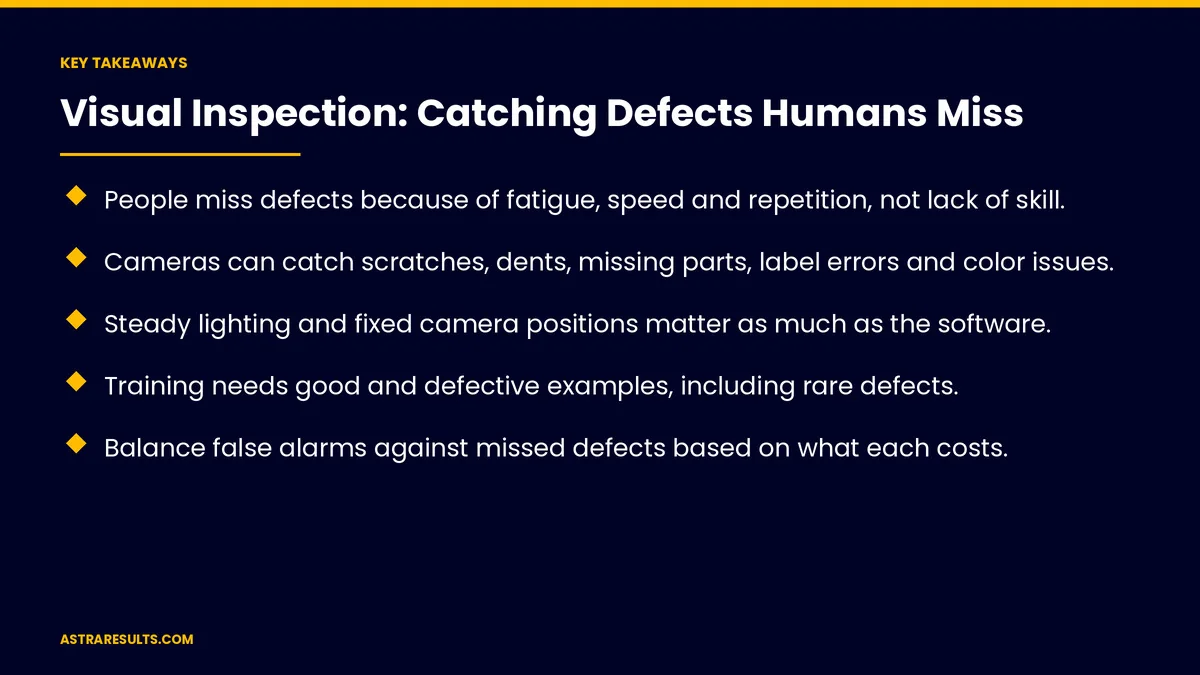
- People miss defects because of fatigue, speed and repetition, not lack of skill.
- Cameras can catch scratches, dents, missing parts, label errors and color issues.
- Steady lighting and fixed camera positions matter as much as the software.
- Training needs good and defective examples, including rare defects.
- Balance false alarms against missed defects based on what each costs.
- People review borderline cases, and every finding is saved with the batch record.
Published: October 31, 2026 | Reading Time: ~9 minutes | Category: Computer Vision
This guide covers why people miss defects, what cameras catch, lighting, training data, false alarms versus missed defects, human review, the line and records. Put plainly: let cameras check every part, tune for the errors that cost most and keep people on the borderline calls.
In This Playbook
- Why do inspectors miss defects on long shifts?
- What cameras catch
- What lighting does camera inspection need?
- Training data
- False alarms versus missed defects
- Human review
- Connecting to the line
- Records and tracing
- Privacy
- Start with a pilot
- What to measure
- The first three months
Why do inspectors miss defects on long shifts?
Fatigue. Attention drops over long shifts.
Speed. Fast lines leave little time per part.
Repetition. Identical parts make flaws easy to overlook.
Tiny flaws. Hard to see at a glance.
What cameras catch
Surface flaws. Scratches, dents and cracks.
Missing or wrong parts. Screws, clips and components.
Labels and printing. Wrong, missing or crooked.
Color and size. Outside the allowed range.
Contamination. Debris or foreign material.
What lighting does camera inspection need?
Steady lighting. Shadows and glare cause false results.
Fixed camera positions. The same view of every part.
Line speed. Cameras fast enough for your throughput.
Sometimes a sensor is enough. As weighed in cameras vs sensors.
Training data
Good examples. Many, from normal production.
Defective examples. Each defect type you care about.
Rare defects. Collected over time or carefully created.
Labeled by experts. Your best inspectors decide what counts.
False alarms versus missed defects
False alarms. Good parts flagged, wasting time and material.
Missed defects. Bad parts shipped to customers.
Tune by cost. Safety-critical parts favor catching everything; cheap parts can accept more misses.
Human review
Borderline cases. Sent to people with the image.
Decisions recorded. So the system learns.
Inspectors' role changes. From watching every part to judging hard cases.
Connecting to the line
Reject gates. Bad parts diverted automatically.
Alerts. When defect rates rise, as in intelligent monitoring.
Line stops. For serious or repeated defects.
Records and tracing
Images saved. With batch, line and time.
Linked to production data. As in manufacturer data.
Linked to field failures. As in warranty claims analysis.
Quality shown to buyers. As in manufacturer video.
Privacy
Point cameras at products. Not at workers.
Safety on the floor too. As in object detection.
Limited retention. Keep what quality records need, as covered in privacy in computer vision.
Start with a pilot
One line, one defect type. Measure before and after, as covered in a 90-day computer vision pilot.
Test ready-made tools fairly. As covered in off-the-shelf first.
What to measure
Missed defects. Bad parts reaching customers.
False alarm rate. Good parts flagged.
Inspection time per part. Before and after.
Scrap and rework. Cost per month.
Customer complaints. For quality issues.
The first three months
Days 1–30: choose and capture
Pick one line and defect type, fix lighting and camera positions and collect labeled good and defective examples.
Days 31–60: test
Run inspection alongside people, compare results and tune the balance between false alarms and missed defects.
Days 61–90: connect
Add reject gates, alerts and human review, save images with batch records and measure misses and scrap.
How Astra builds visual inspection
Astra Results Marketing builds visual inspection for manufacturers. We set up lighting and cameras, train on your good and defective parts, tune for the errors that cost most and keep people reviewing borderline cases.
Engagements begin with a pilot plan through our computer vision team.
Related reading
Frequently asked questions
Why do human inspectors miss defects?
Because of fatigue, line speed, repetition and very small flaws, not lack of skill.
What defects can computer vision catch?
Surface flaws, missing or wrong parts, label and print errors, color and size problems and contamination.
Why does lighting matter so much?
Shadows and glare change how parts look, causing false alarms and missed defects.
What's the difference between false alarms and missed defects?
False alarms flag good parts; missed defects let bad parts through. Tune the balance by what each costs.
Do inspectors still have a role?
Yes. They review borderline cases, label examples and decide what counts as a defect.
What should we measure?
Missed defects, false alarm rate, inspection time per part, scrap and rework and customer complaints.
Ready to catch the defects your team can't see? Astra Results Marketing builds visual inspection that checks every part, tunes for the errors that cost most and keeps your inspectors on the hard calls. ▸ CALL (786) 321-2866 · ▸ REQUEST YOUR CONSULTATION





